
These days, everybody has an opinion about data centers.
They’re too big.
They’re too loud.
They use too much water.
They use too much electricity.
They’re changing neighborhoods, farmland and communities that never expected to become part of the digital economy.
Maybe.
But every time I hear the debate, I find myself thinking about a trip I took nearly thirty years ago.
I was in Palo Alto visiting a young company called Zip2.
Nobody knew it at the time, but one of the founders was a young entrepreneur named Elon Musk.
Back then, Musk wasn’t building rockets or electric cars. They were trying to help newspapers figure out this new thing called the internet and sell local advertising.
As a publisher, my newspaper was considering using them to host a national Hispanic news site.
We weren’t the first newspaper they had landed. Many publications had already signed on: The Washington Post, The New York Times, Knight-Ridder, and Hearst Corp. that owned the San Antonio Express-News.
That got my attention.
Newspapers didn’t move quickly in those days. Editors were cautious. Publishers were skeptical. If organizations like WaPo were willing to trust a Silicon Valley startup with part of their digital future, it was worth taking a look.
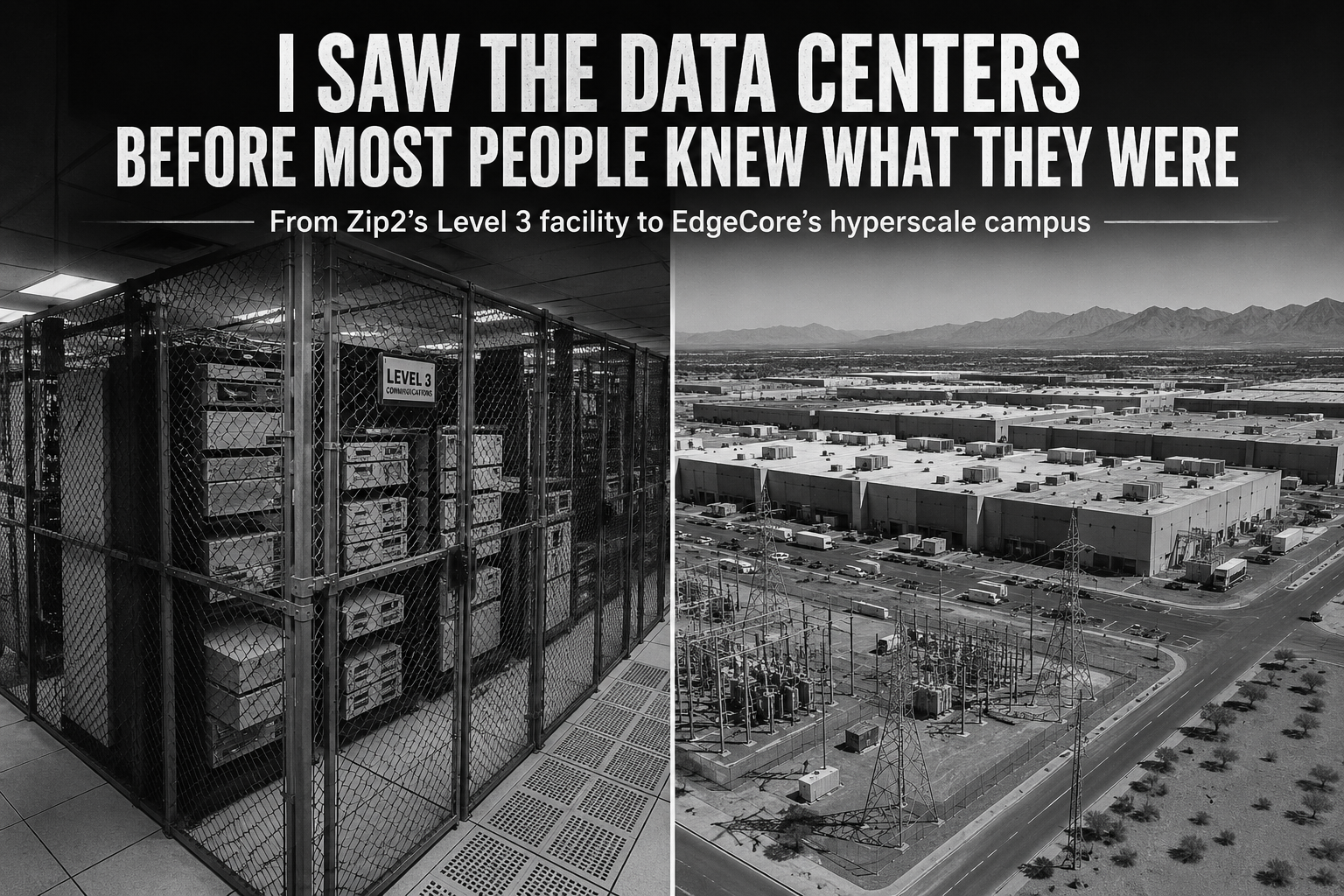
The Zip2 executives took me to see their Level 3 data center.
Today, when people hear the words “data center,” they picture massive buildings consuming enough electricity to power entire towns.
The one I visited wasn’t anything like that.
It was a two-story building filled with cages.
Behind each cage sat racks of servers. Lights blinked. Fans hummed. Bundles of cable ran overhead and beneath raised floors. Cold air moved through the building. Security was tight.
To a newspaper guy who had spent years around printing presses, photo labs and newsroom terminals, it looked like a glimpse into the future.
At the time, I didn’t realize I was looking at the digital equivalent of a railroad yard.
Information would soon move through places like this the way freight once moved through train depots, ports and warehouses.
I remember standing there and realizing something important.
The future wasn’t in the room.
The future was what flowed through the room.
At the time, Zip2 wanted me to choose a city.
That was their business model.
Their city guides were excellent. They had maps, business listings, event calendars and directories. It was one of the first internet products I saw that genuinely made sense.
Their vision of the internet was local.
They offered my team and me San Diego.
I told them I’d take Los Angeles instead.
Not because I disliked San Diego. I was living there at the time.
I chose Los Angeles because the Hispanic population was larger.
But what I really wanted was neither.
I wanted national.
The readers we served didn’t live in just one city. They lived in San Diego, Los Angeles, Houston, Miami, Chicago, New York and hundreds of communities in between.
The internet didn’t care about city limits.
Eventually, Zip2 came back and agreed to make us their first national site.
That may not sound revolutionary today.
In the late 1990s, it was.
Many newspaper executives still thought of the internet as a digital version of a delivery truck route.
The internet had other ideas.
Around that same time, Zip2 had struck a deal with AltaVista, owned by Compaq Computers.
For younger readers, AltaVista was one of the hottest search engines in the world before Google arrived.
For a brief moment, it looked like AltaVista might own the future.
Then the dot-com bubble burst.
Everybody remembers the crash.
What many people forget is that the internet itself didn’t fail.
The business models failed.
Investors were throwing money at anything ending with “.com.”
Companies with little revenue were worth millions. Sometimes billions.
Website traffic became more important than profits.
Nobody seemed particularly interested in the simple question of how any of this was supposed to make money.
Then reality arrived.
The bubble burst.
Hundreds of companies disappeared. Zip2 disappeared. Alta Vista disappeared. Compaq Computers disappeared. My news sites disappeared.
The internet survived.
In fact, it became more important than almost anyone imagined.
Years later, I found myself standing in another data center.
This one wasn’t a two-story building in Silicon Valley.
It was EdgeCore’s hyperscale campus in Mesa, Arizona.
The contrast was staggering.
The Level 3 facility I toured in the 1990s looked like a workshop compared to what I saw in Arizona.
EdgeCore stretched across 84 acres. Still small compared to the thousands of acres planned for the future.
Massive buildings rose from the desert.
Substations stood nearby.
Transmission lines fed the campus.
Cooling infrastructure spread across the site.
Fiber connections linked the facility to the outside world.
At the time, the scale was difficult to comprehend. Today, it’s small compared to Meta’s 3,600-acre site being built in Louisiana.
This wasn’t a server room.
It wasn’t even a building.
It was infrastructure.
The digital equivalent of a power plant, a refinery, a railroad terminal or a container port.
Standing there, I couldn’t help thinking about that trip to Palo Alto decades earlier.
The mission hadn’t changed.
Store information.
Move information.
Process information.
Only the scale had changed.
What once fit inside a two-story building filled with cages now required an industrial campus visible from the air.
And just down the road, Apple’s data center.
That’s where I circle back to today’s debate over AI and data centers.
Many of the people protesting data centers today use them every day without thinking about it.
They organize on Facebook.
They post videos to YouTube.
They send email through cloud services.
They attend Zoom meetings.
They sign online petitions.
Every one of those actions passes through a data center somewhere.
That doesn’t make their concerns invalid.
A person can use electricity and still object to a power plant next door.
A person can drive a car and still oppose a freeway running through their neighborhood.
The issue isn’t whether we use data centers.
We already do.
The issue is whether we’re willing to admit how dependent we’ve become on them.
Unlike the dot-com era, most people aren’t arguing that data centers are a fad.
The opposite is true.
Most people seem to understand they are inevitable.
The internet is not going away.
Cloud computing is not going away.
Artificial intelligence is not going away.
The question isn’t whether America will build more digital infrastructure.
The question is what comes with it.
How much electricity should these facilities use?
How much water?
Should taxpayers subsidize them?
Should local governments offer tax incentives?
Should rural communities host them?
How much growth is too much growth?
Those are legitimate questions.
Communities should ask them.
Developers should answer them.
But what strikes me is how familiar all of this feels.
When I walked through that Level 3 facility in the 1990s, the internet was still viewed as an experiment.
Today, nobody questions whether the internet matters.
It’s as essential as roads, railroads, ports and power lines.
The same thing may happen with AI infrastructure.
People may argue over where it goes, who pays for it, and how it is regulated.
But the infrastructure itself is probably coming whether we like it or not.
That’s what I learned standing inside EdgeCore’s hyperscale campus in Arizona.
The scale wasn’t speculative.
The concrete was real.
The steel was real.
The substations were real.
The fiber was real.
The investment was real.
Whatever happens next, America is building the physical infrastructure for an AI economy.
The argument is no longer whether the future is arriving.
The argument is how we live with it once it gets here.
That’s why I pay attention when people talk about data centers today.
I’ve seen both ends of this story.
I walked through a Level 3 facility when the commercial internet was still finding its footing.
Decades later, I stood on a hyperscale campus in the Arizona desert built to support cloud computing, streaming services, and artificial intelligence.
The technology changed.
The scale changed.
Human nature didn’t.
People are still debating how much change they’re willing to accept.
They were having that argument when I visited Zip2.
They’re having it again today.
The machines are bigger.
The buildings are bigger.
The electric bills are certainly bigger.
But the conversation feels remarkably familiar.
I’ve seen this movie before.
The infrastructure stays.
The arguments simply move on to the next generation of technology.