
Back in 2024, some very smart people at Epoch AI sat down and tried to figure out what would stop artificial intelligence from growing.
They looked at power generation.
They looked at semiconductor factories.
They looked at the number of advanced computer chips the world could manufacture.
And they concluded that electricity and chip production would be the two biggest bottlenecks standing between AI and the future.
They were right.
And they were wrong.
They saw the power plants.
They saw the chip fabs.
They never saw Mrs. Johnson.
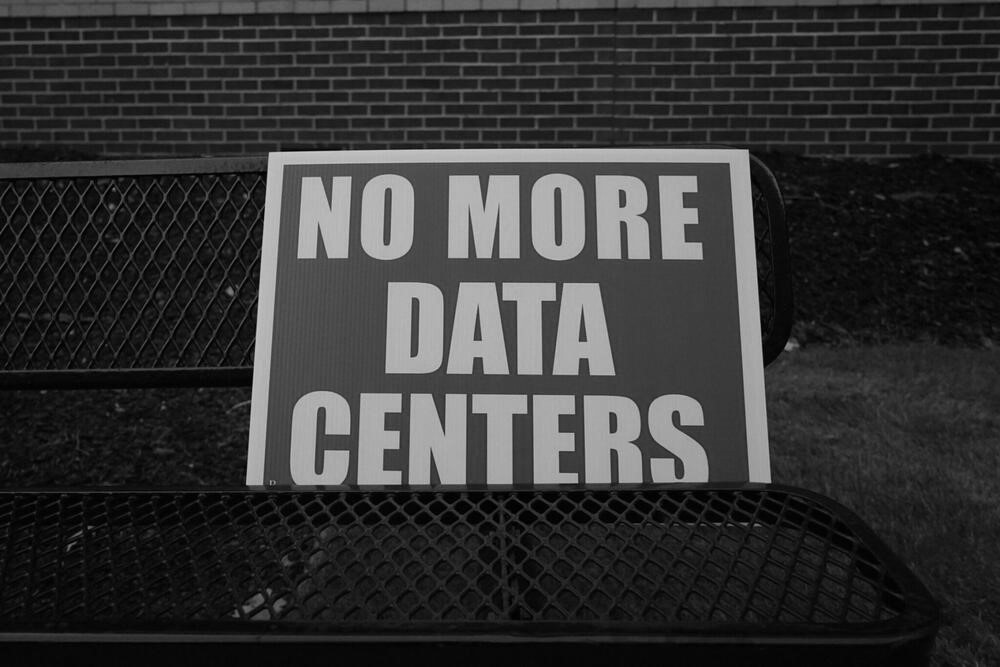
Mrs. Johnson is the woman standing at a county commission meeting in Georgia demanding to know why a data center is pumping millions of gallons of water from her community.
She’s the retiree in Virginia complaining about the constant hum from cooling equipment.
She’s the rancher in Texas who doesn’t want transmission lines crossing his property.
She’s the environmental activist in Arizona.
She’s the conservative property-rights advocate in Kansas.
She’s the progressive climate activist in South Carolina.
She’s the guy in Michigan asking why his utility bills keep climbing.
And together, they’re becoming the most unpredictable force in the entire AI revolution.
The technology crowd spent years worrying about hardware.
Turns out they should have been worrying about humans.
That’s because artificial intelligence isn’t just software anymore.
It isn’t some clever chatbot floating around in the cloud.
AI is becoming physical.
It needs power plants.
It needs substations.
It needs transmission lines.
It needs water.
It needs semiconductor factories that cost more than aircraft carriers.
It needs gigantic warehouses full of computers.
And those warehouses have to be built somewhere.
That’s where the trouble begins.
For decades, Silicon Valley sold a fantasy.
The internet felt weightless.
You clicked a button and something happened.
You posted a photo and it appeared on a screen somewhere else.
The magic seemed to live in cyberspace.
The reality was always different.
The cloud has always been somebody else’s building.
Now those buildings are getting so large that entire communities can see them.
You can’t hide a hyperscale data center.
You can’t disguise a substation the size of a shopping mall.
You can’t tuck away a natural gas power plant behind a smartphone app.
The infrastructure is becoming visible.
And once people can see something, they start asking questions.
Who benefits?
Who pays?
Where does the water come from?
Why are we getting the noise while somebody else gets the profits?
Whether those concerns are justified or not almost doesn’t matter politically.
Perception drives politics.
Always has.
The AI industry discovered something every highway builder, railroad executive, pipeline developer and electric utility learned long ago.
Building things is hard.
Building things near people is even harder.
What’s fascinating is that opposition to data centers is no longer ideological.
It is bipartisan.
You can find conservatives fighting projects in Texas.
Progressives fighting projects in California.
Farmers fighting projects in Indiana.
Retirees fighting projects in Georgia.
Environmentalists fighting projects in Arizona.
Neighborhood associations fighting projects almost everywhere.
The coalition makes no sense politically.
Which is exactly why it matters.
When people who agree on nothing else suddenly agree on one thing, politicians start listening.
That’s the chokepoint the experts didn’t model.
They calculated megawatts.
They calculated chips.
They calculated capital expenditures.
They never calculated public anger.
Now, to be fair, this doesn’t mean the data centers aren’t coming. Even Erin Brockovich says they are inevitable.
I have spent enough time around technology to know better.
The scale keeps growing.
The need keeps growing.
The demand keeps growing.
The AI boom is not a fad.
It’s not a craze.
It’s not going away.
But neither are the people showing up at town halls.
That’s the reality nobody wants to admit.
The future of AI may depend less on engineers than on county commissioners.
Less on algorithms than zoning boards.
Less on software than water permits.
The smartest people in the world spent years searching for the next technological bottleneck.
They found power.
They found chips.
They found manufacturing capacity.
What they missed was the oldest bottleneck of all.
People.