
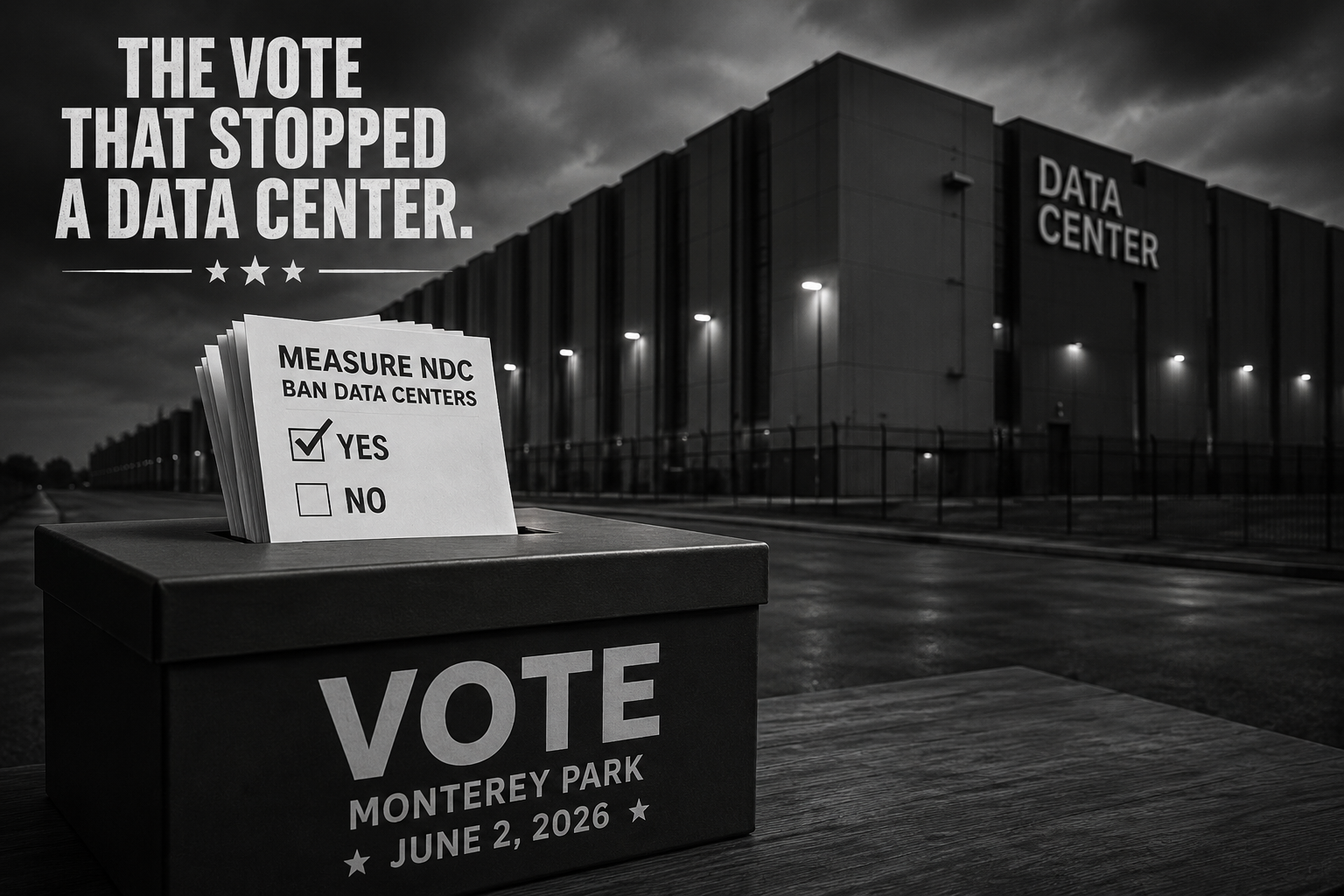
Something happened in California last Tuesday that should have every data center developer, utility executive, politician, and AI evangelist paying attention.
The voters of Monterey Park didn’t just reject a proposed data center.
They banned them.
Not temporarily. Not with a moratorium. Not with a study committee. Not with a promise to revisit the issue later.
They voted to prohibit data centers citywide.
And they didn’t squeak it through.
They passed it with roughly 86 percent of the vote.
Eighty-six percent.
In politics, that’s not a victory. That’s a public hanging.
For years, the conversation around artificial intelligence has been dominated by billionaires, venture capitalists, consultants, technology executives, and government officials eager to announce the next innovation hub. The assumption has always been that communities would eventually get on board once someone explained the benefits.
Monterey Park just delivered a different message.
No thanks.
The irony is that the proposed facility wasn’t particularly large by modern standards. At roughly 247,000 square feet, it would barely register against the hyperscale campuses now being planned across Texas, Arizona, Georgia, Virginia, Ohio, and other states.
But size wasn’t the issue.
Trust was.
Residents looked at the proposal and saw noise, diesel generators, higher electricity demand, and industrial infrastructure sitting near homes. Developers saw jobs, tax revenue, and investment. The two sides weren’t even having the same conversation.
One side was talking about the future.
The other was talking about quality of life.
Guess which side won.
The technology industry has spent years telling the public that AI is inevitable. Maybe it is. But voters are beginning to ask a different question:
Does inevitable mean we have to build the supporting infrastructure here?
That question is becoming harder to answer.
Across the country, communities are organizing. Moratoriums are appearing. Lawsuits are being filed. Public hearings are overflowing. Residents who have never attended a city council meeting are suddenly becoming experts on substations, transmission lines, backup generators, water consumption, and land-use law.
The data center industry often dismisses these people as NIMBYs.
That’s a mistake.
What happened in Monterey Park wasn’t a handful of activists.
It was a democratic landslide.
And before anyone celebrates too much, there is a lesson here for both sides.
The anti-data-center movement should not assume Monterey Park means the public has rejected AI. Most Americans use AI-powered services every day, whether they realize it or not. They still want cloud services. They still want streaming video. They still want online banking, telemedicine, social media, and increasingly, artificial intelligence.
But the industry should not assume the public will automatically accept whatever infrastructure is required to provide those services.
For years, the debate focused on whether AI would change society.
Now we’re entering a new phase.
The debate is becoming physical.
Where do the facilities go?
Who pays for the power?
Who gets the jobs?
Who absorbs the noise?
Who bears the risk?
Who makes the decision?
Monterey Park just answered the last question.
The voters.
And they answered loudly.
The significance of Monterey Park isn’t that one city banned data centers.
It’s that a city of 60,000 people looked at one of the most powerful economic forces of the 21st century and said, “Not here.”
Whether you agree with them or not, that’s a message worth hearing.
Because if developers, utilities, and politicians don’t figure out why 86 percent of voters reached that conclusion, Monterey Park won’t be remembered as an outlier.
It will be remembered as the beginning.