
Every time I write about data centers, somebody eventually asks:
“If China can put them underwater, why don’t we just do that?”
Fair question.
And for the folks in the back row, let’s answer it plainly.
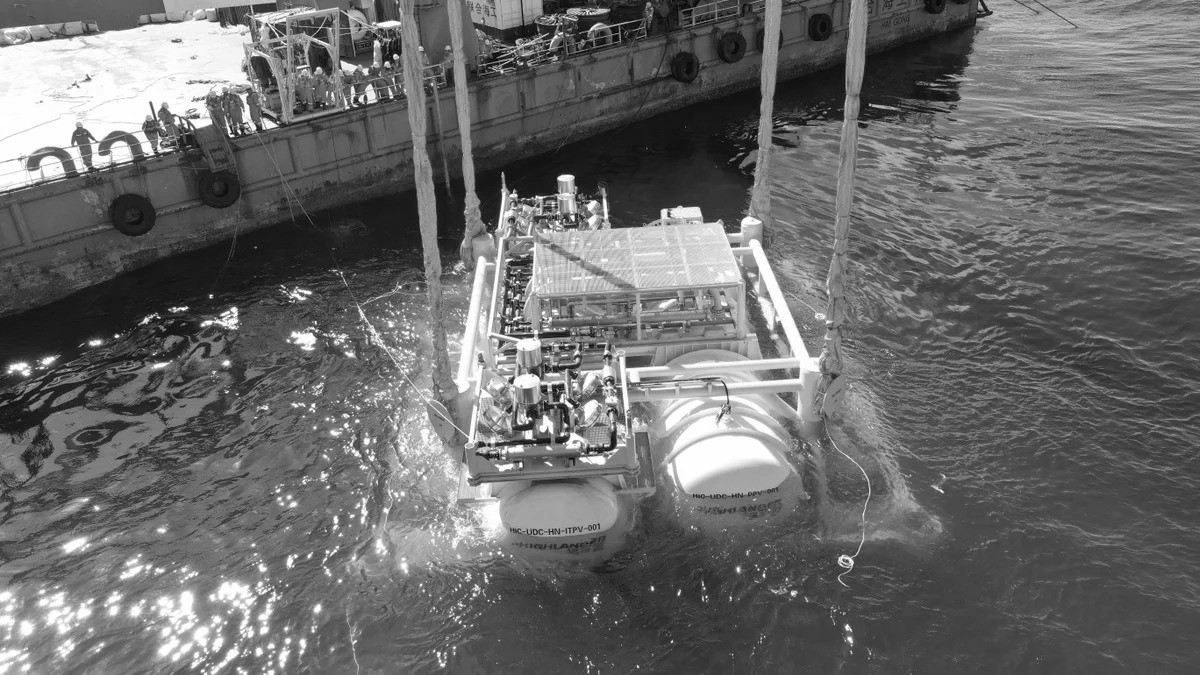
Yes, China put a data center underwater.
Yes, it works.
No, it is not the magic answer some people think it is.
A lot of folks hear “underwater data center” and imagine some futuristic solution where all the problems disappear. No more giant buildings. No more noise. No more water fights. No more complaints from neighbors. Just a bunch of computers sitting peacefully beneath schools of fish while everybody goes home happy.
That’s not exactly how this works.
The Chinese project getting all the attention is an underwater data center operating near Shanghai. It’s about 24 megawatts.
Now, before anybody starts writing letters to the editor, let’s put that number in perspective.
A 24-megawatt underwater facility is about the size of a neighborhood grocery store compared to the giant AI campuses being proposed in the United States. Some of the projects now being discussed here are measured in gigawatts.
One gigawatt equals 1,000 megawatts.
So a one-gigawatt AI campus is more than forty times larger than China’s underwater project.
Some proposed facilities are two, three, even five gigawatts.
That’s like comparing a fishing boat to an aircraft carrier and declaring you’ve solved naval warfare.
China deserves credit for trying something new. That’s how innovation works. Somebody builds something unusual, turns it on, and sees what happens.
The basic idea is straightforward.
Computers generate heat.
Lots of heat.
Cooling them requires equipment, energy, water and money.
The ocean happens to be a very large body of water that is generally cooler than the inside of a server rack.
So engineers sealed thousands of servers inside underwater modules, connected them to power and fiber-optic cables, and let the surrounding seawater help remove the heat.
On paper, it makes sense.
The problem with technology people, however, is they sometimes confuse “we built one” with “we solved the problem.”
We built Concorde.
We built supersonic passenger travel.
Then the economics showed up carrying a baseball bat.
Building something once is engineering.
Building thousands of them profitably for decades is business.
That’s where the underwater data center story gets more complicated.
First, there is maintenance.
When a server fails inside a conventional data center, somebody walks down an aisle, swaps out the part, and goes home.
When something breaks on the ocean floor, things become more interesting.
Now you’re talking about specialized equipment, retrieval operations, underwater inspections, weather conditions, marine engineering and costs that don’t appear in glossy corporate presentations.
Then there is corrosion.
Saltwater is many wonderful things.
Gentle on machinery is not one of them.
The ocean spends every day trying to turn human engineering projects back into a marine habitat.
Engineers know this. That’s why underwater systems require extensive protection, monitoring and maintenance.
Then there is the environmental question.
Supporters point out that underwater facilities may reduce freshwater consumption. That’s a legitimate argument.
But heat doesn’t disappear because we moved the computers underwater.
The heat goes somewhere.
At a pilot scale, scientists can monitor that.
At larger scales, we simply don’t know enough yet.
What happens if dozens of facilities begin discharging heat into coastal waters?
What happens if hundreds do?
What happens to marine ecosystems?
Nobody knows with certainty because nobody has deployed these systems at the scale now being proposed for AI infrastructure.
That’s why it remains a pilot project.
And that word matters.
Pilot.
Not revolution.
Not solution.
Pilot.
China’s underwater data center proves you can put a data center underwater.
That’s it.
It does not prove the economics work at large scale.
It does not prove the environmental impacts are fully understood.
It does not prove maintenance costs will be manageable.
And it certainly does not prove the concept can be expanded into the giant gigawatt-scale AI campuses being proposed across America.
There’s another problem people often overlook.
The biggest challenge facing modern AI data centers isn’t cooling.
It’s electricity.
The ocean can help cool computers.
The ocean cannot magically generate the power needed to run them.
An underwater data center still needs power plants, substations, transmission infrastructure, backup systems and a connection to the electrical grid.
The power bill still arrives.
The question is whether putting the computers underwater solves enough problems to justify creating a whole new set of challenges.
Maybe someday it will.
Maybe underwater facilities become useful in coastal cities, on islands, at military installations, or in places where land is scarce and cooling costs are high.
But today, what China has demonstrated is something much more modest.
They proved the idea can work.
That’s an important first step.
It’s just not the final answer.
So when somebody asks why we don’t simply build data centers underwater like China, the honest answer is this:
Because China is testing a promising idea, not presenting a finished solution.
Around here, we’d like answers to a few old-fashioned questions before we start zoning the ocean floor.
Who pays?
Who profits?
Who regulates it?
Who fixes it when it breaks?
And what happens to the water?
Because history teaches us that whenever someone says they’ve found a simple solution to a complicated problem, it’s usually time to check the fine print.