
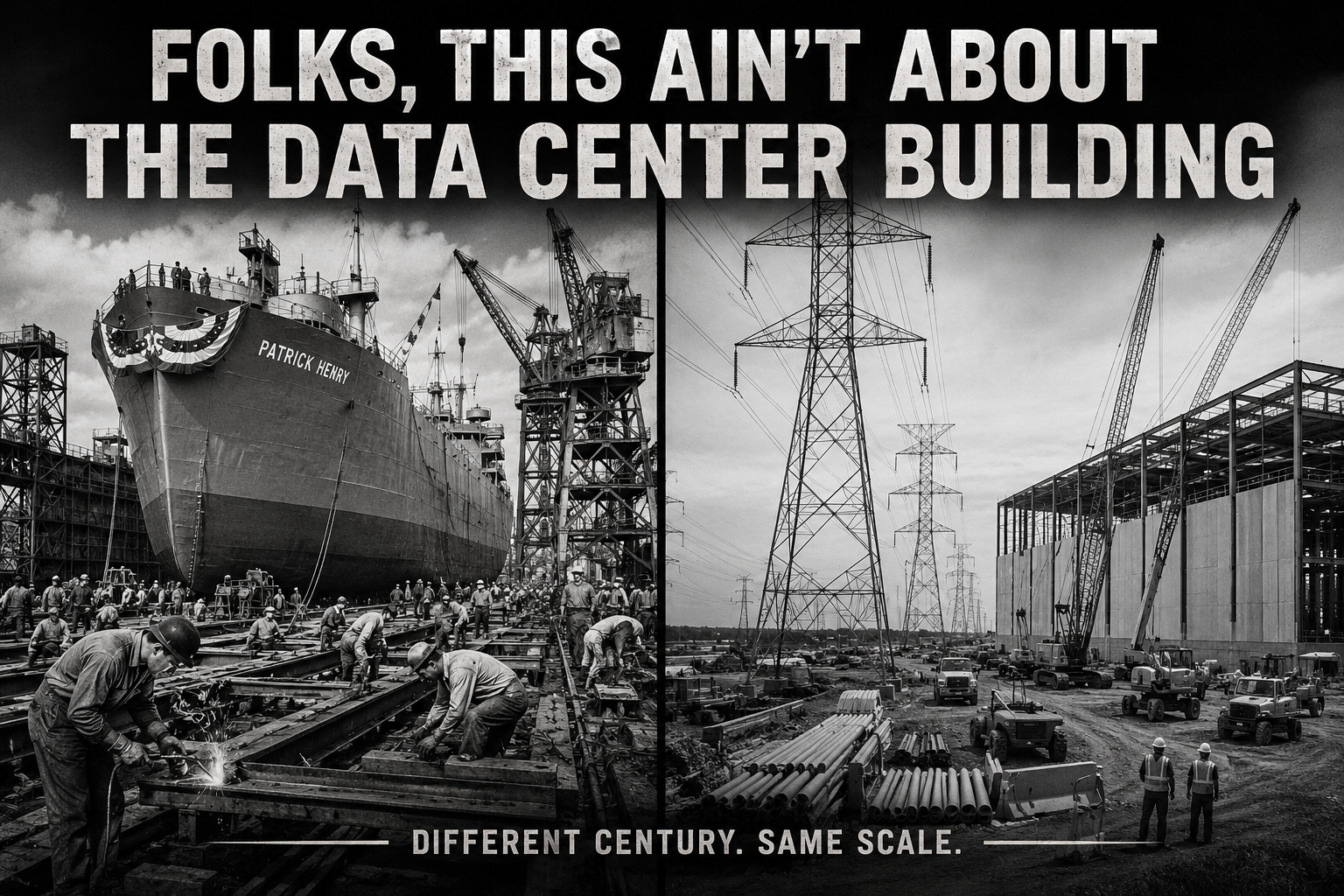
The fight over data centers isn’t really about data centers. It’s about the largest infrastructure buildout America has seen since World War II.
Folks, this ain’t about the data center building.
That’s like saying World War II was about a shipyard.
The shipyard mattered. The factory mattered. The rail yard mattered. The power plant mattered. But none of them was the story.
The story was the machine they were all connected to.
And that’s exactly what we’re witnessing today.
I’ve been watching the data center fights spread across America like summer thunderstorms.
One county fights over water.
Another fights over noise.
Another fights over taxes.
A rancher in Texas doesn’t want to sell.
A town in Arizona worries about its future.
A neighborhood in Virginia complains about diesel generators.
A city council somewhere holds another standing-room-only meeting where residents wave signs and demand answers.
And every one of them believes they’re fighting about a building.
They’re not.
They’re fighting about an era.
That’s the part we’re missing.
Americans tend to see history through the windshield instead of the rearview mirror. We don’t recognize transformations while they’re happening. We only recognize them years later when some historian writes a book and tells us what we should have noticed.
During World War II, people didn’t wake up one morning and say, “My goodness, we’re building the largest industrial infrastructure network in human history.”
They saw shipyards.
They saw factories.
They saw rail lines.
They saw warehouses.
They saw power plants.
They saw workers moving into town.
They saw traffic.
They saw shortages.
They saw construction.
What they didn’t see was the whole machine.
The machine only became obvious after it was built.
Today, we’re making the same mistake.
People see a data center and think it’s the story.
The data center isn’t the story.
The data center is the smokestack.
It’s the visible part.
The story is everything attached to it.
The power plants.
The transmission lines.
The substations.
The fiber routes.
The pipelines.
The battery storage facilities.
The semiconductor plants.
The water systems.
The engineering workforce.
The land acquisitions.
The billions of dollars quietly changing hands.
The story isn’t a building.
The story is a national infrastructure buildout.
And not just any infrastructure buildout.
Possibly the largest since World War II.
That sounds dramatic until you look at the numbers.
Thousands of data centers already exist in America.
Thousands more are planned.
Utilities are rewriting growth forecasts.
States are competing for projects.
Technology companies are spending sums of money that would have seemed impossible a decade ago.
Entire regions are being redesigned around electricity.
Not roads.
Not railroads.
Not airports.
Electricity.
Think about that for a moment.
For most of the last century, infrastructure planning revolved around moving people and goods.
Today, it revolves around moving electrons.
The old economy needed highways.
The new economy needs megawatts.
Lots of them.
So while residents are showing up at county commission meetings arguing over a proposed facility down the road, utility executives are discussing transmission corridors that stretch across multiple states.
While local activists worry about one project, investors are discussing national AI strategies.
While citizens ask what happens to their neighborhood, national security officials are asking what happens if America loses the AI race to China.
Those are not the same conversations.
Yet they’re happening simultaneously.
And that’s where things get complicated.
Because the public is asking legitimate questions.
Who benefits?
Who pays?
Who gets the tax incentives?
Who gets the jobs?
Who gets the water?
Who gets stuck with the environmental consequences?
Those questions deserve answers.
The problem is that the other side is asking questions too.
Can America remain technologically competitive?
Can the electric grid support future demand?
Can artificial intelligence become a strategic advantage?
Can the United States stay ahead of China?
Can the nation build infrastructure fast enough?
Those questions deserve answers as well.
That’s what makes this moment different.
Most public controversies have a clear villain.
This one doesn’t.
The residents aren’t crazy.
The developers aren’t necessarily evil.
The environmental concerns are real.
The economic opportunities are real.
The geopolitical competition is real.
The infrastructure demands are real.
Everybody is standing on a different piece of the elephant and insisting they’re looking at the whole animal.
They’re not.
Nobody is.
Not yet.
But here’s what I suspect historians will write twenty years from now.
They won’t describe this as the Great Data Center Boom.
That’s too small.
They’ll describe it as the construction phase of the American AI infrastructure network.
Just as historians describe the Interstate Highway System.
Or rural electrification.
Or wartime industrialization.
Or the telecommunications revolution.
The data centers themselves may become almost irrelevant.
Most people don’t think much about electrical substations today.
Or railroad switching yards.
Or telephone exchanges.
Yet entire eras were built around them.
Data centers may follow the same path.
Today they’re controversial.
Tomorrow they’re infrastructure.
The real question isn’t whether the buildout happens.
It already is.
The real question is whether Americans get a meaningful voice in shaping it.
Because one thing history teaches us is that massive infrastructure projects tend to benefit those who show up early.
The people who understand what’s happening.
The people who ask hard questions.
The people who demand transparency.
The people who insist that growth serve communities instead of simply using them.
That’s the conversation America should be having.
Not whether a single building belongs down the road.
But what kind of nation are we constructing around it.
Because folks, whether we like it or not, the railroad is already being laid.
The only remaining question is where it’s going.