
Spend enough time following data center debates, and you start feeling like you’ve wandered into a town hall version of Groundhog Day.
The names change.
The counties change.
The developers change.
But the script stays remarkably consistent.
A company announces a project.
Neighbors worry about water.
Farmers worry about land.
Residents worry about noise.
Environmental groups worry about impacts.
Developers promise jobs.
Politicians promise oversight.
Everybody argues.
Everybody leaves.
Then the whole process starts over somewhere else.
Arizona.
Texas.
Virginia.
Wisconsin.
Florida.
North Carolina.
Georgia.
Maine.
One public hearing at a time.
One zoning dispute at a time.
One county at a time.
And the more I watch it unfold, the more I find myself asking a simple question.
Why are we trying to build what may become the most important infrastructure system of the 21st century through thousands of disconnected local battles?
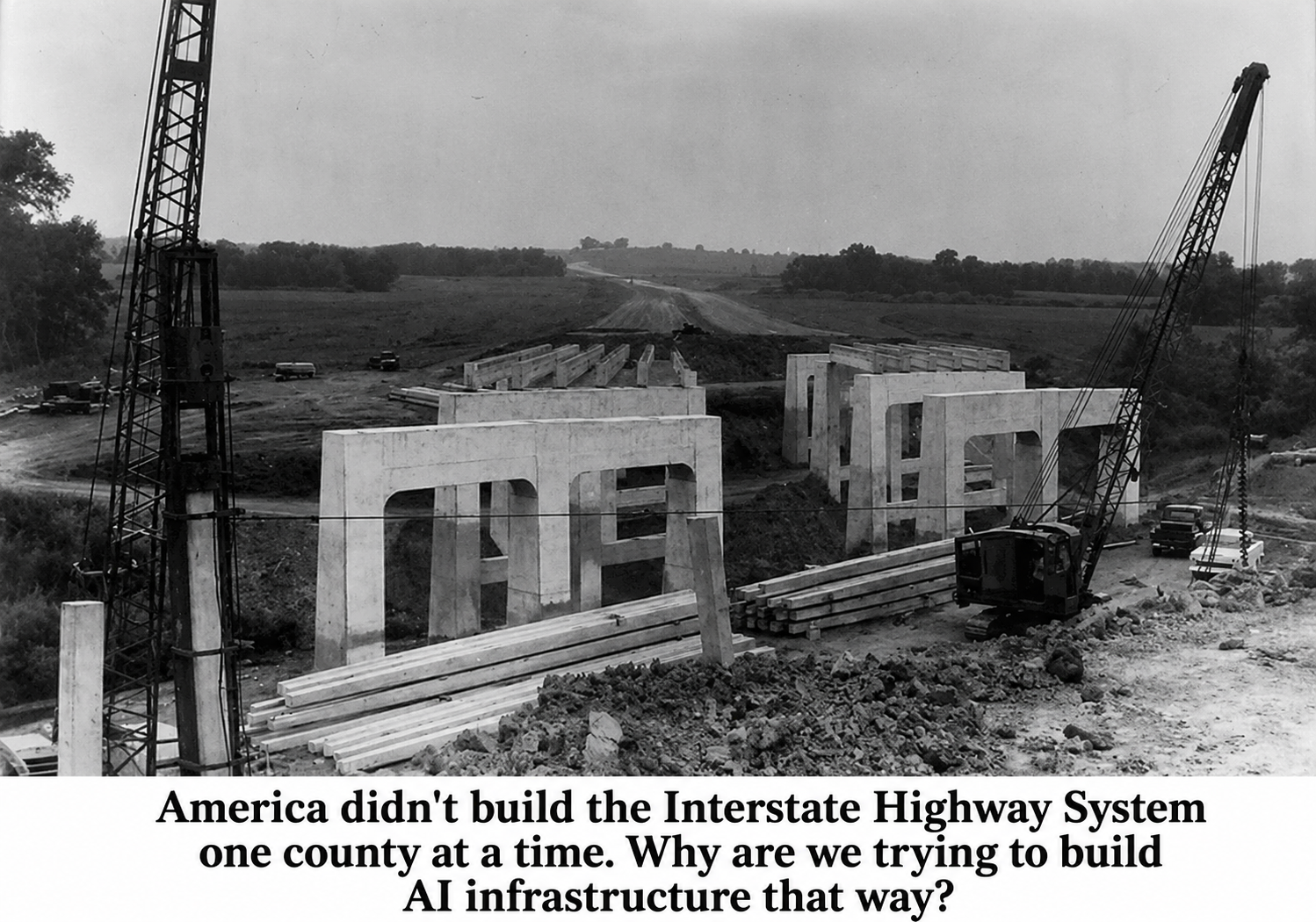
We didn’t ask 3,000 counties to build the Interstate Highway System.
We didn’t win World War II by asking every town to decide how many Liberty ships America should produce.
We didn’t put a man on the Moon by creating fifty separate state space programs.
Yet somehow we’ve convinced ourselves that the infrastructure behind artificial intelligence should be planned through a patchwork of county commission meetings, city council hearings, zoning boards, and state legislatures, all pulling in different directions.
That isn’t a strategy.
It’s improvisation.
And history suggests America eventually runs into trouble when it confuses the two.
Now before anybody starts accusing me of wanting Washington to run everything, let’s establish a few facts.
The people showing up at those hearings have legitimate concerns.
Water matters.
Electricity matters.
Noise matters.
Land use matters.
Environmental impacts matter.
Tax incentives matter.
If a data center is going to consume millions of gallons of water, the public deserves answers.
If it requires new transmission lines crossing farms and ranches, the public deserves answers.
If electric rates might rise because utilities must build new infrastructure, the public deserves answers.
Those aren’t anti-technology questions.
They’re responsible citizenship questions.
The problem is that while local communities are debating local impacts, something much larger is happening above their heads.
Washington is increasingly talking about artificial intelligence the same way earlier generations talked about railroads, aviation, nuclear power, telecommunications, and the space race.
National competitiveness.
National security.
Economic growth.
Scientific leadership.
Military advantage.
Competition with China.
That’s not county-level language.
That’s national strategy language.
And when politicians, military planners, technology executives, and economists begin describing something in those terms, history tells us we’re no longer talking about an ordinary construction project.
We’re talking about infrastructure.
Not a building.
A system.
The electric grid is a system.
The Interstate Highway System is a system.
The railroad network is a system.
The national aviation system is a system.
And increasingly, artificial intelligence appears to be developing into a system as well.
The data center is merely the visible part.
Behind it are power plants.
Transmission lines.
Substations.
Fiber networks.
Water systems.
Cooling infrastructure.
Semiconductor supply chains.
Research institutions.
Military applications.
Cloud providers.
Communications networks.
The entire thing is interconnected.
Which raises an uncomfortable question.
Who exactly is in charge?
At the moment, the answer appears to be everybody and nobody.
Local governments approve permits.
States establish regulations.
Utilities plan transmission.
Federal agencies oversee bits and pieces.
Private companies make billion-dollar decisions.
And somehow we’re supposed to believe all of this adds up to a coherent national strategy.
Maybe it does.
But from where I sit, it looks a lot like America is building a digital interstate highway system without first deciding where the roads should go.
In fact, Washington has already started wrestling with that reality.
In one of his final acts in office, President Biden signed Executive Order 14141, “Advancing United States Leadership in Artificial Intelligence Infrastructure.”
Whether you agreed with the order or not isn’t really the point.
What mattered was what it acknowledged.
The federal government was no longer treating artificial intelligence as merely a technology issue.
It was treating it as an infrastructure issue.
The order directed federal agencies to begin planning for large-scale AI facilities on federal lands, coordinating energy resources, streamlining permitting, and examining how the United States would support, with common sense, the massive electrical demands of the coming AI era.
Think about that for a moment.
Once Washington starts talking about gigawatt-scale facilities, energy corridors, national security, supply chains, and strategic competition with China, you’ve already left the county zoning meeting behind.
The debate is no longer whether the federal government should have a role.
The debate is what that role should be.
Because executive orders come and go.
Administrations come and go.
But national infrastructure lasts for generations.
Historically, that’s not how we handled infrastructure that mattered.
When railroads became essential to the national economy, Congress created the Interstate Commerce Commission.
Not because railroads were evil.
Because railroads had become too important to leave entirely to local decisions.
When aviation became essential, the federal government created national standards.
When telecommunications became essential, the federal government created national standards.
When nuclear power became essential, the federal government created national standards.
Notice the pattern.
The larger the infrastructure becomes, the greater the need for coordination.
That doesn’t eliminate local authority.
It creates a framework within which local authority operates.
So what would that look like for AI infrastructure?
Congress could begin by acknowledging reality.
If artificial intelligence truly is as important as everyone from Silicon Valley to the Pentagon claims, then the infrastructure supporting it should be treated as critical national infrastructure.
Not just real estate.
Not just warehouses full of computers.
Critical infrastructure.
Congress could pass an AI Infrastructure Act.
The Department of Energy could develop long-term forecasts for electricity demand and coordinate national energy planning.
The Federal Energy Regulatory Commission could oversee large-load interconnections, transmission planning, and determine who pays for grid upgrades.
The Environmental Protection Agency could establish national reporting standards for water use, emissions, cooling systems, and environmental performance.
The U.S. Geological Survey could monitor aquifer impacts and groundwater availability in regions experiencing rapid development.
The Department of Commerce and the National Institute of Standards and Technology could establish technical standards, efficiency benchmarks, and competitiveness initiatives.
The Department of Homeland Security could help protect facilities considered critical to national infrastructure.
The Department of Defense could coordinate military requirements and strategic resilience planning.
The Federal Communications Commission could assist with communications infrastructure and network resilience.
No single agency would run everything.
Nor should it.
But somebody should be coordinating the orchestra.
Right now, it often feels as if every musician has been handed a different piece of sheet music.
What’s particularly fascinating is that both sides of the debate tend to miss this larger picture.
Supporters frequently talk as though every project is simply economic development.
Opponents frequently talk as though every project is simply a local environmental threat.
The story is bigger than either argument.
The story is that America is quietly constructing the physical backbone of what many believe will become the next era of economic and military power.
Maybe they’re right.
Maybe they’re wrong.
History will decide.
But if they’re right, then future generations may look back on this moment the same way we look back on rural electrification, the Interstate Highway System, or the industrial mobilization of World War II.
And when they do, they may find it strange that we spent so much time arguing over individual buildings while largely ignoring the system being built around them.
Which brings us back to those county hearings.
The neighbors are worried about water.
The ranchers are worried about land.
The residents are worried about noise.
The activists are worried about environmental impacts.
The developers are worried about permits.
And all of those concerns are legitimate.
But they are not the biggest story.
The biggest story is that America appears to be building a new layer of national infrastructure while still pretending it’s a collection of local projects.
History suggests that never lasts.
Eventually, railroads became a national issue.
Eventually, aviation became a national issue.
Eventually, telecommunications became a national issue.
Eventually, electric power became a national issue.
And if artificial intelligence is truly as transformative as its advocates insist, history suggests it will eventually become one as well.
The real question is not whether a particular county approves a particular data center.
The real question is whether the United States intends to approach AI infrastructure the way it approached the Interstate Highway System, rural electrification, the space program, and the industrial mobilization of World War II.
With a plan.
With coordination.
With accountability.
With a national strategy.
Because we didn’t ask 3,000 counties to build the Interstate Highway System.
And if artificial intelligence is truly going to shape America’s economic, technological, and military future, we’re eventually going to have to decide why we’re asking them to build this.
That’s the story.
Not the building.
Not the permit.
Not the zoning hearing.
The system.
And whether America has finally realized it’s building one.