
The headline practically writes itself.
“AI Data Center Sues for Colorado River Water.”
Well, there you go.
Somewhere, a Facebook post just picked up another thousand shares.
The villain is obvious. The giant AI company wants to suck the Colorado River dry so people can generate cat videos and term papers.
The hero is obvious. The local water district is standing between Big Tech and the last drop of water in the American West.
Case closed.
Except that’s not what the lawsuit says.
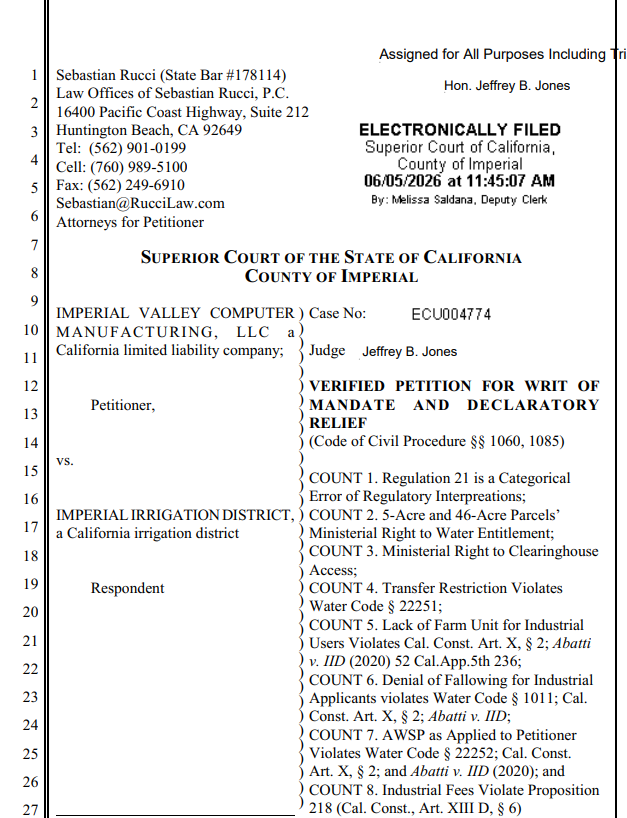
I spent some time reading the complaint filed by the developer behind a proposed AI data center in California’s Imperial Valley.
The public discussion is all about water.
The lawsuit is mostly about paperwork.
That’s a problem because paperwork is boring and outrage is entertaining.
The project would use about 260 million gallons of water annually for cooling.
That sounds enormous until you discover Imperial Valley agriculture uses roughly 978 billion gallons of Colorado River water every year.
Not million.
Billion.
The proposed data center would consume about 0.026 percent of the water agriculture already uses.
Agriculture uses roughly 3,700 times more water than the project.
Now before somebody writes me an angry email, this is not an attack on farmers.
The Imperial Valley feeds America.
The point is simply that if water volume were truly the issue, we’d be having a very different conversation.
Instead, the lawsuit argues something far more interesting.
The developer, Imperial Valley Computer Manufacturing, LLC, claims the Imperial Irrigation District denied its application using a regulation that doesn’t apply.
According to the filing, IID relied on Regulation 21, a rule governing “Small Parcel Service.”
The company argues it wasn’t requesting small parcel service at all.
It was requesting industrial raw-water service.
Think of it this way.
Imagine applying for a commercial driver’s license and being denied because you didn’t meet the requirements for a fishing license.
You might still get denied for some other reason.
But you’d probably want somebody to explain why they were using the wrong rulebook.
That’s essentially what the lawsuit says happened.
The complaint goes even further.
The irrigation district reportedly suggested the company obtain water through the City of Imperial instead.
The company says that won’t work because the city has already opposed the project, rejected previous water proposals, and reserves the right to terminate service outside city limits whenever it chooses.
In other words, according to the developer:
“You told us to go ask the people who already said no.”
Again, whether that’s true is for a judge to decide.
But that’s a lot different from the social media version where a giant AI company storms into town carrying a giant straw and a bucket.
The lawsuit also claims the property already has existing water-service rights associated with the land.
One parcel already receives water.
Another has paid water availability charges.
The company argues it isn’t asking for a new right.
It’s asking to exercise an existing one.
Now we’re no longer talking about technology.
We’re talking about property rights.
We’re talking about administrative law.
We’re talking about whether government agencies can interpret regulations one way for one customer and another way for somebody they don’t particularly like.
That’s where the case gets interesting.
Because if the irrigation district wins, opponents of data centers will celebrate.
If the developer wins, supporters of industrial development will celebrate.
But neither side may get the story they think they’re getting.
The court may never decide whether AI deserves Colorado River water.
The court may simply decide whether the right regulation was used.
Which brings us back to that headline.
“AI Data Center Sues for Colorado River Water.”
That’s what everybody is arguing about.
But after reading the complaint, I’m not convinced the fight is really about water at all.
It may be about who gets to decide which rulebook gets pulled off the shelf.
And in America, those fights often end up mattering a lot more than the water.