
“I hate data centers.”
A woman wrote that recently.
I believe her.
A lot of people do.
They worry about water.
They worry about electricity.
They worry about giant industrial buildings appearing where ranches, farms, forests, and open land once stood.
Those concerns are legitimate.
Communities should ask questions.
Developers should answer them.
But when I read her comment, I couldn’t stop thinking about how she posted it.
Because chances are she posted it from inside a world powered by the very thing she hates.
Let’s walk through an ordinary American day.
The dog wakes you up.
Not artificial intelligence.
Not a billion-dollar corporation.
Not a data center.
Just a dog.
For a few glorious seconds, you’re living exactly the way humans have for thousands of years.
Then you look at your watch.
And the modern world arrives.
The watch tells you it’s 6:30 a.m.
It gives you a sleep score.
It checks your heart rate.
It may have spent the night looking for signs of atrial fibrillation.
You wander into the kitchen.
Coffee.
Still mostly analog.
The dog goes outside.
Still analog.
Then you pull out your phone.
You check the weather.
You read the news.
You scroll Facebook.
You check X.
You look at your calendar.
You read your email.
An alert tells you a package arrived overnight.
There’s even a photograph showing the box sitting on your front porch.
Before breakfast, you’ve already touched dozens of systems running through data centers scattered across the country.
Nobody thinks about that.
Nobody thinks about the electric grid when they turn on a lamp.
At eight o’clock, Alexa says good morning.
She gives you the weather forecast.
You nod and continue with your day.
A reminder appears telling you it’s time to take medication.
You upload a few photographs from a recent trip.
You post a story to your website.
Readers share it.
Friends comment on it.
Someone texts you a link.
Someone else emails a response.
It all feels effortless.
That’s because the machinery is hidden.
Infrastructure always disappears when it works.
Around lunchtime, you head out to meet friends.
You start your car.
Your favorite playlist starts playing.
Years ago, that meant a cassette.
Then a CD.
Now it means reaching into a music library larger than every record store in America combined.
You hit play.
A song begins.
You don’t think about what happened.
A server verified your account.
Another found your playlist.
Another tracked royalty information.
Another recorded listening habit.
The music simply appeared.
Which is exactly how infrastructure is supposed to feel.
Then GPS takes over.
The satellites know where you are.
Data centers know where traffic is.
They know where accidents are.
They know where construction is.
They know the fastest route to lunch.
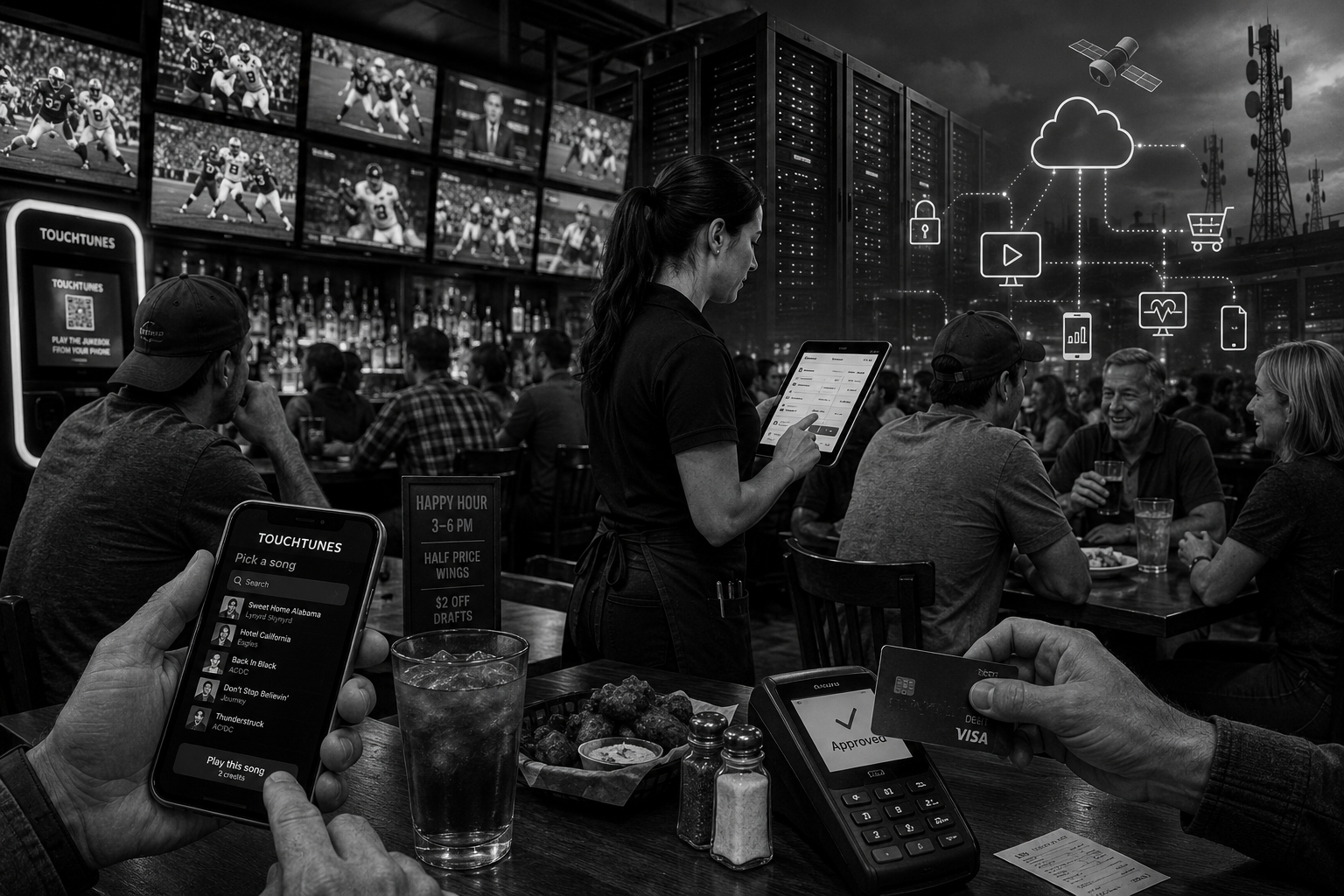
You arrive at a sports bar.
Or maybe it’s a restaurant.
The point is, you’re meeting friends.
Talking politics.
Talking baseball.
Talking grandchildren.
Entirely human activities.
Yet everything supporting those activities is digital.
The hostess checks a screen.
The server enters your order into a point-of-sale system.
The kitchen receives the order electronically.
Management sees sales in real time.
Inventory systems know what ingredients are running low.
Suppliers may already be receiving automatic restocking information.
Employee schedules are online.
Payroll is online.
Training records are online.
Food safety certifications are online.
Health and compliance courses are online.
The manager can probably check half the operation from a phone while sitting at home.
Around the room are dozens of televisions.
Customers are watching sports.
The televisions are receiving content from networks that pass through data centers.
Advertising systems are updating.
Viewer metrics are being collected.
Content is being distributed.
Nobody notices.
They just watch the game.
Then somebody at the next table decides the place needs more classic rock.
Years ago, he would have walked over to the jukebox and dropped in a quarter.
Today, he pulls out a cellphone.
A few taps later, a song begins playing through the TouchTunes system.
The customer thinks he just played a song.
What actually happened is that a phone connected to a network, a payment was processed, servers updated a queue, licensing information was recorded, royalty tracking was updated, and a jukebox received instructions.
Nobody in the room notices.
They just hear the music.
That’s the story of modern America.
The technology fades into the background.
The experience remains human.
You pay the bill with a debit card.
The transaction takes two seconds.
Several computers in several states may have participated.
Nobody cares.
The payment worked.
That’s all anybody notices.
You head home.
Back at the computer.
More emails.
More news.
More photos.
More stories are uploaded to websites.
More interactions that feel local but are actually moving through networks spanning continents.
At five o’clock, you watch the evening news.
Not live.
Recorded.
Stored somewhere.
Delivered from somewhere.
Later, you browse Netflix.
Amazon Prime.
Paramount.
YouTube TV.
Maybe all four because nobody can remember which service owns which show anymore.
Then you head to bed.
The dog curls up nearby.
The house gets quiet.
You go to sleep.
The systems do not.
Your watch continues monitoring your heart.
Your phone synchronizes data.
Photographs back themselves up.
Software updates download.
And somewhere around two o’clock in the morning, a medical monitoring device wakes up.
It connects through Wi-Fi.
Twenty-four hours of heart data travel through telecommunications networks into medical systems.
The information becomes available to doctors.
Algorithms check for problems.
Records are updated.
The patient sleeps through all of it.
The infrastructure does not.
Which brings me back to the woman who said she hates data centers.
Maybe she does.
Maybe she doesn’t want one near her home.
Maybe she worries about water.
Maybe she worries about electric rates.
Maybe she worries about environmental impacts.
Those are reasonable concerns.
But there is another truth sitting right beside them.
Most Americans who say they hate data centers begin using them before breakfast.
Not because they’re hypocrites.
Because modern life has changed.
The same thing happened with electricity.
People once complained about power plants.
Then they flipped on a light switch.
People once complained about telephone lines.
Then they picked up the phone.
People once complained about highways.
Then they drove to town.
Infrastructure has always worked that way.
The debate isn’t whether data centers are part of modern life.
That debate is over.
Every email answers it.
Every GPS route answers it.
Every streaming television show answers it.
Every debit card transaction answers it.
Every uploaded photograph answers it.
Every online article answers it.
Every medical monitor answers it.
The real debate is where they should be built, how they should be built, who should pay for them, and what protections communities deserve.
Those are important questions.
But the woman who said she hates data centers probably posted that comment from a smartphone.
After checking her email.
After looking at the weather.
After consulting her calendar.
After using GPS.
Perhaps while sitting in a restaurant run by cloud software.
Watching a game delivered through digital networks.
Listening to music selected on a cellphone.
Before going home to stream television.
And before a medical device quietly uploaded health information while she slept.
She may still hate data centers.
But she spent the entire day living inside one of the societies they make possible.