
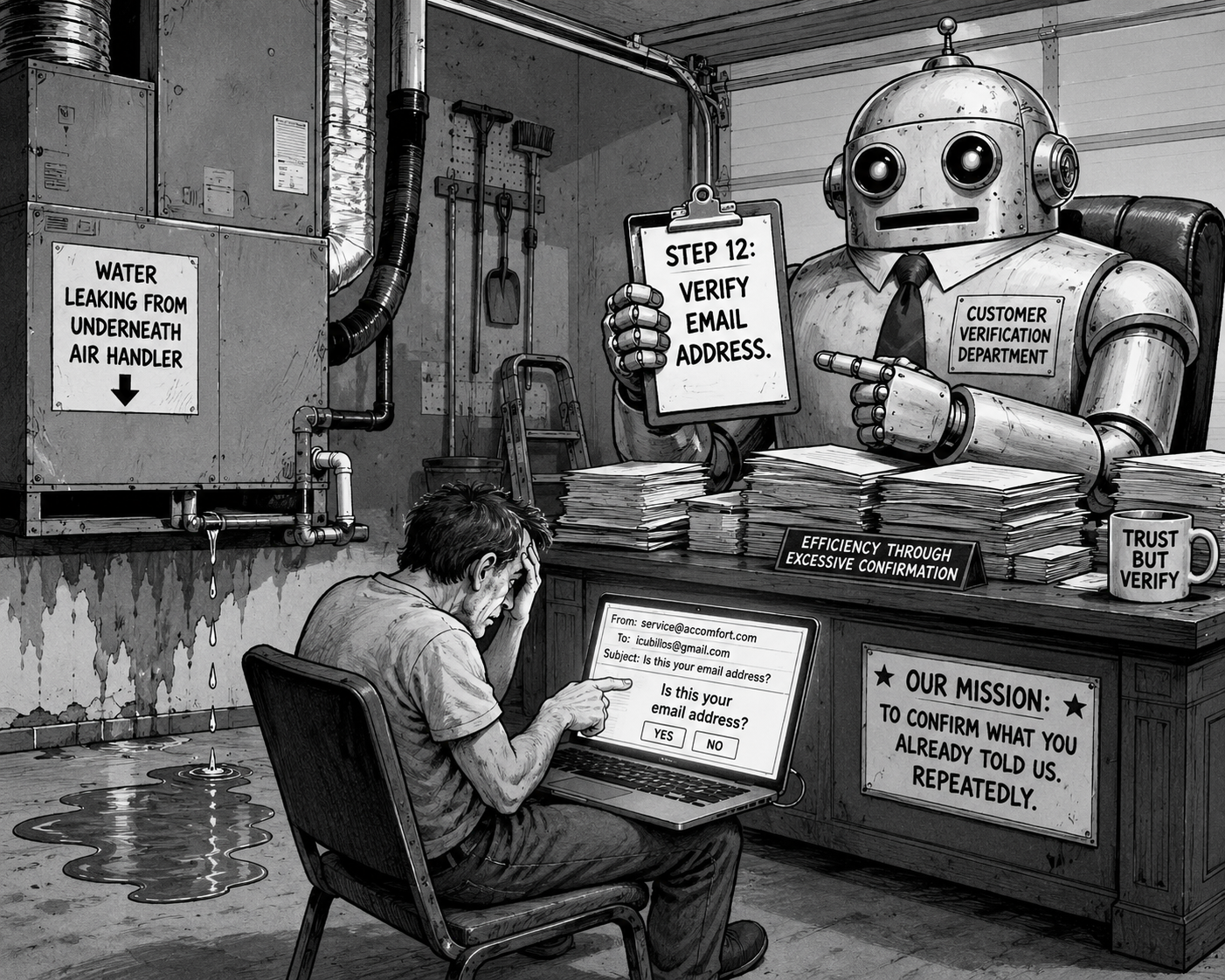
It started with a puddle.
Not one of those biblical homeowner catastrophes where water is shooting through the ceiling and the neighbors gather in lawn chairs to watch the excitement.
Just a puddle.
Clear water.
Under the air conditioner handler in my garage.
The unit was cooling fine. The house was comfortable. But there was water on the floor and some damage to the drywall underneath.
So I did what modern Americans do.
I went online.
The air conditioning company had a convenient service request form. No waiting on hold. No listening to recordings about how important my call was. No dispatcher named Debbie who has worked there since the Reagan administration and can diagnose an air conditioner before you’ve finished describing the problem.
This was the future.
Artificial intelligence.
Efficiency.
Progress.
I filled out the form.
Name.
Address.
Phone number.
Email address.
Description of the problem.
Submitted.
A few minutes later, an email arrived.
“Is your name Isaac?”
Yes.
A few minutes later, another email arrived.
“Is this your phone number?”
Yes.
A few minutes later, another email arrived.
“Is this your email address?”
Now, I don’t like making assumptions, but since the question arrived through that email address, I felt reasonably confident.
Yes.
Another email.
“Is this your address?”
I looked around.
The furniture appeared familiar.
The dog recognized me.
The garage looked exactly like my garage.
Yes.
I was beginning to suspect I wasn’t scheduling an air conditioner repair.
I was applying for a mortgage.
Or entering a witness protection program.
Or perhaps joining a secret government agency.
The emails continued.
One question.
One answer.
One question.
One answer.
One question.
One answer.
This went on long enough that I started wondering if the next email would ask me to identify all the traffic lights in a series of photographs.
Now, we’re constantly told artificial intelligence is changing the world.
AI will discover new medicines.
AI will diagnose diseases.
AI will drive cars.
AI will write software.
AI will transform education.
AI will reshape the economy.
And all of that may very well be true.
But the AI handling my leaking air conditioner had a more immediate mission.
Determine whether I was actually me.
Over.
And over.
And over again.
What fascinated me wasn’t that it asked questions.
Questions are fine.
What fascinated me was the sequence.
A human dispatcher would have solved this problem in about ninety seconds.
“What’s wrong?”
“Water leaking under the air handler.”
“Probably a clogged condensate drain. We can get someone there Thursday morning.”
Done.
Instead, I found myself participating in what felt like a digital version of a congressional hearing.
Sir, can you verify your identity?
Sir, can you verify your phone number?
Sir, can you verify your email address?
Sir, can you verify your physical location?
Sir, can you verify your continued existence?
At one point, I became curious whether the robot knew there was an air conditioner involved.
Eventually, after enough emails to qualify as a correspondence course, it offered me three appointment dates.
I selected one.
Then another email arrived.
Three appointment windows.
Morning.
Midday.
Afternoon.
Progress.
The robot had finally concluded that I was indeed Isaac, that I did indeed live where I said I lived, and that there was apparently an air conditioner somewhere in this story.
Now, before anyone writes to explain how these systems work, I understand.
This isn’t really an AI problem.
This is a bureaucracy problem.
Somewhere there was a meeting.
There is always a meeting.
Someone from legal attended.
Someone from compliance attended.
Someone from information technology attended.
Someone from management attended.
Someone whose entire purpose in life is to create forms attended.
After several hours, three PowerPoint presentations, and enough coffee to fuel a small aircraft carrier, they created a workflow.
The workflow was perfect.
Every field verified.
Every box checked.
Every risk eliminated.
Every ounce of common sense carefully removed.
The remarkable thing about modern technology is that it often takes a process that once required a human being and transforms it into a process requiring six databases, four servers, an algorithm, and seventeen confirmation emails.
Which brings me back to the puddle.
The puddle is still there.
The drywall still has water damage.
The technician hasn’t arrived yet.
But somewhere in a data center, a computer now possesses absolute certainty that my email address is, in fact, my email address.
And perhaps that’s the most honest description of the AI age I’ve encountered so far.
The future didn’t arrive as an all-knowing digital assistant.
The future arrived one email at a time, asking me to confirm information it already had.