
I’ve been a reporter long enough to know that whenever somebody begins a sentence with, “They don’t want you to know this,” I immediately want to know two things.
First, who exactly is “they”?
Second, did anybody actually read the document?
The latest internet panic arrives wrapped in official government language, executive orders, and enough capital letters to make a billboard salesman blush.
The claim goes something like this:
President Trump has classified AI data centers as military installations.
The government now gets every advanced AI model 30 days before the public sees it.
Nuclear reactors will power AI facilities because they’re essentially military bases.
The media ignored it.
Cue dramatic music.
The problem is that this story appears to be what happens when two separate executive orders are tossed into a blender and served as a single conspiracy theory.
The first is Executive Order 14318, “Accelerating Federal Permitting of Data Center Infrastructure,” signed July 23, 2025, and published in the Federal Register on July 28, 2025.
The second is Executive Order 14409, “Promoting Advanced Artificial Intelligence Innovation and Security,” signed June 2, 2026, and published in the Federal Register on June 5, 2026.
Those are two different executive orders addressing two different issues.
EO 14318 is largely about data centers, power generation, permitting, infrastructure, federal land, and accelerating the construction of AI-related facilities.
EO 14409 focuses on advanced AI systems, cybersecurity, frontier AI models, and cooperation between government and AI developers on security issues.
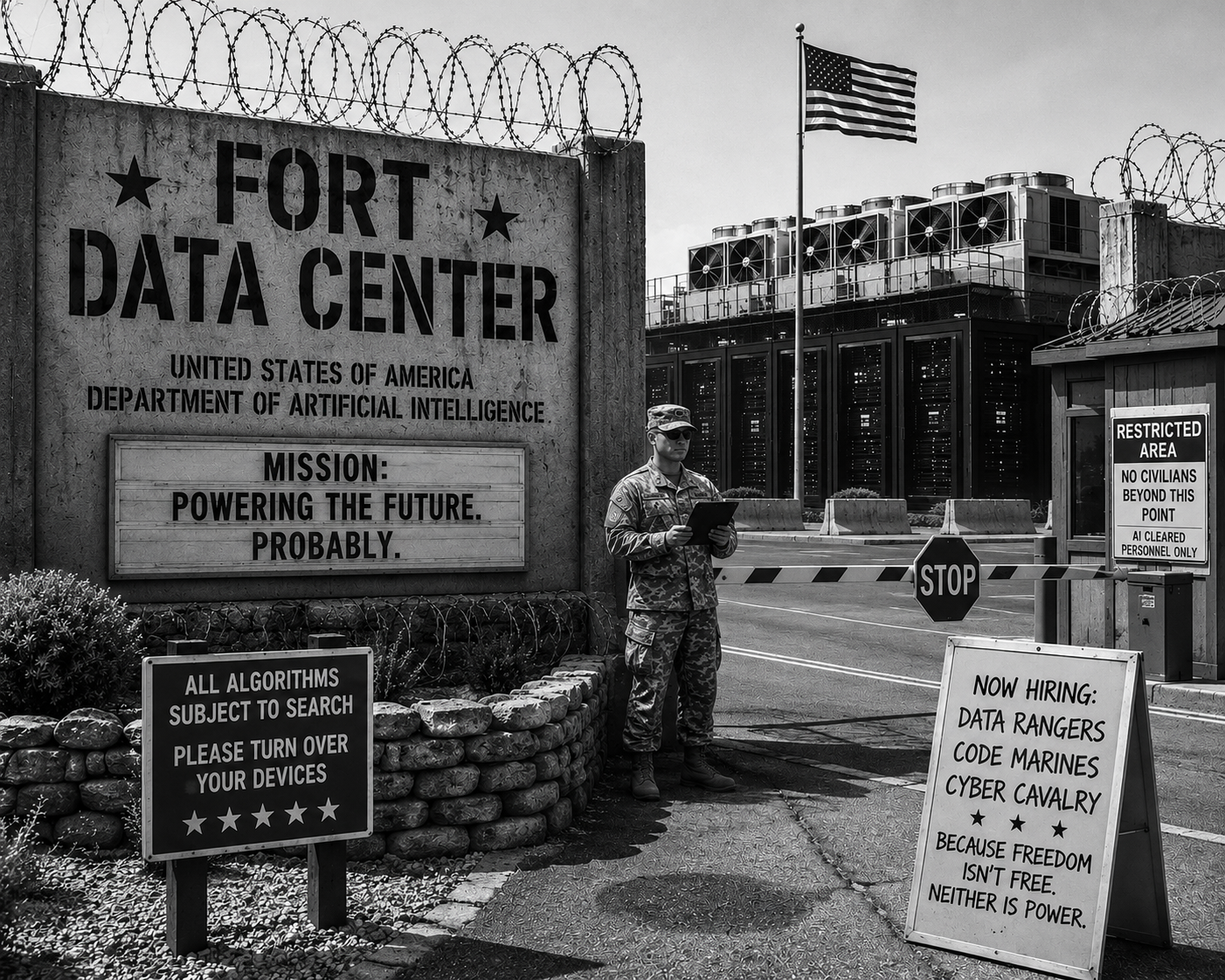
The conspiracists looked at both documents, tossed them together, and concluded that America had quietly transformed every server farm into Fort Data Center.
That’s not what either order says.
Now, before anybody accuses me of defending Washington, let me save them the trouble.
I don’t trust the government because it’s the government.
I don’t trust corporations because they’re corporations.
My default setting after 35 years in journalism is simple:
Show me the paperwork.
And the paperwork tells a more interesting story.
EO 14318 repeatedly describes AI infrastructure as important to national security and directs federal agencies to accelerate permitting for data centers and related power infrastructure. It also specifically mentions dispatchable energy sources, including nuclear power equipment, as part of the infrastructure that may support qualifying projects.
That’s a significant policy decision.
But there is a difference between saying something is strategically important to national security and saying it is a military installation.
Railroads were strategically important.
Ports were strategically important.
Telecommunications networks were strategically important.
The interstate highway system was strategically important.
None of that automatically transformed them into military bases.
Likewise, discussions of future nuclear power for AI facilities do not magically turn a data center into an aircraft carrier simply because both may use nuclear energy.
EO 14409 is where many online posts get their second talking point.
The order discusses frontier AI systems and establishes mechanisms for cooperation between the government and AI developers on security issues.
What many social media posts translate this into is:
“The government gets every AI model 30 days before release and decides what it can do.”
That is a far stronger claim than the language most legal analysts have found in the order.
The actual debate is whether the federal government should have greater visibility into powerful AI systems that may have national security implications.
Reasonable people can disagree about that.
But that debate is not the same thing as claiming Washington now approves every AI model before the public can see it.
The more interesting question is why so many people are eager to believe the most dramatic interpretation possible.
Perhaps it’s because trust in institutions has collapsed.
Perhaps it’s because giant data centers are appearing in communities that never asked for them.
Perhaps it’s because the relationship between government, the military, and major technology companies is becoming increasingly visible.
Those concerns are real.
The strategic importance of AI is real.
Which is precisely why we don’t need to invent things that aren’t in the documents.
As a reporter, I’ve learned that reality is usually neither as comforting as the official press release nor as terrifying as the viral meme.
It’s almost always somewhere in between.
And that’s exactly where these two executive orders live.
We used to have a saying in journalism: If your mother says she loves you, check it out.
In 2026, I’d update that rule.
If a Facebook post says the government secretly turned every data center into a military base, check that out, too.