
A journalist develops an annoying habit after enough years in the business. We don’t stop reading when everyone else does.
We follow the footnotes.
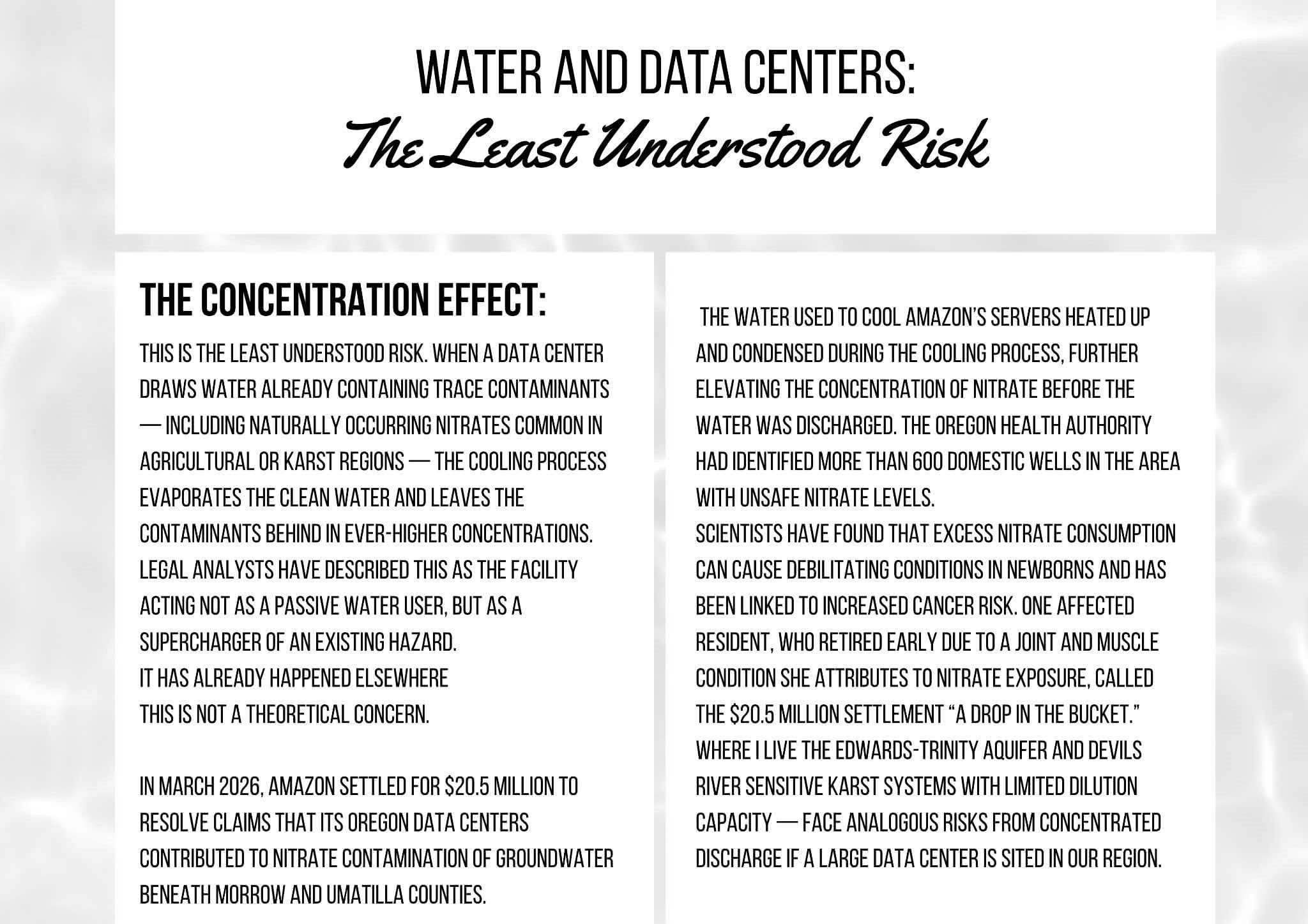
This week someone posted an infographic titled “Water and Data Centers: The Least Understood Risk.” It looked authoritative. It was well designed. It cited lawsuits. It explained chemistry. It warned about groundwater contamination.
The chart itself carried no author’s name. It is supposedly from a person who is identified as holding a Ph.D. in computer science from the University of Texas at Austin. The person spent decades working in commercial and scientific computing, specializing in power and cooling efficiency. Most recently, the person directed IBM research and development programs involving data center power, cooling and cloud computing. Before retiring, the unnamed person worked in some of the world’s largest commercial and weapons-research data centers, improving power efficiency, designing cooling technologies, and developing massive cloud computing systems.
Those are impressive credentials–if true.
Which is exactly why I decided to do what journalists do.
I read the court filings.
The infographic claimed Amazon settled for $20.5 million because its Oregon data centers contributed to nitrate contamination of groundwater. That part is true. Amazon agreed to a $20.5 million settlement while denying any wrongdoing.
But then the chart quietly skipped over the most important part of the story.
Actually, it skipped over an entirely different lawsuit.
The average reader would never know there were two cases.
The first lawsuit—Pearson v. Port of Morrow—was filed against agricultural, food-processing and industrial defendants. It alleges that decades of fertilizer use, wastewater disposal, food processing and other industrial activities contaminated groundwater in Oregon’s Lower Umatilla Basin with nitrates.
Amazon wasn’t one of those defendants.
That’s because the groundwater contamination already existed.
State agencies had been documenting unsafe nitrate levels for years. Hundreds of domestic wells exceeded federal drinking water standards long before anyone accused Amazon of anything.
Then came the second lawsuit.
Plaintiffs filed a separate action against Amazon Data Services with a different legal theory. They did not claim Amazon created the nitrate contamination. Instead, they argued Amazon’s evaporative cooling process concentrated nitrate already present in groundwater before discharging water back into the system, allegedly making an existing problem worse.
That distinction matters.
Creating contamination and allegedly exacerbating existing contamination are two very different claims.
Here’s another fact missing from the chart.
The lawsuit and the proposed $20.5 million settlement were filed on the very same day. That doesn’t mean the case was resolved overnight—settlement negotiations almost certainly occurred beforehand—but it does mean no judge or jury ever evaluated the competing scientific evidence before the parties asked the court to approve their agreement.
There was no lengthy discovery battle. No parade of expert witnesses. No trial. No jury. No judge weighing competing scientific testimony before issuing findings of fact.
Amazon denied liability and agreed to settle.
Companies settle lawsuits every day for reasons having nothing to do with admitting fault. Sometimes litigation costs more than settlement. Sometimes businesses want certainty. Sometimes they simply want to move on.
A settlement is not the same thing as a court finding that the allegations are true.
Yet the infographic presents the allegation as though it has already been proven.
That’s where journalism and advocacy take different roads.
Advocacy says, “This happened.”
Journalism says, “This was alleged.”
Those are not interchangeable.
None of this means the unnamed alleged engineering concerns should be dismissed. Far from it. The person’s background suggests they understand data center cooling systems better than most people ever will. The explanation of how evaporative cooling can increase the concentration of dissolved contaminants is scientifically plausible and worthy of serious discussion.
But engineering expertise and legal history are not the same discipline.
An engineer can accurately explain how a cooling tower works.
A journalist has to explain whether a court determined that process caused contamination in a specific case—or whether that remained an allegation resolved through settlement without an admission of liability.
The Oregon litigation is important. It may influence how regulators evaluate future data centers. It deserves careful attention.
It also deserves careful reporting.
Leaving readers with the impression that Amazon caused Oregon’s nitrate crisis isn’t telling the whole story. The larger lawsuit against agricultural and industrial defendants is still moving through the courts. The nitrate problem predates Amazon’s arrival by years. And the separate Amazon case ended in a settlement reached before any judge or jury determined whether the allegations were correct.
That’s not a small omission.
It’s the story.
As journalists, our first loyalty isn’t to a corporation or an activist. It isn’t to the technology industry or to those fighting it.
It’s to context.
Because facts without context don’t just leave readers uninformed.
Sometimes they leave them misinformed.
And that’s why, after all these years, I still read the footnotes.
Sometimes the biggest story isn’t what’s printed in the chart.
It’s what the chart forgot to tell you.