
Every few days another meme makes the rounds claiming to expose the “truth” about artificial intelligence.
This week’s version goes something like this:
India has three times as many internet users as the United States but only about 153 data centers.
China has four times as many internet users but only around 449.
America has only 324 million internet users—and more than 5,200 data centers.
The conclusion practically screams off the screen:
“The numbers don’t add up.”
Actually, they don’t.
Just not in the way the meme thinks.
Here’s the first clue.
Suppose someone told you America has 6,000 airports while France has only 800.
Would you conclude Americans are lying about aviation?
Of course not.
Because an airport isn’t an airport.
A grass landing strip in rural Kansas isn’t Atlanta’s Hartsfield-Jackson.
A private airfield isn’t Chicago O’Hare.
Counting airports tells you almost nothing unless you know what kind of airports you’re talking about.
Data centers work exactly the same way.
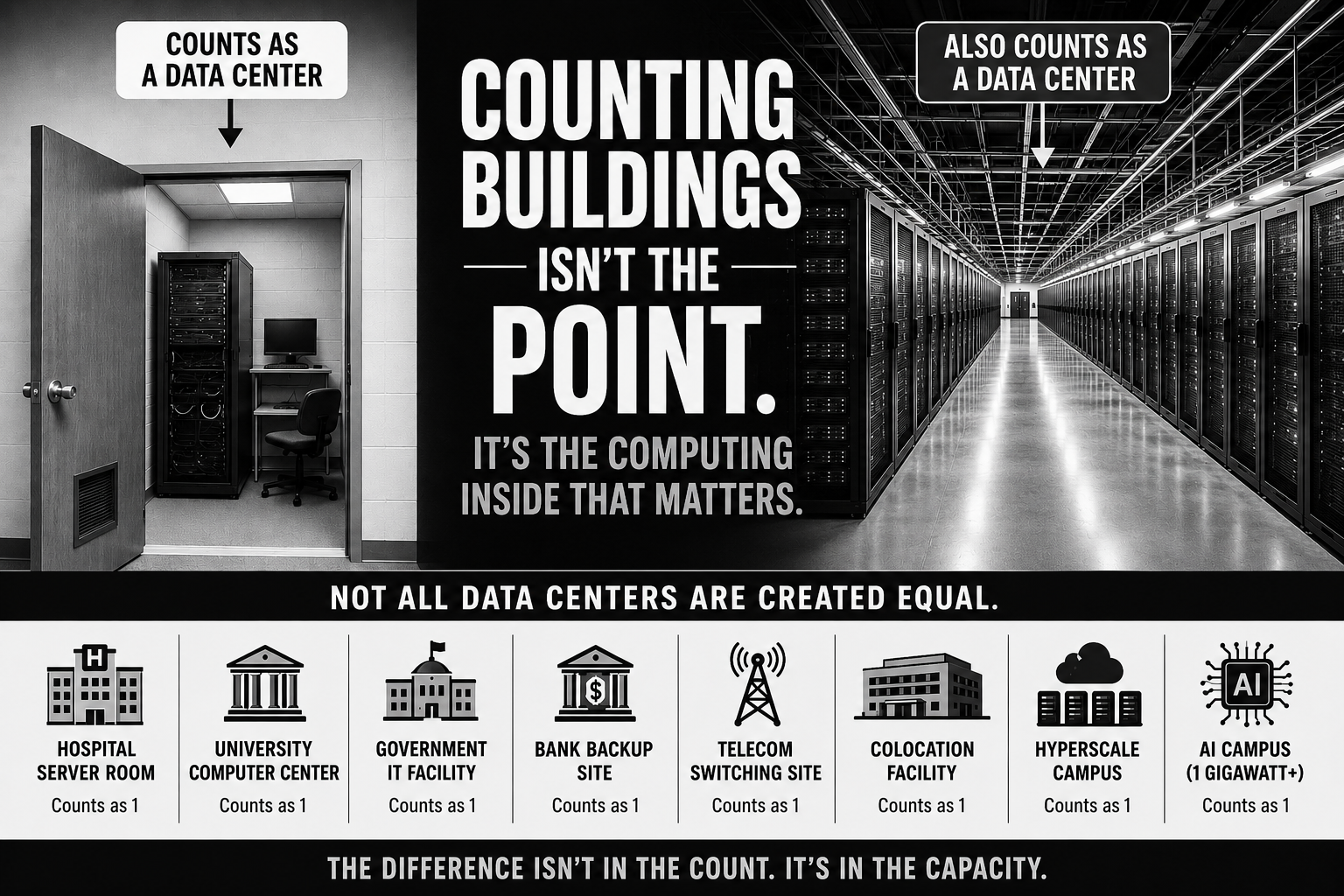
A 500-square-foot server room tucked inside a hospital counts as a data center.
So does a university computer center.
A county government’s IT room counts.
A bank’s disaster recovery site counts.
A regional colocation facility counts.
And yes, so does a one-gigawatt AI campus containing hundreds of thousands of GPUs and enough computing power to train frontier artificial intelligence.
The meme counts all of those as “one.”
That’s like counting a bicycle and a Boeing 787 as identical because both have wheels.
The problem isn’t the math.
It’s the categories.
Take, for example, Erin Brockovich’s AI Data Center map. The map includes AI operating facilities, projects under construction, proposed developments, and user-submitted reports. With all layers enabled, the map can appear almost entirely red, making it easy to misinterpret every marker as an existing AI data center, even though many represent proposals or public submissions.
Then there’s the little matter of history.
America didn’t wake up one morning and decide to build thousands of data centers because ChatGPT showed up.
The United States has been building the Internet since most people thought AOL was cutting-edge technology in 1991.
The companies that largely created today’s cloud economy are American.
Amazon.
Microsoft.
Google.
Meta.
Oracle.
IBM.
Apple.
Cloudflare.
Akamai.
Digital Realty.
Equinix.
The cloud didn’t magically appear over Silicon Valley one afternoon.
It was built, one server rack at a time, over decades.
Here’s something else the meme ignores.
When someone in Germany uploads vacation photos to Google Photos…
When a company in Brazil stores backups in AWS…
When an Australian business runs software on Microsoft Azure…
When someone in Japan asks ChatGPT a question…
There’s a decent chance that request is being processed inside an American data center.
Those buildings aren’t serving only Americans.
They’re serving the world.
Imagine criticizing the Port of Los Angeles because California doesn’t consume all the cargo moving through it.
That’s not how ports work.
It’s not how cloud computing works either.
Then comes my favorite statistic in the meme.
Internet users.
Apparently we’re supposed to believe that the number of people browsing social media determines how many data centers a nation should have.
That’s like saying every city should have the same number of warehouses because everyone eats dinner.
Not all computing is equal.
A country can have a billion people watching short videos on inexpensive smartphones.
Another country can have a fraction of the population but host Wall Street trading platforms, biotech simulations, Hollywood rendering farms, Fortune 500 companies, military computing, scientific research, cloud platforms, and artificial intelligence training.
Guess which one needs more computing infrastructure?
The answer has nothing to do with population.
It has everything to do with workload.
And America doesn’t merely consume cloud services.
It exports them.
Cloud computing has become one of America’s largest digital exports.
AWS.
Microsoft Azure.
Google Cloud.
Oracle Cloud.
They generate hundreds of billions of dollars serving customers scattered across nearly every continent.
Those data centers are factories.
Only instead of producing automobiles or refrigerators, they produce computing.
Now let’s talk about China.
The comparison sounds simple.
It isn’t.
China’s internet is largely separate from the global internet.
Its dominant cloud companies—Alibaba Cloud, Tencent Cloud, Huawei Cloud, and Baidu AI Cloud—operate in a very different regulatory environment.
Government involvement is far greater.
Western commercial databases don’t necessarily catalog Chinese facilities the same way they catalog American ones.
China also tends to build enormous government-backed computing clusters, while the United States accumulated thousands of privately owned enterprise facilities over decades.
Comparing one commercial database’s U.S. listings to another country’s ecosystem is hardly apples to apples.
It’s closer to apples and aircraft carriers.
Finally, let’s address the elephant humming away behind those warehouse-sized buildings.
Artificial intelligence.
AI is not web browsing.
Training frontier AI models requires tens of thousands—and increasingly hundreds of thousands—of specialized GPUs operating simultaneously.
The electrical demand of a modern AI campus would have seemed absurd just five years ago.
That’s why utilities are planning upgrades.
That’s why transmission lines are being expanded.
That’s why developers are racing to secure power.
The infrastructure isn’t growing because people suddenly started checking email more often.
It’s growing because the computing requirements have fundamentally changed.
One last point.
That number—5,247 data centers—usually comes from commercial directories such as Cloudscene or Data Center Map.
Those directories count everything.
Enterprise server rooms.
University facilities.
Hospitals.
Telecommunications switching centers.
Government computing sites.
Regional colocation buildings.
Hyperscale campuses.
They’re useful directories.
They’re terrible sound bites.
The meme quietly encourages readers to imagine 5,247 giant AI supercomputers blanketing America.
Reality is far less dramatic.
Many of those facilities have been quietly doing their jobs for decades.
They don’t train AI.
They store medical records.
Run county payroll.
Keep banks online.
Deliver streaming video.
Host websites.
Route phone calls.
Support universities.
Power businesses.
They are simply part of the digital plumbing that most of us never notice until it stops working.
Which brings us back to where we started.
The meme asks us to compare buildings.
The real comparison is computing capacity.
It’s the difference between counting gas stations and measuring how much fuel they sell.
Or counting airports instead of passengers.
Or counting libraries instead of books.
Once you understand that, the mystery disappears.
The question isn’t why America has more data centers.
The better question is why anyone thought counting buildings would explain the digital economy in the first place.
Good public policy begins with good information. Bad public policy usually begins with a meme.
If we’re going to debate the future of AI, electricity, and data centers, let’s argue about the real issues: power demand, water use, tax incentives, land use, and who benefits.
But let’s stop pretending that counting every server closet, hospital IT room, university computer lab, and hyperscale AI campus as if they’re identical tells us anything useful.
It doesn’t inform citizens.
It misleads them.
And democracy works a whole lot better when we’re arguing over facts instead of faulty arithmetic.