
There are two kinds of people in this country.
The first kind can tell you the horsepower of a 1969 Camaro, the caliber of the rifle their grandfather carried in World War II, and probably the batting average of the Yankees’ cleanup hitter.
The second kind knows where the breaker box is.
Most of us, however, couldn’t tell you much about the biggest machine we use every single day.
That’s because we don’t think of it as a machine.
We call it “the grid.”
It’s just… there.
Flip a switch, and the lights come on. Plug in the coffee maker, and breakfast begins. Charge your phone before bed, and by morning it’s ready to tell you you’re running late. We expect electricity to appear with the same certainty that the sun rises in the east. When it does, we never give it a second thought. When it doesn’t, we suddenly realize how completely our lives depend on it.
The remarkable thing about America’s electric grid isn’t that it’s old.
It’s that it still works so well.
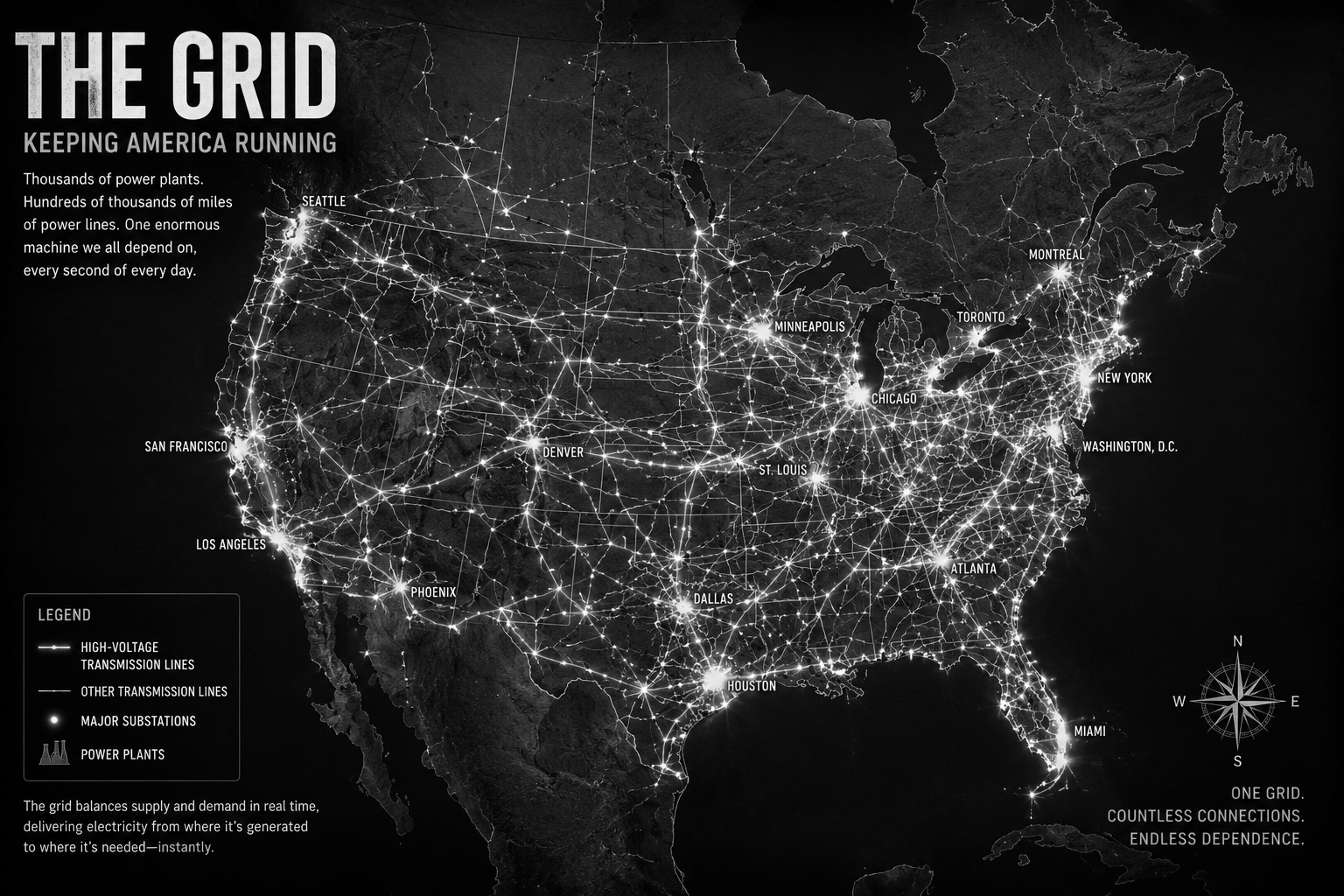
The North American electric grid is one of the largest and most complex machines ever built. It stretches across the United States, Canada and parts of Mexico, linking thousands of power plants with hundreds of thousands of miles of high-voltage transmission lines, substations, transformers and local distribution networks. Every second of every day, it performs an elaborate balancing act, matching electricity generation with demand almost instantaneously.
Here’s the part that surprised me.
Much of the backbone of that system was built during the great expansion of the 1950s and 1960s. America was booming. New suburbs appeared almost overnight. Factories hummed. Air conditioners were becoming common, and utilities raced to connect a growing nation with a growing appetite for electricity.
Nobody was thinking about artificial intelligence.
Nobody was thinking about electric vehicles.
Nobody was streaming movies to a phone while sitting in an airport.
Nobody imagined a warehouse full of computers that might someday consume as much electricity as a small city.
Yet here we are.
Now, before someone writes me to say, “Isaac, my local utility just replaced the poles on my street,” let me save you the postage.
Utilities replace equipment all the time.
Transformers wear out. Poles rot. Switches fail. Substations are modernized. Engineers are constantly repairing, upgrading and replacing pieces of the system. This isn’t a story about an electric grid that’s been neglected for 70 years.
It’s a story about a system whose basic architecture was designed for a different America.
The Department of Energy has been saying as much for years. The grid is facing new demands from population growth, more electrification, severe weather, cybersecurity threats and large new industrial customers. The Government Accountability Office has reported that much of the nation’s transmission infrastructure is decades old, even as electricity demand is expected to grow significantly in the years ahead.
That doesn’t mean the lights are about to go out.
It does mean the people who keep them on have a harder job than they used to.
One of the things I’ve learned while writing about AI data centers is that people often assume they’re the problem. They’re certainly adding demand, but they didn’t invent the challenge. Long before anyone heard of ChatGPT, utilities were warning about aging transmission lines, long waits for new substations, and the difficulty of building major power projects in a country where just about everybody wants reliable electricity but very few people want a transmission line crossing the back forty.
There’s a lesson in that.
It’s easy to blame whatever’s new. Today it’s AI. Twenty years ago it might have been the internet. Before that it was air conditioning, suburban growth or another wave of industrial expansion. Every generation has introduced technologies that demanded more from the grid than the generation before it.
The grid has adapted every single time.
Not quickly.
Not cheaply.
But it adapted.
That’s because electricity isn’t magic. It’s engineering, planning, and an awful lot of people climbing poles in the rain, repairing transformers after hurricanes, monitoring control rooms through the night, and figuring out how to keep supply and demand in balance when millions of Americans decide to turn on the air conditioner at the same time.
We tend to notice infrastructure only when it fails. A bridge collapses. A water main breaks. The power goes out, and suddenly everyone becomes an expert on the electric grid.
The truth is, boring infrastructure is usually successful infrastructure.
If nothing dramatic happens today, that’s because thousands of people you’ve never met did their jobs well.
Maybe that’s why the grid fascinates me.
It’s the invisible machine behind nearly everything else we talk about. Artificial intelligence, electric vehicles, new factories, hospitals, military bases, your neighborhood grocery store—they all begin with the same simple expectation that electricity will be there when needed.
We have spent a lot of time arguing over what should plug into the grid.
Maybe it’s time we spent a little more time talking about the grid itself.
Because it’s older than most of us think, more complicated than most of us realize, and far more important than most of us appreciate.