
Politics has always been full of surprises.
Every so often, you look up from your coffee and discover that people who spent years arguing with one another have somehow wandered into the same room carrying the same sign.
Welcome to the latest chapter in America’s AI debate.
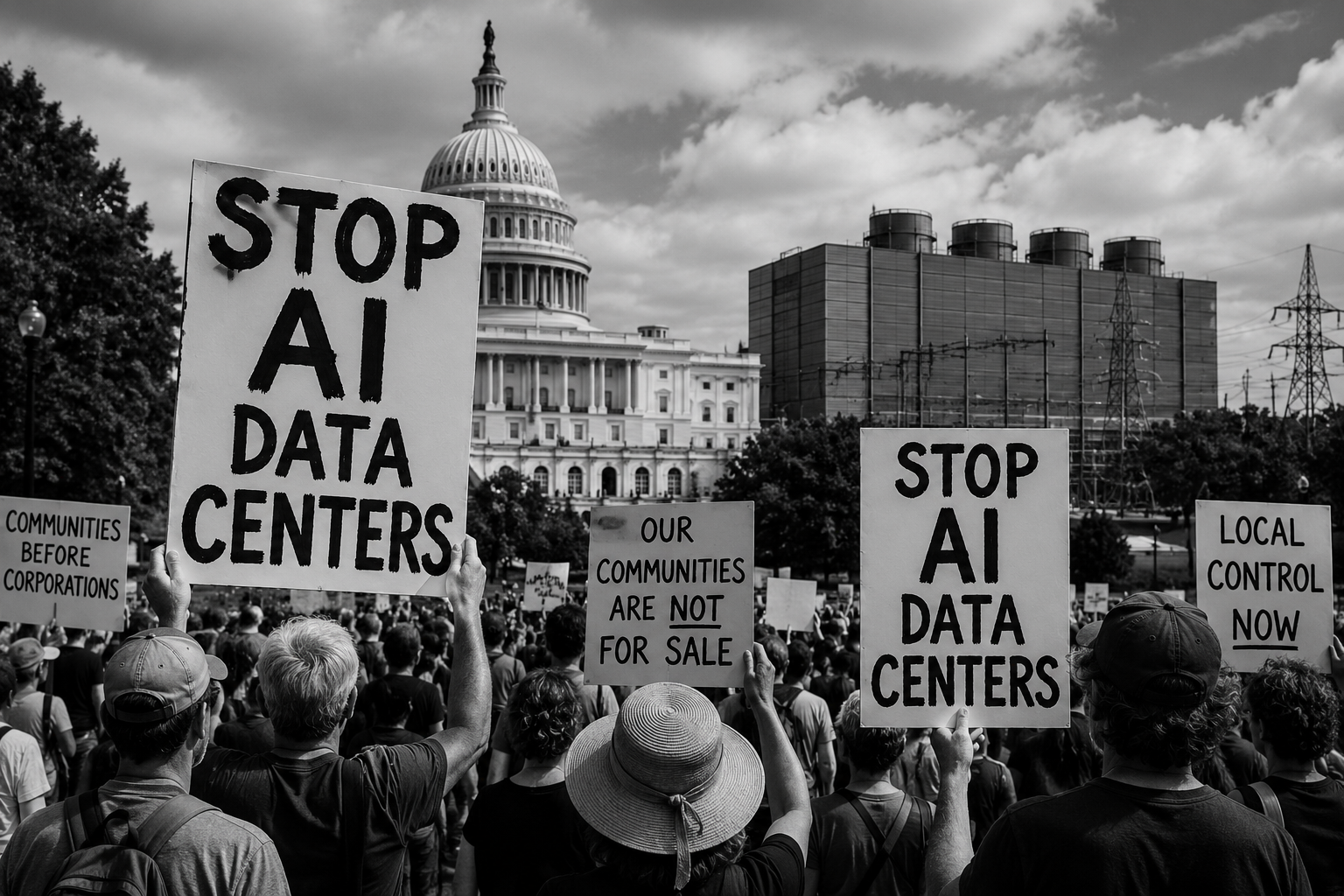
On July 18, a nationwide protest against the rapid expansion of AI data centers is expected to take place in communities across the country. At first glance, you might assume it’s another environmental demonstration organized by progressive activists worried about water, electricity and sprawling industrial campuses.
Not this time.
Many people attending the July 18 protests may not realize they are being organized by a conservative advocacy organization led by a founder of the Tea Party and Trump ally who created Women for Trump.
The protest is being organized by Humans First, a conservative advocacy organization chaired by Amy Kremer, a longtime Tea Party activist who helped organize the Jan. 6, 2021, Ellipse rally in Washington before the attack on the U.S. Capitol.
That bit of background matters because politics has a funny way of playing tricks on our assumptions.
Scroll through social media and you’ll find plenty of liberal Democrats enthusiastically sharing information about the protest. Whether they know who is organizing it is another question entirely.
It’s a reminder that in today’s social media world, people often share a headline long before they ask where it came from.
Humans First is not presenting itself as an anti-AI organization. Instead, it argues that the benefits of artificial intelligence have become concentrated in the hands of a handful of powerful technology companies while local communities are left dealing with the consequences of enormous data centers being built nearby.
Across the aisle, Sen. Edward Markey of Massachusetts has introduced what he calls the AI Accountability Agenda, a package of proposed legislation aimed at increasing federal oversight of AI infrastructure, including several proposals affecting hyperscale data centers.
Different politics.
Different philosophy.
Some remarkably similar questions.
Who pays for new transmission lines?
Who covers the cost of upgrading the electric grid?
How much water are these facilities using?
Should companies disclose more information about their energy consumption?
How much say should local communities have before a billion-dollar industrial campus moves in next door?
Those questions are no longer being asked only at county commission meetings. They’re being debated in Congress, state legislatures, utility commissions and neighborhood town halls from Arizona to Virginia.
That’s a remarkable change in a very short period of time.
Only a year ago, AI data centers were largely an industry story. Engineers talked about megawatts. Investors talked about billions. Utilities talked about substations.
Now everyone is talking about them.
Farmers.
Environmental groups.
County commissioners.
Conservative activists.
Progressive lawmakers.
Homeowners who had never heard the word “hyperscale” six months ago.
The coalition doesn’t agree on much else.
Some people oppose artificial intelligence itself.
Others welcome AI but want stricter rules for the infrastructure that powers it.
Some are worried about electricity prices.
Others are focused on water.
Still others simply don’t want a facility the size of several shopping malls built across the road from their neighborhood.
Lumping all of those voices together misses the point.
This isn’t one movement.
It’s a collection of movements that have temporarily found themselves standing in the same place for very different reasons.
That’s what makes this moment so interesting.
The story isn’t simply about data centers anymore.
It’s about who gets to decide where the future is built, who pays for it, and who benefits once it arrives.
And if American politics has taught us anything over the years, it’s this: strange bedfellows have a habit of showing up just when everyone is convinced they’ve figured out the plot.