
There was a moment in the White House this week that told you everything you need to know about Washington fantasy versus oil-patch reality.
Donald Trump, freshly confident about Venezuela, sat across from the men who actually write the checks — and they gave him the corporate equivalent of a cold shower.
The president talked urgency.
The executives talked risk.
And when those two languages collide, urgency loses every time.
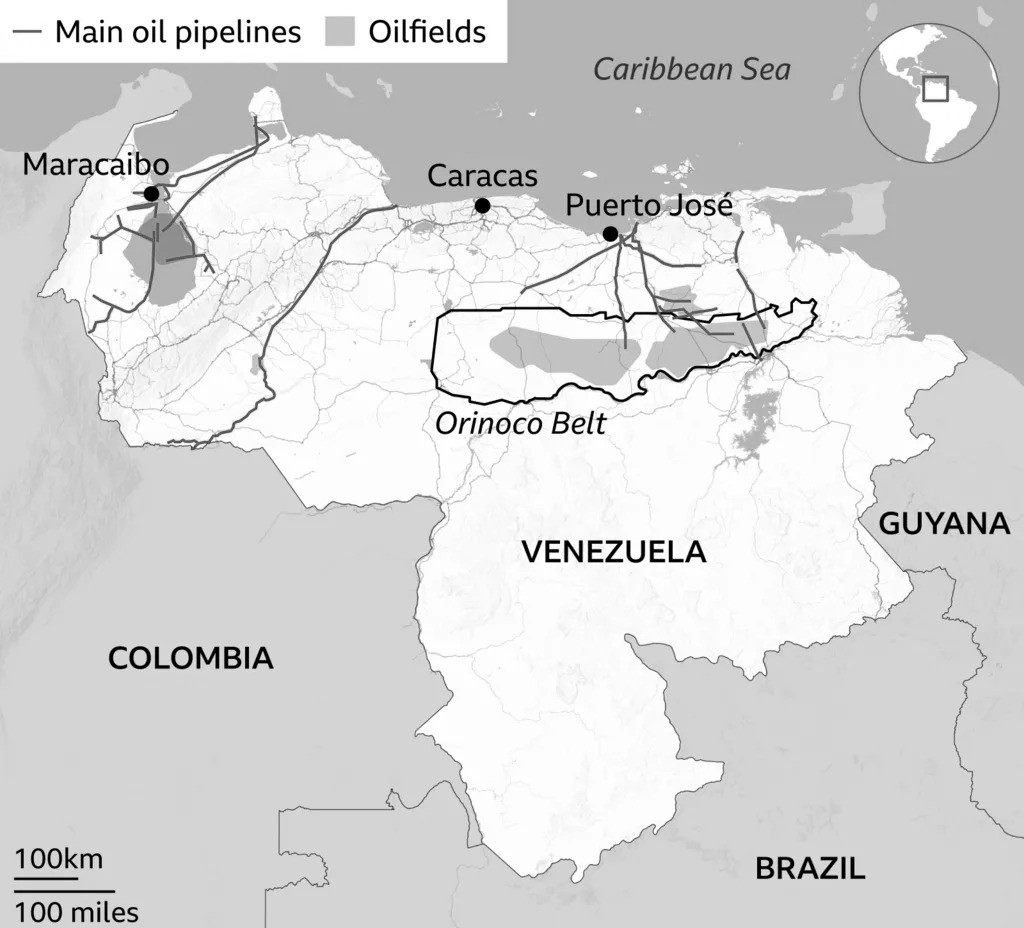
Trump wants to pour billions into Venezuela’s oil fields, revive production, and bring gasoline prices down like he’s flipping a switch in the Situation Room. It sounds decisive. It sounds muscular. It also ignores about fifty years of history and a dozen pages of legal fine print.
That reality came into sharp focus when Exxon Mobil CEO Darren Woods described Venezuela as “un-investible.” Not hostile. Not ideological. Just un-investible — the most damning word in modern capitalism.
That wasn’t a jab at Trump. It was a spreadsheet talking.
Oil companies don’t bet on speeches
Venezuela has oil. Lots of it. No one disputes that. What it doesn’t have — and hasn’t had for decades — is something oil companies need more than crude: a government that honors contracts after the applause fades.
Executives around that table didn’t forget:
-
Nationalizations in the 1970s and 2000s
-
Assets seized, partners expelled
-
Billions tied up in arbitration
-
Equipment stranded and unpaid
Those memories don’t disappear because a president promises “security.”
You can’t insure a promise. You can’t depreciate one either.
Trump says the country is safe now. The men who insure rigs, pipelines, ports, and expat engineers politely declined to agree.
The numbers don’t lie — they whisper
Even the best-case scenarios floated at the meeting were modest.
Chevron says it might boost output by about 50 percent over a couple of years, from an already existing footprint under a special license. Spain’s Repsol talked about tripling production from a very small base.
Add it all up and you’re talking maybe a couple hundred thousand barrels a day — eventually.
That’s not a revolution. That’s a rounding error in a global oil market that moves on hurricanes, wars, refinery fires, and rumors.
Trump’s problem isn’t oil — it’s time
Oil projects don’t run on election calendars. They run on 20- to 30-year horizons. Pipelines last for decades. Contracts last longer. Governments, especially shaky ones, do not.
Venezuela still doesn’t have:
-
Clear legal authority
-
A trusted judiciary
-
A credible tax and royalty regime
-
A solvent national oil company (PDVSA)
And no amount of White House swagger fixes that overnight.
Trump’s impatience was visible when ConocoPhillips raised the small matter of being owed about $12 billion from past seizures — and the president suggested writing it off, as if that money belonged to Monopoly tokens instead of shareholders.
That’s not deal-making. That’s how you get lawyers to quietly take notes.
Markets aren’t listening — and that’s the point
If traders believed Venezuela was about to flood the market with oil, prices would already reflect it. They don’t.
Why? Because markets listen to balance sheets, not press conferences.
They see:
-
Political uncertainty despite the removal of Nicolás Maduro
-
Massive infrastructure decay
-
Heavy crude that’s expensive to refine
-
Long memories in boardrooms
That’s why oil prices barely twitched. The market heard what the executives said — not what the president promised.
When politicians start talking about “simple solutions,” you should check your wallet.
Trump wants speed. Big Oil wants certainty. History says certainty wins.
Venezuela may one day become a serious oil player again. But it won’t happen on command, on cue, or on cable TV.
Oil companies don’t salute. They calculate.
And right now, they’re still doing the math — very slowly.