
 I spent this past week cleaning a sailboat.
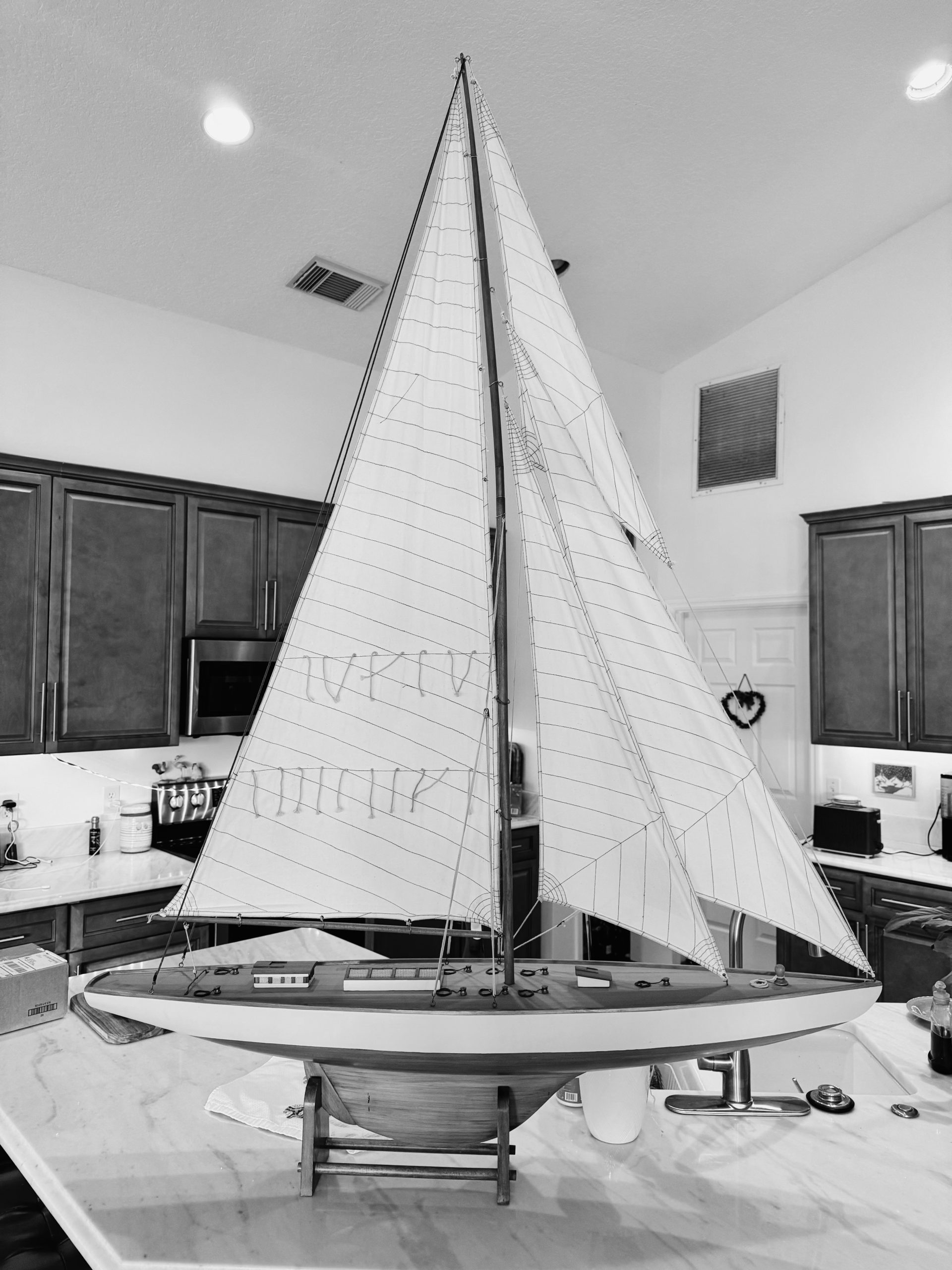
Not one that will ever touch water, but one that carries itself like it could. Four feet long. Five feet tall. A tall mast reaching toward the ceiling. White paneled sails. Long overhangs. A hull that looks fast even sitting still.
It belonged to my neighbor, Ron.
He died about ten years ago. His wife, Judy, passed last month. Last week, their daughter came to my door carrying the boat. She said her father would have wanted me to have it.
There was no ceremony. Just a quiet transfer from one set of hands to another.
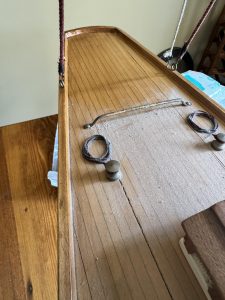 When I brought it inside, I could see time on it. Dust settled into the rigging. A soft film across the deck. Not neglect — just stillness.
I didn’t rush it.
An artist’s paintbrush for the lines and stays. A small hand vacuum to lift what years had left behind. Baby wipes along the rails. Q-tips worked gently into the seams between deck planks. A few inches at a time. A few minutes here and there. I never tried to finish it in one sitting.
You don’t muscle something like that.
You tend it.
Up close, the craftsmanship reveals itself. Individual planks laid straight and true. Companionway hatches framed carefully. The deck fitted with tiny coils of line wound neatly.
Those coils tell you something. No one rushes coils. You sit with them until they lie right.
As I worked dust out of the seams, I realized I wasn’t just cleaning a model. I was acknowledging hours. Patience. A standard.
The boat is modeled after the great America’s Cup defenders from around 1900, the era of Columbia. Long bow. Counter stern that seems to stretch beyond gravity. A tall Marconi rig climbing like a church spire. A cutter-rigged sloop, a sailor friend told me — one mast, but two headsails forward, built for balance and weather.
That felt right.
Years ago, in a casual conversation, I told Ron that in seventh-grade wood shop, I built a sailing boat for a model regatta. My mother made the sails from real canvas at our kitchen table.
I had forgotten I told him that.
He hadn’t.
Builders remember builders.
We grew up in a time when boys learned to measure and cut before they learned to swipe and scroll. When wood shop was expected. When something leaned, you straightened it. If it cracked, you fixed it.
You didn’t replace it.
Standing in my kitchen, the boat commands the room. The mast is proud. The lines are tight. And now the deck shines again.
That’s what pleases me most.
The shine was always there. It just needed attention.
 We talk about progress as if it requires discarding what came before. It doesn’t. The tools change. The materials evolve. But patience, care, and craftsmanship never go out of style.
Old skills. Old friends. Old ways of doing things.
Sometimes they come back into your life not with noise, but with quiet weight.
And sometimes, if you’re willing to work a few inches at a time, they stand again under full sail.
The deck shines again. The sails stand full. That boat didn’t land in the wrong harbor.