
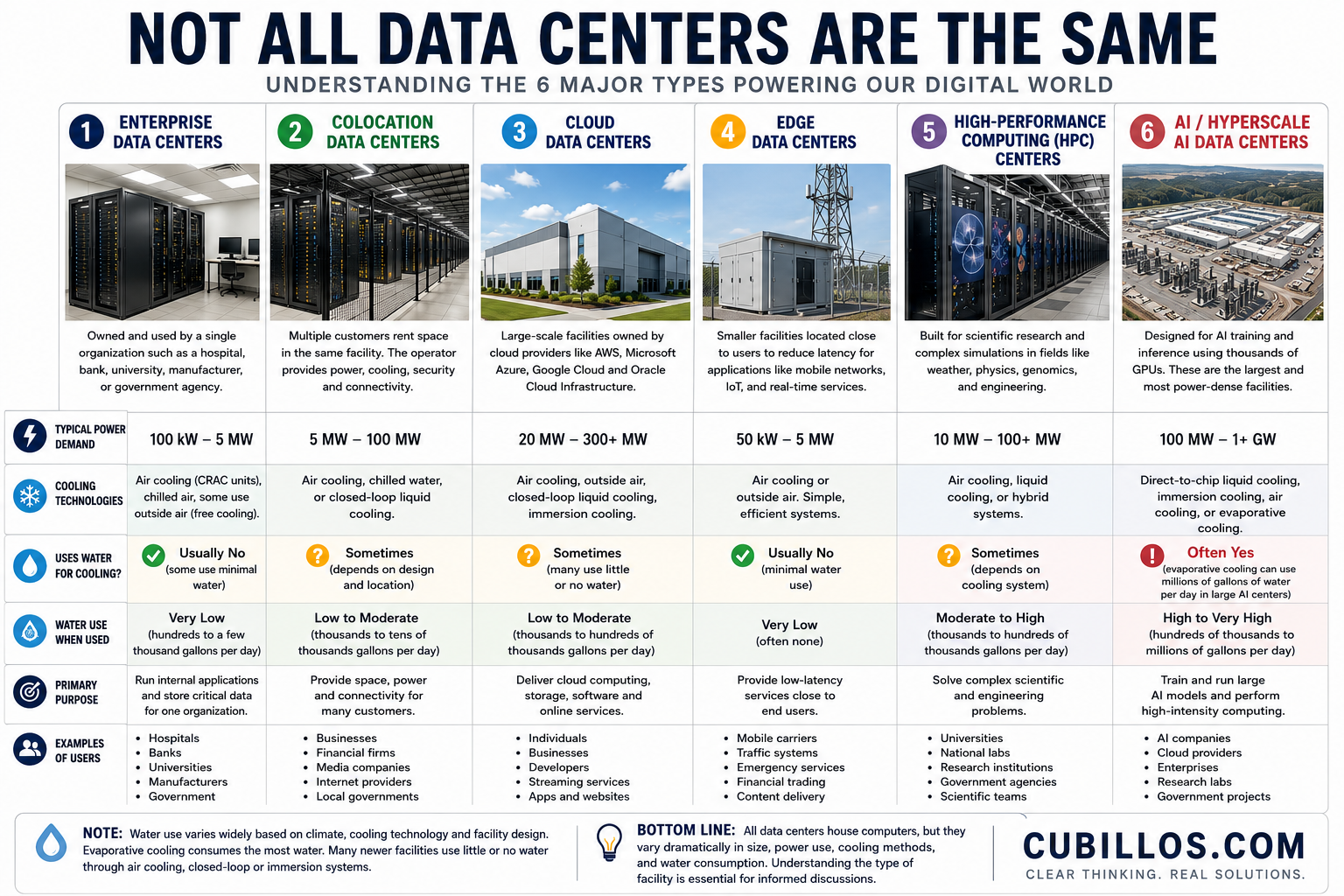
A guide to understanding the buildings powering the digital world.
Every week, I see another social media post warning that “data centers are taking over America.”
Sometimes the concern is about electricity. Sometimes it’s water. Sometimes it’s noise, land use, or artificial intelligence.
There’s just one problem.
Most of those posts never explain what kind of data center they’re talking about.
That’s like writing an article about “aircraft” without telling readers whether you’re discussing a crop duster, a Boeing 777, an F-35 fighter, or a medical helicopter. They’re all aircraft, but they serve very different purposes and have vastly different impacts.
The same is true for data centers.
The term “data center” has become a catch-all phrase that lumps together everything from a hospital’s computer room to a billion-dollar artificial intelligence campus. Once those distinctions disappear, so does any meaningful discussion.
So let’s clear up the confusion.
What is a data center?
At its simplest, a data center is a building that houses computer servers and the equipment needed to keep them running.
Those computers might store medical records.
They might run payroll for a corporation.
They might host websites.
They might stream movies.
Or they might train the next generation of artificial intelligence.
They’re all data centers—but they are not all the same.
1. Enterprise Data Centers
These are probably the most common, yet they’re rarely mentioned in the news.
An enterprise data center belongs to a single organization.
That organization might be:
- A hospital
- A bank
- A university
- A manufacturer
- An insurance company
- A government agency
If a hospital stores MRI images or electronic medical records, those servers have to live somewhere.
If a bank processes millions of transactions every day, those computers need a secure facility.
Most enterprise data centers consume anywhere from 100 kilowatts to about 5 megawatts of electricity, depending on their size.
Many rely entirely on air conditioning systems similar to those used in large office buildings and use little or no water for cooling.
2. Colocation Data Centers
Think of these as apartment buildings for computers.
Instead of one company owning the entire facility, dozens—or even hundreds—of customers rent space.
One customer might be a local government.
Another might be a regional bank.
Another could be a software company.
The data center operator provides the building, electrical power, cooling, security, and Internet connectivity.
Customers simply bring their servers.
These facilities typically use 5 to 100 megawatts of electricity.
Some use water-based cooling systems, while others rely primarily on air cooling or newer liquid-cooling technologies.
3. Cloud Data Centers
When you save photos from your phone…
When you use Microsoft 365…
When you stream a movie…
When a business runs software online…
You’re probably using a cloud data center.
These facilities belong to companies such as Amazon Web Services, Microsoft Azure, Google Cloud, and Oracle Cloud Infrastructure.
Cloud computing existed long before today’s AI boom.
Many cloud campuses use 20 to more than 300 megawatts of electricity, although some newer campuses are significantly larger.
Cooling methods vary widely. Some use outside air in colder climates. Others use closed-loop liquid cooling systems that continuously recirculate coolant rather than consuming it.
4. Edge Data Centers
Not every data center is enormous.
Edge data centers are intentionally small.
Their job is to place computing closer to people.
That reduces what’s known as “latency”—the tiny delay between requesting information and receiving it.
Edge facilities support services such as:
- Cell phone networks
- Traffic management systems
- Emergency communications
- Financial trading
- Content delivery networks
Most consume between 50 kilowatts and 5 megawatts.
Many require little or no water because conventional air cooling is sufficient.
5. High-Performance Computing Centers
Long before ChatGPT arrived, scientists were already building incredibly powerful computers.
These facilities perform massive calculations for:
- Weather forecasting
- Climate research
- Nuclear simulations
- Aerospace engineering
- Medical research
- Genomics
- Physics
High-performance computing centers typically consume 10 to more than 100 megawatts.
Some use water-assisted cooling. Others use advanced liquid cooling or air cooling, depending on the hardware.
6. AI Data Centers
This is the category making headlines.
Artificial intelligence data centers are different because they are designed around graphics processing units, or GPUs.
Instead of simply storing files or running websites, they train and operate large AI models.
Those processors generate enormous amounts of heat.
As a result, AI facilities often consume 100 megawatts to more than one gigawatt of electricity.
Many newer AI facilities are adopting direct-to-chip liquid cooling or immersion cooling, technologies that can reduce electricity use and, depending on the design, significantly reduce freshwater consumption compared with older evaporative cooling systems.
Some projects still use evaporative cooling, while others rely almost entirely on air cooling or closed-loop systems.
The important point is this:
There is no single cooling method used by every AI data center.
What is a hyperscale data center?
Another term frequently misunderstood is hyperscale.
Hyperscale doesn’t automatically mean AI.
It refers primarily to size and the ability to expand rapidly.
A hyperscale campus may support cloud computing, online storage, streaming services, enterprise customers, AI workloads—or all of the above.
Many hyperscale campuses now include AI because demand has exploded, but “hyperscale” describes the scale of the infrastructure, not the specific work being performed.
| Type | Typical Power Demand | Uses Water? | Primary Purpose |
|---|---|---|---|
| Enterprise | 100 kW–5 MW | Sometimes, often no | Hospital, bank, university, factory |
| Colocation | 5–100 MW | Depends on design | Rent space to many customers |
| Cloud | 20–300+ MW | Increasingly less, depending on cooling | Cloud computing and storage |
| Edge | 50 kW–5 MW | Usually no | Local Internet, 5G, emergency services |
| High-Performance Computing | 10–100+ MW | Often, but not always | Scientific research, weather, physics |
| AI / Hyperscale AI | 100 MW–1+ GW | Often, but many newer facilities reduce or eliminate water | AI training and inference |
Do all data centers use huge amounts of water?
No.
Some use virtually none for cooling.
Others use closed-loop systems that continuously recycle coolant.
Some use direct-to-chip liquid cooling.
Some use immersion cooling, where servers sit in a special non-conductive fluid.
Some facilities in colder climates rely heavily on outside air.
Others still use evaporative cooling, which consumes more water in exchange for reducing electricity needed for mechanical refrigeration.
The cooling method depends on the equipment, climate, economics, and design—not simply on whether it’s called a data center.
Why the confusion matters
Imagine someone says:
“There are more than 5,000 airports in the United States.”
Technically, that’s true.
But that number includes international airports, county airports, private airfields, military bases, and tiny grass landing strips.
They all count as airports.
They are not remotely comparable.
The same thing happens with data centers.
A county government’s server room counts.
A hospital computer center counts.
A university research lab counts.
A regional Internet exchange counts.
A billion-dollar AI campus drawing a gigawatt of electricity counts.
They’re all data centers.
But they are not the same.
The bottom line
As artificial intelligence expands, communities deserve honest conversations about electricity, water, land use, and environmental impacts.
But those conversations should begin with accurate definitions.
Not every data center is an AI data center.
Not every AI data center is hyperscale.
Not every hyperscale campus is devoted to AI.
And not every data center uses massive amounts of electricity or water.
If we want productive public discussions about the future of digital infrastructure, the first step is making sure we’re talking about the same thing.
Otherwise, we’re arguing about “aircraft” without knowing whether we’re looking at a crop duster or a fighter jet.