
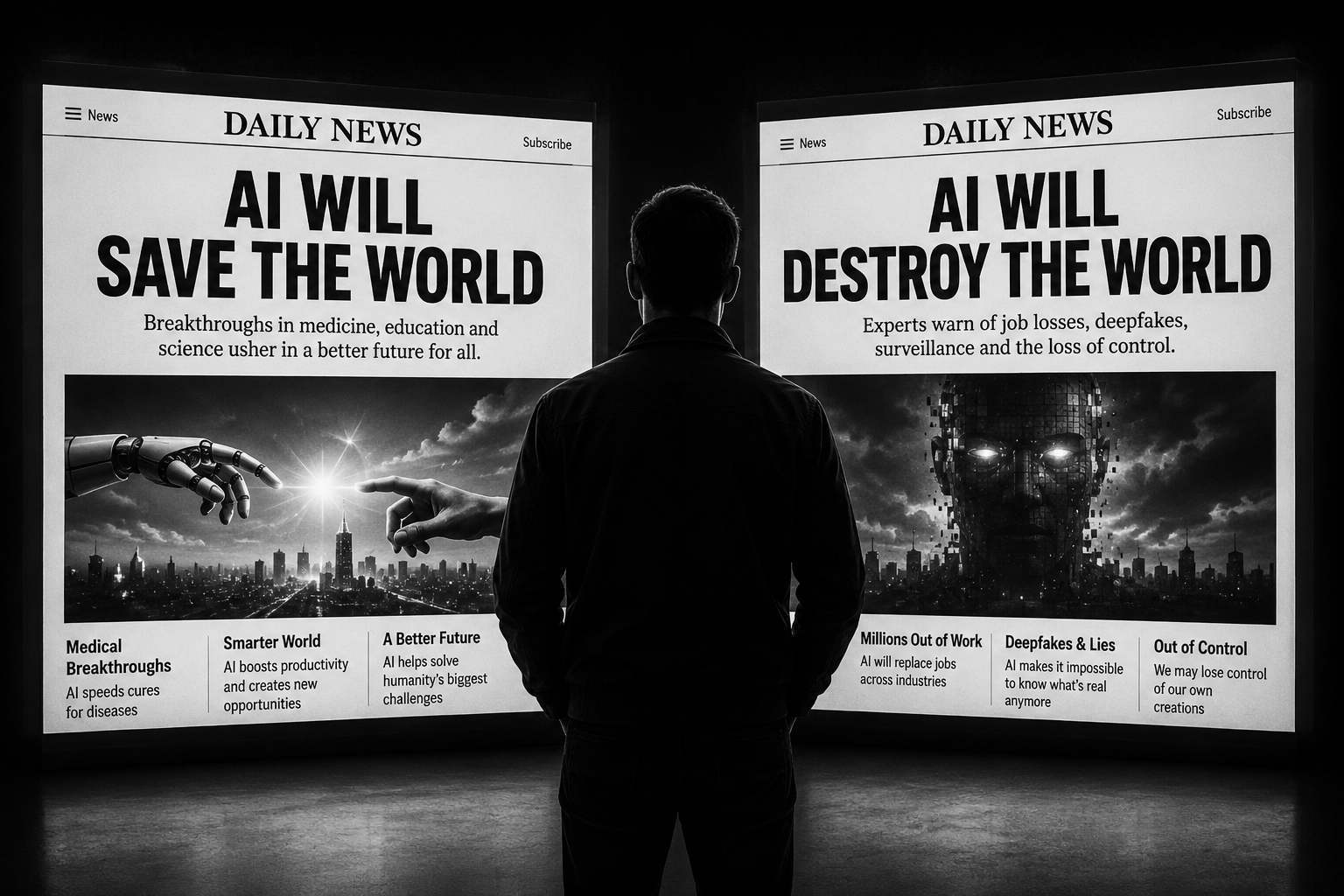
If you only read the headlines, you’d think America has decided artificial intelligence is the next great menace.
That’s not what the numbers say.
A new national survey conducted by NORC at the University of Chicago for Athena Insights found that about two-thirds of Americans are concerned about AI’s growing role in society, while fewer than one in four say they’re excited.
That sounds ominous.
Until you keep reading.
Because buried beneath those numbers is something far more interesting.
Americans aren’t saying AI is evil.
They’re saying they don’t know what’s real anymore.
That may be the most honest poll we’ve seen about artificial intelligence.
Think about the last six months.
Every day, social media delivers another AI apocalypse.
AI will steal every job.
AI will use all the nation’s water.
AI will destroy the electric grid.
AI will become sentient next Tuesday.
AI will cure cancer.
AI will replace your doctor.
AI will replace your lawyer.
AI will replace your children.
Depending on which post you click, artificial intelligence is either the Second Coming or the Fifth Horseman of the Apocalypse.
People are exhausted.
The survey reflects that.
When asked whether they’re already seeing people struggle to tell what’s real from what’s fake because of AI, 82 percent said yes—they’re seeing it now or beginning to see it.
Read that again.
Not 82 percent expecting it someday.
Eighty-two percent believe it’s already happening.
That’s remarkable.
There’s another statistic that deserves more attention than the headline.
Seventy percent of Americans said AI is coming into their lives whether they want it or not.
Only fifteen percent believe people like them have much ability to shape how much AI becomes part of daily life.
That isn’t fear.
That’s resignation.
There’s a difference.
People accepted that electricity was coming.
They accepted automobiles.
They accepted the Internet.
Now they’re accepting AI.
But acceptance isn’t the same as confidence.
One finding surprised me.
This isn’t a Republican issue.
It isn’t a Democratic issue.
Concern about AI was almost identical across party lines.
Republicans: 66 percent concerned.
Democrats: 65 percent concerned.
Independents: 65 percent concerned.
Good luck finding another issue in America where everyone agrees that closely.
Politics isn’t driving this.
Experience is.
The survey also reveals something else.
Americans don’t see AI as simply good or bad.
In the next 20 years, most respondents think AI is likely to produce major scientific and medical breakthroughs.
The same people also think AI is likely to behave in unintended ways.
They believe it may surpass humans at many tasks.
They believe it could help create weapons of mass destruction.
That isn’t a contradiction.
That’s adulthood.
Most transformative technologies have always carried promise and risk.
Electricity powers hospitals.
Electricity also powers electric chairs.
Nuclear physics gave us cancer treatments.
It also gave us Hiroshima.
The Internet gave us unlimited knowledge.
It also gave us scams, conspiracy theories, and comment sections.
Technology has never been either angel or devil.
It’s usually both.
One question in the survey particularly caught my attention because I’ve spent months writing about data centers.
Respondents weren’t simply asked about the environment.
They were specifically asked whether government is doing enough regarding AI’s environmental footprint, including from data centers. Nearly twice as many Americans said government is doing too little as said it is doing too much.
That’s important.
Notice what the survey didn’t ask.
It didn’t ask whether every claim circulating online is true.
It didn’t ask whether every proposed data center uses millions of gallons of water.
It didn’t ask whether every project will crash the power grid.
It simply asked whether people think the government is paying enough attention.
Those are two very different questions.
And confusing them is exactly how misinformation spreads.
For the past year, I’ve written columns explaining how AI data centers differ from Internet data centers.
Why some use evaporative cooling while others don’t.
Why power consumption varies enormously from one facility to another.
Why counting data centers tells you almost nothing unless you know what kind you’re counting.
Not because I work for the industry.
Because facts still matter.
Especially now.
Here’s what I think this survey really tells us.
Americans aren’t asking someone to stop AI.
They’re asking someone to explain it honestly.
Without hype.
Without marketing.
Without fearmongering.
Without pretending every new chip will either save civilization or end it.
That’s a much harder job than writing viral Facebook posts.
It’s also journalism’s job.
If there’s one lesson in this poll, it’s this: People don’t just want better artificial intelligence. They want better information about artificial intelligence.
Those are two very different things.
And right now, the second one may be in shorter supply than the first.