
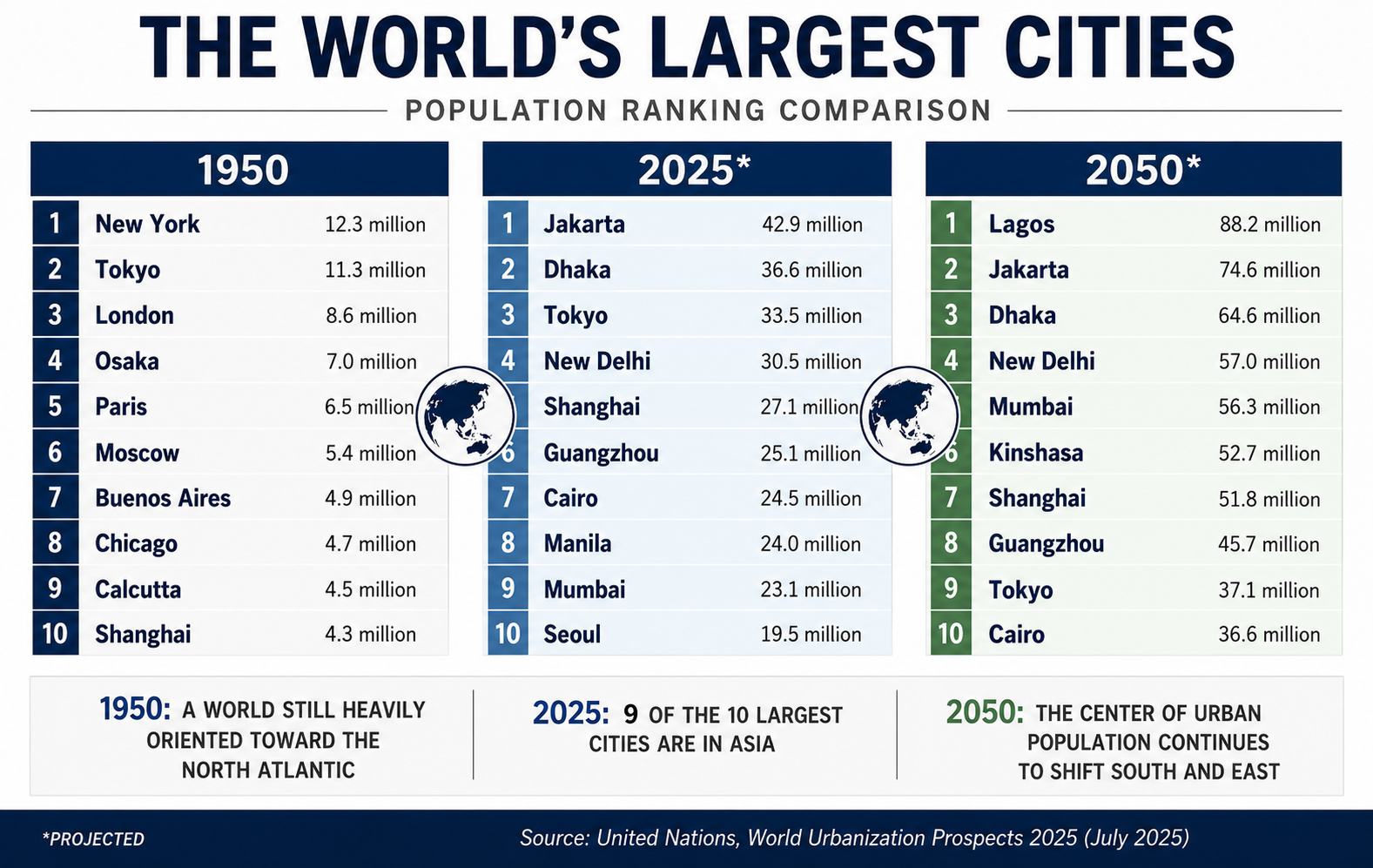
Every once in a while, a chart tells you something Washington has spent several trillion dollars trying not to notice.
I was looking at one the other day showing the world’s largest cities from 1950 into the future.
Back in 1950, the list looked reassuringly familiar to an American of a certain age. New York was enormous. London mattered. Paris mattered. Europe was still the neighborhood where the big kids lived.
Look at the list today.
Jakarta. Dhaka. Tokyo. New Delhi. Shanghai. Guangzhou. Manila. Mumbai.
Nine of the world’s 10 largest cities are now in Asia.
That got me thinking about something Gen. Anthony Zinni told me more than a quarter-century ago.
Zinni was no armchair strategist. At the time, he commanded U.S. Central Command, which meant he had responsibility for the part of the world that has been keeping American presidents awake at night ever since Jimmy Carter was worrying about the Persian Gulf.
I asked Zinni about Europe and Asia.
His answer was simple.
“Our hearts are in Europe. But our future is in the Pacific.”
Well, General, the future showed up.
We just weren’t exactly waiting at the station when it arrived.
The Pivot
After Sept. 11, the United States spent the better part of two decades looking in almost precisely the opposite direction.
There were good reasons.
There usually are.
Afghanistan. Iraq. Al Qaeda. ISIS. Syria. Iran.
One crisis followed another, and each required troops, ships, airplanes, intelligence assets and money.
Especially money.
Washington has always possessed a remarkable ability to discover that the answer to the last expensive military commitment is another expensive military commitment.
Meanwhile, Asia kept growing.
China became the world’s manufacturing floor. India grew. Southeast Asia boomed. Ports expanded. Cities exploded in size.
Eventually somebody in Washington looked up.
During the Obama administration, the United States announced what became known as the “Pivot to the Pacific.”
The official term was “rebalance,” which is the sort of word Washington prefers because it sounds less alarming and requires at least three PowerPoint slides to explain.
But the idea was straightforward.
America had spent too much attention and military power on the Middle East and not enough on Asia.
Obama’s national security adviser actually said as much in 2013. The United States had become “over-weighted” in places including the Middle East and “underweighted” in Asia.
Hard to argue with that.
The important part is that the Pivot wasn’t supposed to consist solely of moving Navy ships around the Pacific.
There was an economic component.
It was called the Trans-Pacific Partnership.
Then We Left Our Own Party
TPP included the United States and 11 other Pacific nations.
There were plenty of reasons to argue about it.
Labor didn’t like parts of it. Manufacturing interests worried about jobs. Globalization had already done a pretty fair job of convincing working-class Americans that whenever economists announced something would be good for everybody, it was time to hide the silverware.
Those arguments were real.
But TPP wasn’t just about tariffs.
The Obama administration called it the centerpiece of America’s economic rebalance toward Asia.
The idea was that if Asia was becoming the center of the world economy, the United States might want to be sitting at the table when the rules were written.
Then Donald Trump withdrew the United States from TPP in 2017.
The other countries did something terribly inconsiderate.
They went ahead without us.
Eleven nations created the Comprehensive and Progressive Agreement for Trans-Pacific Partnership.
Even Britain eventually joined.
And then China applied.
There is something almost exquisitely Washington about helping build a club designed to keep America economically engaged in Asia, keeping China at bay, quitting the club, and then watching China knock on the door.
You couldn’t make it up.
The Map Doesn’t Vote
Which brings me back to that population chart.
Politicians can repeal laws.
Presidents can reverse policies.
Trade agreements can be signed and unsigned.
Demography is considerably less impressed with executive orders.
The world’s population has been shifting.
So has its economic weight.
Asia now contains most of the world’s megacities. India has surpassed China as the world’s most populous country. Southeast Asia contains hundreds of millions of people and some of the fastest-growing economies on Earth.
Africa is coming next.
And between those population centers run some exceedingly important stretches of water.
The Taiwan Strait.
The South China Sea.
The Strait of Malacca.
The Indian Ocean.
The Strait of Hormuz.
The Bab el-Mandeb.
The Suez Canal.
If you buy gasoline, electronics, clothing, automobiles, or almost anything else produced by the modern global economy, odds are pretty good that something you depend upon has passed through one of them.
The Pentagon knows this.
China certainly knows it.
The difficulty is that knowing something and doing something about it are two entirely different departments of the federal government.
There Are Only So Many Ships
American strategy has identified the Indo-Pacific as critically important.
Fine.
But ships remain stubbornly physical objects.
An aircraft carrier cannot be in the western Pacific and the Middle East simultaneously, no matter how persuasive the PowerPoint presentation at the Pentagon.
Neither can a destroyer.
Neither can an attack submarine.
Neither can the oiler needed to keep those ships fueled.
And sailors, despite repeated Pentagon experiments to the contrary, still require sleep.
Every time another crisis erupts, somebody has to answer the phone.
For much of the past quarter-century, that phone has been ringing from the Middle East.
One can argue the merits of every individual commitment. That’s not the point.
The point is accumulation.
Eventually strategy runs into arithmetic.
If China is America’s principal long-term military competitor, and the Pacific is the theater where that competition is most likely to matter, then forces committed elsewhere are forces that aren’t available there.
This isn’t isolationism.
It’s counting.
Zinni Saw It Coming
What strikes me now is when Zinni told me what he did.
He wasn’t commanding Pacific Command.
He was commanding CENTCOM.
The man responsible for the Middle East was telling me America’s future wasn’t there.
“Our hearts are in Europe. But our future is in the Pacific.”
Then came 9/11.
Meanwhile, the future he pointed toward kept arriving.
China built ships.
Asia built cities.
India grew.
Trade expanded.
The Pacific and Indian oceans became more important, not less.
Obama tried to pivot.
Trump abandoned the economic centerpiece of that pivot.
Presidents after them continued talking about the importance of the Indo-Pacific while discovering, as presidents invariably do, that the rest of the world declines to cooperate with American strategic planning.
And now we find ourselves in an interesting position.
The United States has spent almost 30 years recognizing where the world’s center of gravity is moving while repeatedly finding reasons to look somewhere else.
Maybe that is unavoidable.
A superpower doesn’t get to choose every crisis.
But it does eventually have to choose priorities.
Because there aren’t enough ships, airplanes, troops or dollars to make everywhere the priority.
That’s what that population chart reminded me of.
Washington’s Pivot to Asia may have stalled.
The world’s didn’t.
And somewhere in the back of my mind, I can still hear Gen. Anthony Zinni telling me where the future was headed.
Turns out the general could read a map.