
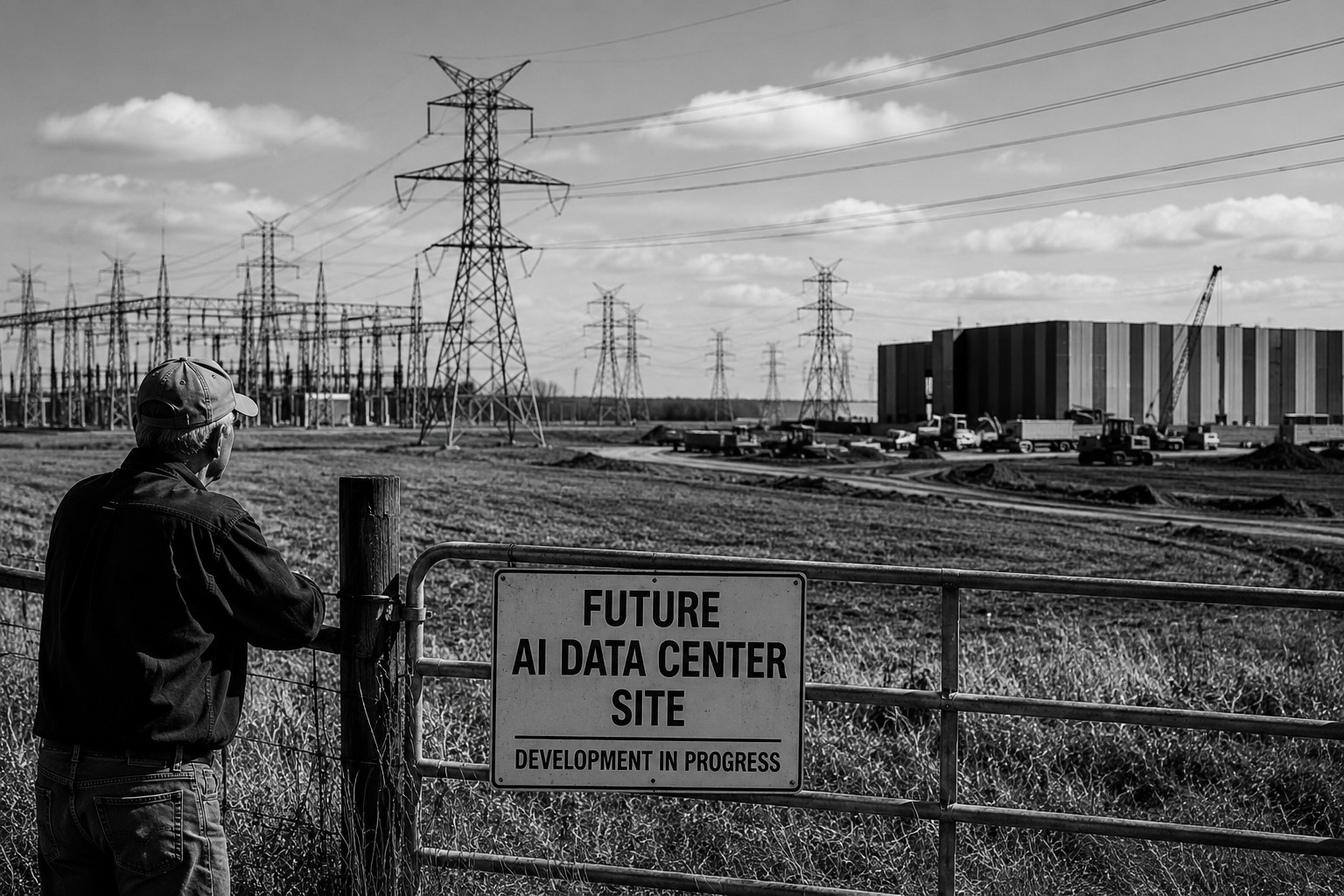
Most people think a data center gets built like this:
Google buys some land, pours concrete, installs servers, and starts running AI.
Simple.
Except that’s usually not what happens at all.
Modern AI data centers are more like giant industrial ecosystems involving layers of:
- land deals
- infrastructure financing
- utilities
- developers
- construction firms
- power companies
- investors
- and finally, the tech tenant itself
And because most of that happens quietly behind the scenes, local communities often only see the final logo slapped on the building long after the real decisions were made.
So here’s what the process usually looks like in the real world.
Step 1: The Land Seller
It often starts with a farmer, ranch owner, timber company, or industrial landholder.
For decades, the property may have been worth ordinary agricultural or rural commercial prices.
Then suddenly somebody realizes the land sits near:
- a major transmission corridor
- available electrical capacity
- fiber infrastructure
- natural gas lines
- rail or highway access
- or a large substation
At that moment, the land stops being “farmland.”
It becomes strategic infrastructure real estate.
That’s why some rural property owners are suddenly getting offers that seem almost unbelievable.
The dirt itself isn’t the goldmine.
The electricity nearby is.
Step 2: The Land Assembly Company
Next comes a developer or investment group, like Digital Bridge, Blackstone or Equinix.
This is usually NOT the final AI company people recognize.
Instead, it may be:
- an industrial developer
- infrastructure investment fund
- private equity group
- real estate investment trust
- or specialized data center developer
Their job is to:
- assemble parcels
- negotiate purchases
- secure zoning
- obtain permits
- conduct environmental reviews
- negotiate tax incentives
- and prepare the site for industrial use
This layer may operate through LLCs that most residents have never heard of.
That’s one reason communities often get confused during hearings: The familiar tech company name may not appear anywhere yet.
Step 3: The Utility and Transmission Layer
Now the really expensive part begins.
Electric utilities, transmission operators, and infrastructure engineers from companies like PJM Interconnection or ERCOT start analyzing:
- available megawatts
- substation capacity
- transmission upgrades
- backup power requirements
- cooling infrastructure
- water availability
And this is where the AI boom is now colliding with reality.
In many major markets, utilities are telling developers:
“We can’t provide enough power for several years.”
That’s why “power availability” has now become more important than cheap land.
A field with weak electrical infrastructure is nearly worthless to AI.
A field near a massive substation becomes strategic territory.
Step 4: The Power Developers
Increasingly, separate companies are now being brought in just to solve the electricity problem.
This can involve:
- natural gas plants
- solar farms
- battery storage systems
- private microgrids
- backup generation
- dedicated substations
Some AI campuses are effectively becoming miniature utility systems unto themselves.
That’s where phrases like:
- “behind-the-meter power”
- “bring your own power”
- and “private generation”
start appearing.
Translation:
the AI industry is increasingly building its own energy infrastructure because the public grid cannot expand fast enough.
Step 5: The Construction and Shell Operator
Another company, like NTT Global or CRG, may then build and own the actual physical structure.
This includes:
- cooling systems
- industrial chillers
- server halls
- networking systems
- security infrastructure
- backup generators
- water systems
At this stage, the project starts looking less like a tech startup and more like:
- an oil refinery
- an industrial plant
- or a logistics megahub
Because physically, that’s much closer to what modern AI infrastructure has become.
Step 6: The Final Tenant
Only near the end does the recognizable company often arrive:
- Microsoft
- Amazon
- Meta
- AI startups
- cloud providers
- defense contractors
Sometimes they lease space.
Sometimes they partially own it.
Sometimes they self-build.
But often the company name the public sees is simply the final tenant sitting on top of an enormous industrial and financial structure.
Why this matters
This layered process is one reason many communities feel confused or distrustful.
At public hearings, residents may hear:
- one company name on permits
- another on power agreements
- another on construction filings
- another on tax negotiations
Meanwhile the actual AI tenant may remain undisclosed until late in the process.
To ordinary people, it can feel opaque and almost intentionally complicated.
And honestly, modern infrastructure finance often is.
But understanding the full chain matters because it reveals something bigger:
The AI revolution is not just software.
It’s becoming one of the largest industrial infrastructure buildouts in modern history.
The “cloud” now involves:
- land speculation
- utility expansion
- water negotiations
- energy development
- private investment
- industrial construction
- and geopolitical competition
Which means that when people see a giant data center rise outside town, they’re not just looking at a tech building.
They’re looking at an entire industrial ecosystem that started moving long before the first concrete was poured.