
Updated Jan. 18, 2026
In 2010, I wrote a book called Military Reporters: Stylebook and Reference Guide. It’s out of print now, which I once took as progress. I figured the chapters on protective gear — helmets, eye protection, body armor — would stay where they belonged: war zones, disaster areas, places where governments had already lost their grip.
Turns out that was wishful thinking.
Back then, the checklist was for reporters heading overseas. Embeds. Collapsing states. Protests where the lines were already gone. I never imagined that in 2026 I’d be dusting off the same advice for journalists covering federal law enforcement actions and protests in American cities.
I still have the gear. Helmet. Safety glasses. Chest protection. I kept it because you don’t throw away experience. What I didn’t expect was to recommend it to colleagues reporting at home, just to make sure they got out in one piece.
And it’s not theoretical anymore.
According to Reporters Without Borders, at least 27 journalists were attacked by law enforcement while covering protests between June 6 and June 8. That’s not a civil war. That’s a weekend. In the United States.
Add to that the new reality, the head of Homeland Security, Kristi Noem, said that American citizens may be asked to prove their citizenship. I don’t argue hypotheticals anymore. I carry my passport when I leave the house. Not to cross a border — just to do my job in public. Fifteen years ago, that sentence would’ve sounded like satire.
The danger now doesn’t come with labels. It comes from crowds that see cameras as targets and from authorities who see cameras as obstacles. It comes from confusion, compression, and orders that seem to change mid-sentence. When that happens, press credentials don’t always count for much, and explanations don’t travel faster than batons.
Wearing protective gear isn’t a political statement. Carrying documentation isn’t an admission of guilt. It’s the same calculation reporters have always made: assess the risk, adapt, and don’t kid yourself about the environment you’re walking into.
In that 2010 book, I quoted war correspondent Dickey Chapelle, who put it better than anyone: “The first rule for a war correspondent is, you must live to get out and tell the story.” I never imagined that line would read like domestic advice.
The guides that follow — from the National Press Club and the Committee to Protect Journalists, and my list below — exist because people before us learned the hard way. I learned similar lessons covering the military: protect your eyes and head, plan your exits, carry what you need to establish who you are, and never let pride convince you to stay five minutes too long.
It’s disappointing to admit this is where we are. But pretending otherwise doesn’t make it safer.
No story is worth permanent injury. No photograph is worth losing an eye. And no democracy is strengthened by journalists bleeding in the street while doing their jobs.
Pack accordingly. Read the guides. Do the work.
And make sure you live to tell the story.
Field Gear, 2026
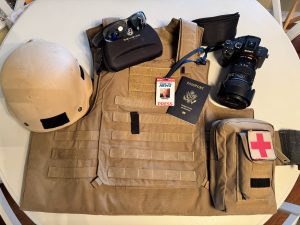 I never thought I’d be updating this list for domestic reporting. But here we are.