
If you’d wandered into the Marietta, Ga., planning meeting without knowing the agenda, you might have thought someone was proposing to build the Death Star.
People spoke of “the data center” the way previous generations whispered about nuclear plants.
There were worries about power.
Questions about neighborhoods.
Concerns about what it all meant.
Fair enough.
Communities should ask hard questions whenever a significant project is proposed.
But somewhere between the planning documents and social media, something happened.
People stopped talking about this data center and started talking about every data center.
In today’s America, the words “data center” seem to trigger a mental image of a billion-dollar AI campus stretching to the horizon, sucking enough electricity to light half a state while armies of robots train the next artificial intelligence to replace humanity.
That’s quite a picture.
There’s only one problem.
It wasn’t what Marietta was considering.
The proposal wasn’t for hundreds of acres.
It wasn’t for dozens of new buildings.
It wasn’t for one of those hyperscale AI campuses you’ve been reading about in Texas, Utah, Virginia, or Arizona.
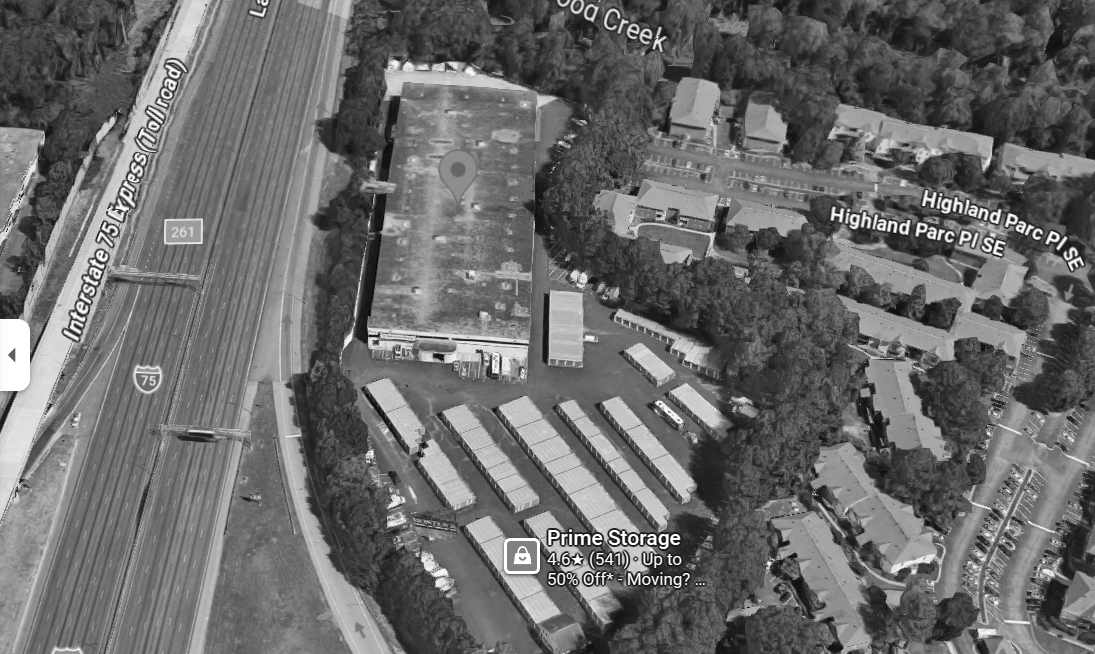
It was a proposal to convert part of an existing commercial building—a Prime Storage facility near Interstate 75—into a low-latency data center.
The building is already there.
No sprawling new campus.
No forests being cleared.
No miles of server buildings rising from farmland.
Just part of an existing commercial structure being converted into computing space.
Now before anyone accuses me of carrying water for the industry, let’s establish something.
Neighbors have every right to ask questions.
How many backup generators?
How loud will they be?
How often are they tested?
Will traffic increase during construction?
How much electricity will the facility use?
Will nearby property owners be affected?
Those are exactly the questions citizens should ask.
But those questions should be answered in context.
The proposed site isn’t surrounded by quiet farmland or a secluded subdivision. It sits in an established commercial corridor immediately adjacent to Interstate 75, one of metro Atlanta’s busiest highways. Nearby apartment residents already live with the constant sound of freeway traffic, day and night.
That doesn’t mean additional noise is irrelevant.
It means the important question isn’t whether the project will make noise. The important question is how much additional noise it would contribute beyond the environment that already exists.
That’s something engineers can measure, planners can evaluate, and citizens can debate using facts instead of assumptions.
What exactly is a low-latency data center?
The phrase sounds like something engineers invented so nobody else would understand it.
In reality, it’s surprisingly simple.
Latency means delay.
That’s it.
It’s the time between when you ask a computer to do something and when it responds.
You’ve experienced latency every time you’ve clicked on a website.
If the page appears immediately, that’s low latency.
If you stare at a spinning wheel wondering whether your internet has died, that’s higher latency.
Distance matters.
Imagine you’re sitting in Atlanta.
If your computer sends a request to nearby Marietta, the response comes back quickly.
If that same request has to travel across several states—or across an ocean—it takes longer.
Light moves incredibly fast through fiber-optic cable.
It just doesn’t move infinitely fast.
For checking baseball scores, those extra milliseconds probably don’t matter.
For streaming a movie, you may never notice.
But imagine someone arrives at an Atlanta emergency room showing signs of a stroke.
Doctors perform a CT scan or MRI.
Specialized software—or increasingly, artificial intelligence—helps analyze those images for signs of bleeding or a blocked artery.
If the computing resources are nearby, those images can be processed and returned more quickly than if they had to travel hundreds or thousands of miles to another data center.
We’re not talking about minutes.
We’re talking about milliseconds.
But emergency medicine, financial trading, 911 systems, factory automation, traffic management, video conferencing, and many AI applications all live in a world where milliseconds matter.
That’s why low-latency—or edge—data centers exist.
They aren’t built because companies enjoy collecting warehouses.
They’re built because distance still matters.
Here’s another fact that tends to disappear once people hear the words “data center.”
The Marietta proposal is expected to use about 12 megawatts of electricity initially, with room to expand to 18 megawatts.
Now, twelve megawatts sounds enormous until you compare it with what else is being built.
A typical edge or enterprise data center often falls in the 5- to 20-megawatt range.
Large regional facilities may use 20 to 50 megawatts.
A hyperscale campus—the kind making national headlines—may require 100 to more than 300 megawatts.
Some of the AI campuses now being planned around the country are measured in 500 megawatts, 750 megawatts, even more than one gigawatt.
Compared to those projects, the Marietta proposal would use roughly one-thirtieth to one-eightieth as much electricity.
That’s rather like confusing your neighborhood grocery store with a Costco distribution center.
They’re both places where things are stored.
Nobody mistakes one for the other.
Thousands of facilities like the one proposed in Marietta already operate quietly across America.
Many occupy office buildings.
Others are tucked into warehouses.
Some share space with telecommunications companies.
Some have been serving hospitals, banks, governments, internet providers, and businesses for years.
Most people drive past them every day without giving them a second thought.
That’s because they don’t look like the hyperscale AI campuses dominating the news.
Does that mean every proposal deserves approval?
Of course not.
Communities should demand facts.
Developers should answer difficult questions.
Planning commissioners should insist on transparency.
That’s how local government is supposed to work.
But citizens also deserve something else.
Perspective.
Not every airport is Hartsfield-Jackson.
Not every hospital is the Mayo Clinic.
Not every military base is the Pentagon.
And not every data center is a hyperscale AI campus.
Which brings us back to that planning meeting in Marietta.
The neighbors still have every right to decide whether this project belongs in their community.
That’s their job.
But they’ll make a far better decision if they’re debating the building that’s actually on the agenda instead of the imaginary one that’s been living rent-free in everyone’s imagination.
Good public policy begins with good information.
The debate shouldn’t begin with fear.
It should begin with understanding exactly what’s being built.
Because once we start treating every data center like the biggest one in America, we’ve stopped having a discussion.
We’ve started telling ourselves ghost stories.
UPDATE JULY 3, 2026: The Marietta Planning Commission voted 4–3 July 1 to recommend approval of a proposal to convert part of an existing storage facility off Delk Road into a low-latency data center, despite objections from some nearby residents.