
There’s an old saying that when the engineers start worrying about the bridge, it’s probably time for everyone else to stop arguing about the paint color.
That may be where we are with artificial intelligence.
For the past few years, the AI conversation has split into two camps. One side says it’s the greatest invention since electricity. The other says it’s the beginning of the end of civilization. Both sides have become so loud they’ve nearly drowned out everyone standing in the middle asking a simpler question:
“What happens to the people?”
Now comes an unusual answer.
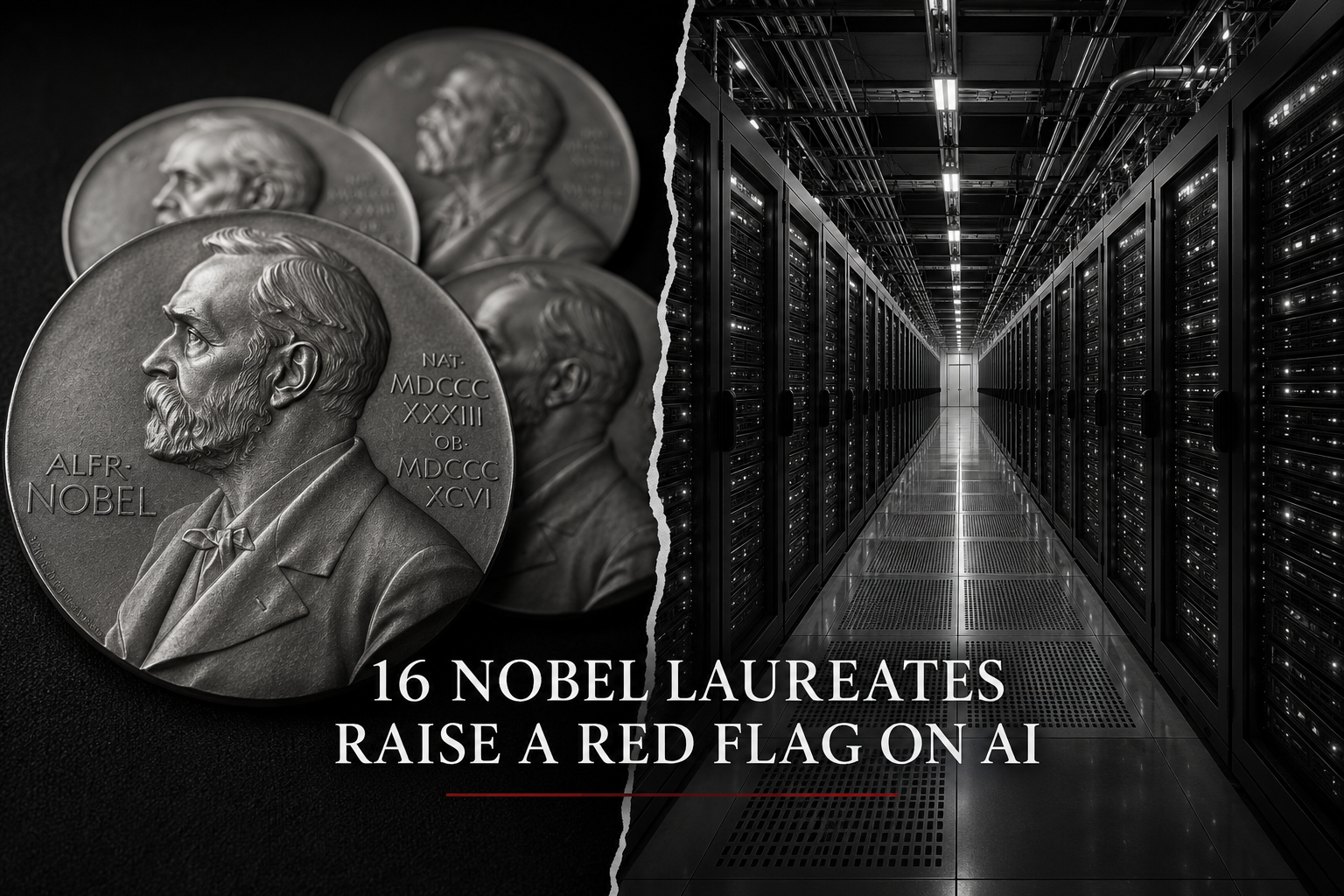
Nearly 200 economists, technology leaders and researchers—including 16 Nobel Prize winners—have signed a public statement called We Must Act Now. This wasn’t written by anti-technology activists or politicians looking for headlines. Among the signers are economists connected to OpenAI and Anthropic, two of the companies helping build the very AI systems transforming the economy.
Their warning isn’t about killer robots.
It isn’t about machines becoming self-aware.
It’s about paychecks.
The statement says artificial intelligence could transform the economy on a scale larger than the Industrial Revolution, but compressed into roughly a decade instead of generations. That kind of speed, they argue, could bring enormous prosperity while also creating widespread job displacement if governments, businesses and researchers don’t prepare for it.
Notice what they did not say.
They didn’t call for banning AI.
They didn’t demand a pause in development.
They didn’t suggest smashing data centers with pitchforks and torches.
Instead, they asked for something remarkably old-fashioned: planning before the disruption instead of after it.
That’s refreshing.
We’ve become accustomed to treating technology like weather. It arrives, everyone shrugs, and then we spend the next decade cleaning up consequences nobody supposedly could have predicted.
Except, in this case, people are predicting them.
Not everyone agrees with the dire outlook. Some economists argue AI will follow the same path as previous technological revolutions. Agriculture mechanized. Manufacturing automated. Computers replaced countless clerical jobs. Yet over time, new industries emerged and employment adapted.
That’s a fair point.
History is filled with predictions that technology would permanently eliminate work. History is also filled with people finding entirely new kinds of work that nobody imagined beforehand.
But history also contains another lesson.
Transitions hurt.
Ask the textile workers of the Industrial Revolution.
Ask the steel towns that emptied in the late twentieth century.
Ask the travel agents, film processors, newspaper compositors or video rental clerks.
Eventually, economies adjusted.
Eventually.
The problem is that “eventually” can be a very long time when it’s your mortgage payment due next month.
Meanwhile, companies aren’t waiting for economists to settle the debate.
Oracle. Meta. Cisco. Cloudflare. Coinbase.
Those are among the companies that have openly linked at least some workforce reductions to artificial intelligence. Independent layoff tracker Founder Reports estimates that more than 100,000 U.S. job cuts during the first half of 2026 have been attributed to AI, though the exact role AI played varies from company to company and is difficult to measure precisely.
That doesn’t prove AI is replacing everyone.
It does prove the transition has already begun.
Here’s the part I find most interesting.
For years, anyone who questioned AI’s economic impact risked being labeled anti-progress. Today, many of the warnings are coming from people inside the AI community itself.
That doesn’t mean they’re right.
It means they’re paying attention.
Artificial intelligence may ultimately create extraordinary prosperity. It may become as indispensable as electricity or the internet. It may generate entirely new careers that today’s students can’t even imagine.
I hope it does.
But hope isn’t a strategy.
The petition’s authors aren’t asking society to fear artificial intelligence. They’re asking society to think about it before the consequences arrive instead of after they’re impossible to ignore.
That isn’t alarmism.
It’s what responsible adults are supposed to do when they see a storm gathering on the horizon.