
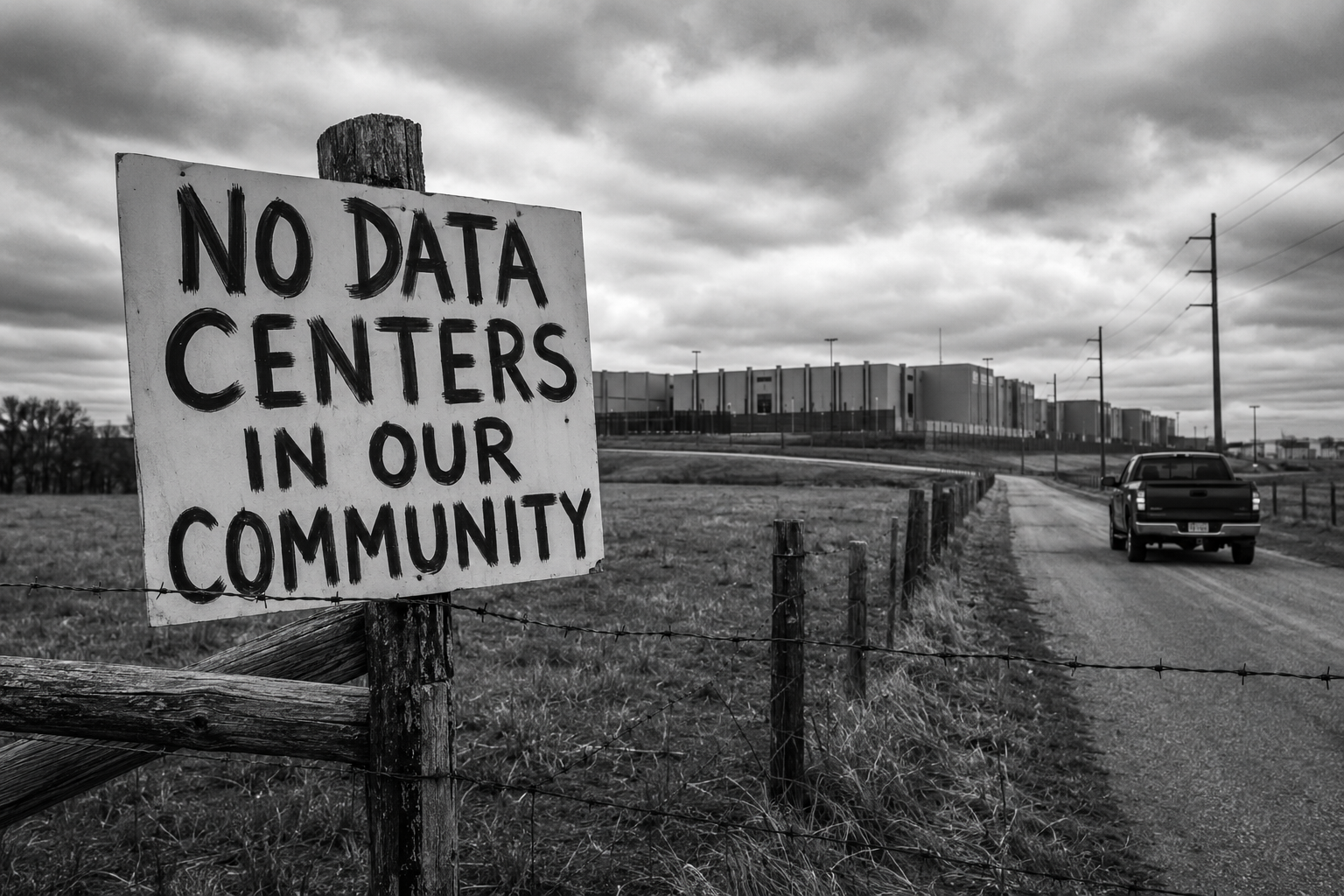
There was a time when zoning meetings were about whether somebody wanted to put up a Dollar General next to a church softball field. Maybe a new subdivision. Maybe a truck stop off the interstate. Folks would grumble, somebody would wave a stack of papers, and eventually everybody went home.
Now? It’s data centers.
And brother, the temperature is rising.
Across America — from the pine woods of Maine to the dry scrub of Arizona to the suburbs outside Detroit — regular people are showing up at town halls to fight what they see as the industrialization of their communities in the name of artificial intelligence. These aren’t little server closets humming behind office parks anymore. These are giant concrete-and-metal computer warehouses that suck down electricity, gulp water, and drone day and night like a squadron of diesel generators parked behind your house.
The backlash is bipartisan, local, emotional, and getting louder by the month.
People are getting hauled out of meetings for talking too long. County officials are reportedly receiving threats. Facebook groups are turning into digital war rooms. And for the first time in decades, ordinary Americans are learning words like “load balancing,” “closed-loop cooling,” and “substation capacity” because a billion-dollar AI facility might be headed for the cow pasture down the road.
And nowhere is that collision happening harder than in Texas.
In Hill County, south of Fort Worth, county commissioners approved a one-year moratorium on new data center construction in unincorporated areas after residents raised concerns about water, electricity demand, noise, and what exactly was being built in their backyard. Locals say they’ve heard through word of mouth about farmers quietly selling land to developers while giant projects move ahead faster than county governments can understand them.
That one vote may end up being a turning point.
Because Texas was supposed to be the easy place to build.
Cheap land. Open space. Business-friendly politics. Massive transmission corridors. Yet even there, resistance is spreading from county to county as people begin realizing the “cloud” isn’t floating in the sky. It’s a very real industrial footprint made of steel, concrete, cooling systems, substations, diesel backup generators, and transmission lines stretching across ranchland.
In Ypsilanti, the University of Michigan partnered with America’s nuclear weapons scientists on a proposed $1.2 billion data center project. Local officials responded this month by pausing water service approvals for new data centers for six months. The university called the move “unlawfully discriminatory.”
That’s where we are now in America. We’ve reached the point where water itself has become political infrastructure.
Down in Colleton County, SC, officials approved a six-month moratorium on new data centers after residents erupted over plans for an 800-acre project near the ACE Basin estuary — one of the largest undeveloped wetland ecosystems left on the East Coast. The proposed build would reportedly impact roughly 200 acres of wetlands.
And here’s the part that ought to make everybody pause: this wasn’t even the developer’s first try.
The same project had already crashed and burned in Georgia after local opposition got too strong.
That pattern keeps repeating.
In Washington Township, NJ, logistics giant Prologis was eyeing a 312-acre data center project. Residents packed planning meetings. They organized online. They pushed back hard enough that the developer withdrew the application entirely.
Township Clerk Audrey Brown summed it up bluntly afterward: there would now be a temporary moratorium while the community figured out what legal guardrails it needed before somebody tried again.
Because there’s always another proposal coming.
Over in Caledonia, Wisc., Microsoft abandoned a planned 244-acre project after roughly 2,000 residents signed petitions against rezoning farmland for the facility. Local officials complained that residents were never allowed meaningful access to the company early in the process.
And that complaint — more than almost anything else — keeps surfacing everywhere these fights erupt.
People feel like these projects arrive fully formed. The land deals are already signed. The utility studies are already done. The transmission lines already mapped. Then somebody walks into a county meeting with a polished slideshow and says, essentially: “Good news. The future has arrived.”
Except not everybody asked for the future.
Now, states are stepping in.
Georgia lawmakers are considering legislation that would halt local permitting for new data centers until 2027. Maryland lawmakers are debating whether to pause projects until the state figures out how to supply enough power. Oklahoma is considering slowing development while studying water and utility impacts. Even Virginia — basically the Saudi Arabia of American data centers — is debating limits tied to electrical infrastructure.
That’s not some fringe movement anymore.
That’s the political map changing in real time.
Of course, the industry still wins plenty of fights.
In Maine, lawmakers nearly approved what would have been the nation’s first statewide moratorium on new data centers. Governor Janet Mills vetoed it, saying she agreed with the concerns in principle but wanted exceptions for projects already underway.
That sentence right there tells the whole story of modern America.
Everybody wants the economic benefits. Nobody wants the substation behind their neighborhood.
And here’s the thing the tech crowd still doesn’t fully understand: this fight is no longer just about buildings.
It’s about trust.
People watched factories leave town for thirty years. They watched malls die. They watched local newspapers collapse. They watched their communities get hollowed out while Silicon Valley became one of the richest concentrations of wealth in human history.
Now those same communities are being told they should sacrifice water, power capacity, quiet nights, farmland, wetlands, and local control so artificial intelligence can generate anime selfies, automate call centers, and train chatbots.
You don’t have to be left-wing or right-wing to understand why that sales pitch is getting a rough reception.