
Every war produces rumors.
The digital war over data centers is no different.
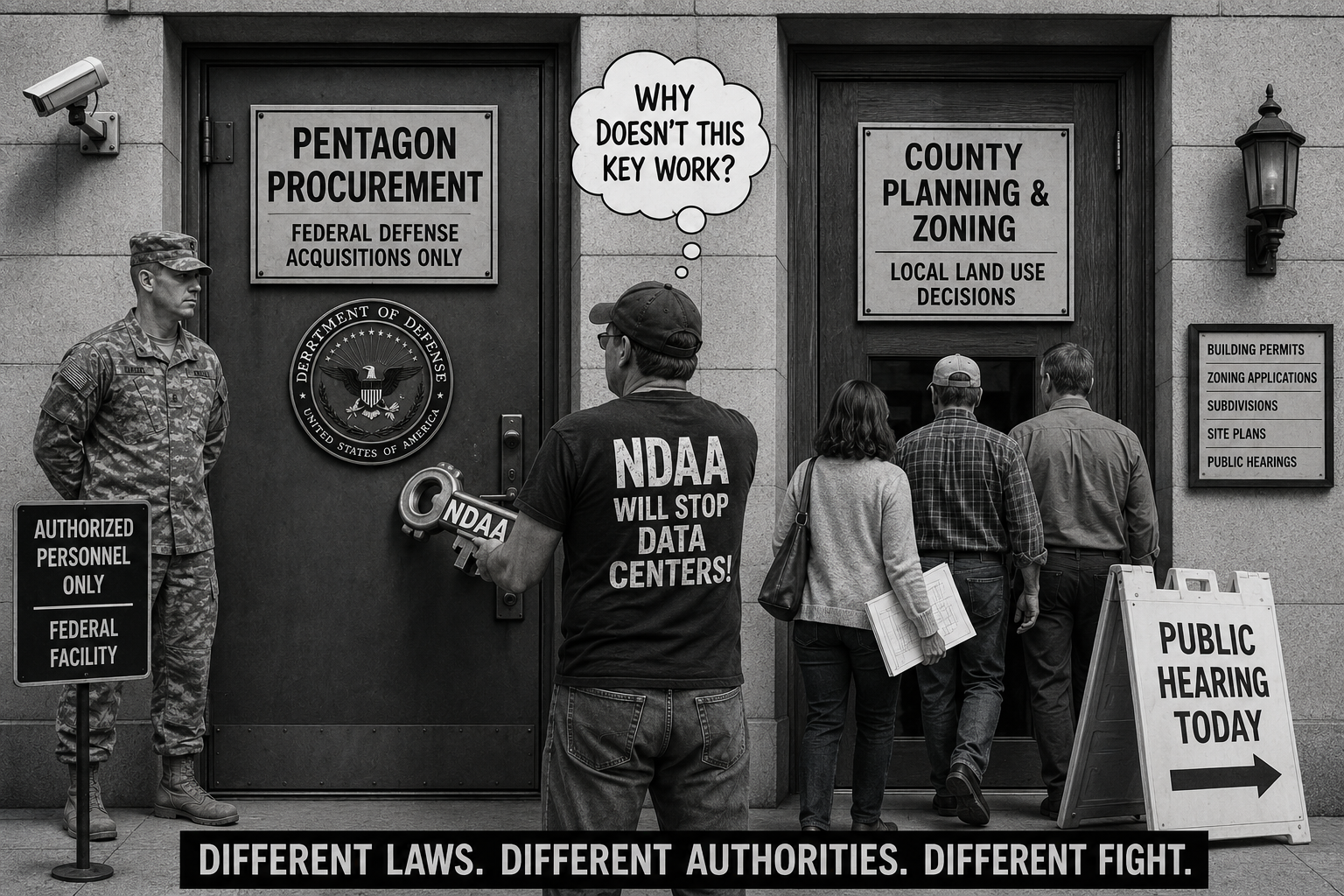
Lately, I’ve been seeing social media posts claiming the National Defense Authorization Act—the NDAA—is some kind of silver bullet that can stop data centers because they supposedly contain Chinese-made components.
The theory sounds good if you’ve never read the law.
I’ve been reading NDAAs for years as part of my military reporting.
They’re not exactly beach reading.
There are hundreds of pages of defense policy, procurement rules, budget authority, acquisition restrictions, and congressional guidance directed at one customer: the United States military.
That’s why I cringe when somebody waves around an NDAA citation on Facebook and declares they’ve discovered a way for a county zoning board to stop a private data center.
No.
That’s not what the law says.
And it’s not what the law was ever intended to do.
Unfortunately, reality has a way of ruining good theories.
Let’s start with the obvious.
The NDAA is not a zoning ordinance.
The NDAA is not a county planning document.
The NDAA is not a local land-use regulation.
The NDAA is Congress telling the Department of Defense how to spend defense dollars.
That’s why it’s called the National Defense Authorization Act.
Defense.
As in Pentagon.
As in military.
As in the people who buy aircraft carriers instead of issuing building permits.
Somewhere along the line, people started reading federal procurement restrictions and convinced themselves they had discovered a legal hand grenade that could be thrown at every proposed data center in America.
That’s not how any of this works.
A county commissioner cannot enforce Pentagon procurement regulations any more than a Navy admiral can issue a zoning permit for a shopping mall.
Different jobs. Different authorities. Different laws.
The NDAA contains restrictions on certain Chinese telecommunications and surveillance equipment (updated June 2026) because the federal government doesn’t want potentially compromised technology sitting inside sensitive military systems.
That makes perfect sense.
If you’re building a network for the Pentagon, the intelligence community, or a classified defense program, federal procurement rules matter.
A lot.
If you’re building a commercial data center on private land outside a small town in Texas, the county’s concerns are going to be much more mundane.
Water.
Power.
Traffic.
Noise.
Environmental impacts.
Tax incentives.
Emergency services.
Those are the battlegrounds where data center fights are actually happening.
Not federal procurement law.
I understand why people are looking for shortcuts.
Data centers are controversial.
Across America, communities are fighting over water use, power demand, noise pollution, tax breaks, farmland conversion, and quality of life.
Those are legitimate debates.
But legitimate debates require legitimate arguments.
What concerns me is how quickly misinformation spreads once it confirms what people already want to believe.
Somebody posts a screenshot.
Somebody adds a legal interpretation they heard from a friend.
A few hundred shares later, people are treating it like settled law.
It isn’t.
Here’s a simple test.
If the NDAA automatically prohibited private data centers because they might contain Chinese-made components, then half the commercial buildings in America would be in trouble.
Modern supply chains are global.
Servers contain parts from multiple countries.
Network equipment contains parts from multiple countries.
Industrial control systems contain parts from multiple countries.
The real world is messy.
The law is usually more complicated than a Facebook meme.
The irony is that opponents of data centers already possess powerful tools.
They don’t need imaginary ones.
If a proposed project threatens local water supplies, challenge the water study.
If the project overloads electrical infrastructure, question the utility plan.
If noise is the concern, demand enforceable limits.
If traffic is the issue, examine the transportation analysis.
If the environmental review is weak, attack it.
Those are real arguments.
Those are arguments that courts understand.
Those are arguments local governments actually have authority to consider.
The NDAA is a defense law.
A county zoning board is a county zoning board.
Confusing the two doesn’t strengthen the case against data centers.
It weakens it.
And if you’re going to fight a billion-dollar project, the first rule is simple:
Know what weapon you’re holding before you pull the trigger.