
Hollywood loves neat starting points.
September 1, 1939. German troops rolling into Poland. Tanks. Stukas. Black-and-white footage. Cue the solemn music and the voiceover telling America that the world was suddenly at war.
Clean. Simple. Easy to package for streaming.
Problem is, history isn’t neat. And if you grew up on the around Navy towns, old veterans, and people who actually remembered the Pacific before Pearl Harbor, you know the war didn’t begin there.
Not really.
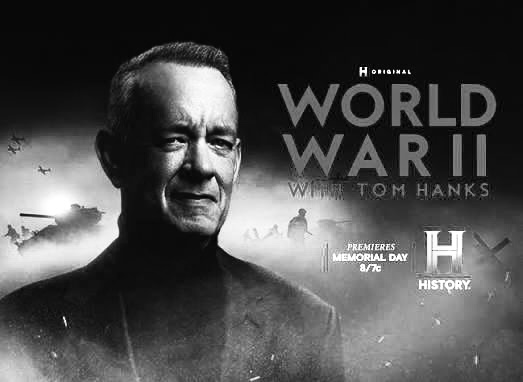
I’ve been watching the new Tom Hanks-produced WWII documentary. Big budget. Beautifully restored footage. Serious narration. Prestige television. I’m into Episode 3 now — Hitler launching Barbarossa into the Soviet Union — and I realized something halfway through the second cup of coffee:
I’ve heard all of this before.
Every bit of it.
Not because it’s bad. It’s professionally done. Hanks genuinely cares about the subject. That comes through. But for those of us who grew up devouring WWII documentaries back in the 1950s, ’60s, and ’70s, there’s very little here that feels new.
And right from the start, they stepped into the same old trap.
The documentary opens the war in September 1939.
Europe again.
Always Europe first.
But out West, especially in naval circles, many people viewed the war differently. The first real warning wasn’t Poland. It was the USS Panay Incident.
December 1937.
Japanese aircraft bombed and strafed an American gunboat sitting in the Yangtze River. American flags clearly visible. Journalists aboard. Civilians wounded. Cameras rolling.
The footage shocked people at the time because Americans could actually see it happen. Not read about it weeks later. See it.
The Japanese apologized. Washington accepted it. The headlines faded.
But old Navy men never forgot.
Neither did the China hands.
And neither did people on the Pacific coast who understood something Washington elites often didn’t: Asia was already on fire years before Hitler rolled into Poland.
The war in Asia had been raging since the Mukden Incident. Then Shanghai. Then the full-scale Second Sino-Japanese War. Cities bombed. Refugees flooding roads. Civilians massacred. Whole regions collapsing into chaos while Europe still pretended diplomacy might work.
And here’s the uncomfortable part modern documentaries rarely touch directly:
Race probably mattered too.
Asian suffering often felt distant to Western audiences in ways European suffering did not.
The slaughter in China was enormous. The Nanjing Massacre alone was one of the great atrocities of the twentieth century. Yet much of the Western press and public still treated the war in Asia as something foreign, complicated, and somehow separate from “world civilization.”
Then Hitler marched into Poland and suddenly the language changed. Newspapers spoke about the collapse of European civilization. The threat to the West. The danger to the modern world.
That framing mattered.
The reality is the 1930s Western world still operated inside racial assumptions that shaped immigration laws, colonial systems, diplomacy, and yes — media coverage. People instinctively identified more with Europeans who looked culturally familiar to them than with civilians dying in Shanghai or Nanjing.
Even the Panay incident partly broke through because Americans were attacked.
Not because Chinese civilians had already been dying by the hundreds of thousands.
That’s not comfortable history.
But it is history.
And maybe that’s why some of us who grew up buried in WWII history feel a little underwhelmed by modern productions.
We already walked these roads decades ago.
A whole generation grew up with The Rise and Fall of the Third Reich sitting on the shelf like a family Bible.
Shirer wasn’t just a historian digging through archives years later. He was there. A correspondent in Berlin watching Nazi Germany evolve in real time. Listening to Hitler speeches. Watching educated people slowly adapt themselves to insanity one compromise at a time.
That gave his writing weight.
The same with writers like Cornelius Ryan and John Toland. Or the old veterans interviewed in documentaries before they were all gone. Back then, the war still smelled faintly of diesel fuel, cigarettes, darkrooms, and VFW halls.
It wasn’t mythology yet.
It was memory.
And the truth is, Tom Hanks grew up with that same world too.
He came from the tail end of the generation that still lived in the shadow of WWII every day. Veterans were everywhere. Fathers, uncles, teachers, cops, mechanics, railroad workers. Men who rarely talked about the war directly but carried it with them anyway.
That’s probably why Hanks approaches these projects with genuine reverence instead of cynicism. You can feel that respect in everything he produces about WWII.
But reverence and freshness are two different things.
And that’s what makes this series different from From the Earth to the Moon.
That Apollo series taught viewers things they didn’t already know. NASA politics. Engineering failures. Personality clashes. The improvisation behind missions most Americans barely remembered. Even hardcore space buffs learned something.
It expanded the story.
This WWII documentary feels more like revisiting sacred terrain already mapped a thousand times.
You’re not discovering.
You’re remembering.
That’s what many modern WWII documentaries struggle to recreate. They have better restoration technology, sharper sound, bigger budgets, and dramatic music — but often less immediacy.
By Episode 3, we’re at Operation Barbarossa. Another familiar march through the standard checklist: Hitler’s arrogance, the endless Russian steppe, winter, logistics, mud, Soviet factories moving east.
All true.
All important.
All covered a thousand times before.
What’s missing is the raw edge. The uncertainty. The sense that people living through those years had no idea how the story would end.
Older documentaries captured that better because many of the people making them had actually lived through the war or its immediate aftermath.
Today’s productions often feel safer than the history itself.
And maybe that’s because we’ve turned WWII into national scripture instead of studying it as a warning.
The Panay should have been a warning.
Manchuria should have been a warning.
Shanghai should have been a warning.
But democracies are experts at ignoring distant fires until the smoke reaches their own front porch.
That lesson, unfortunately, still feels current.