
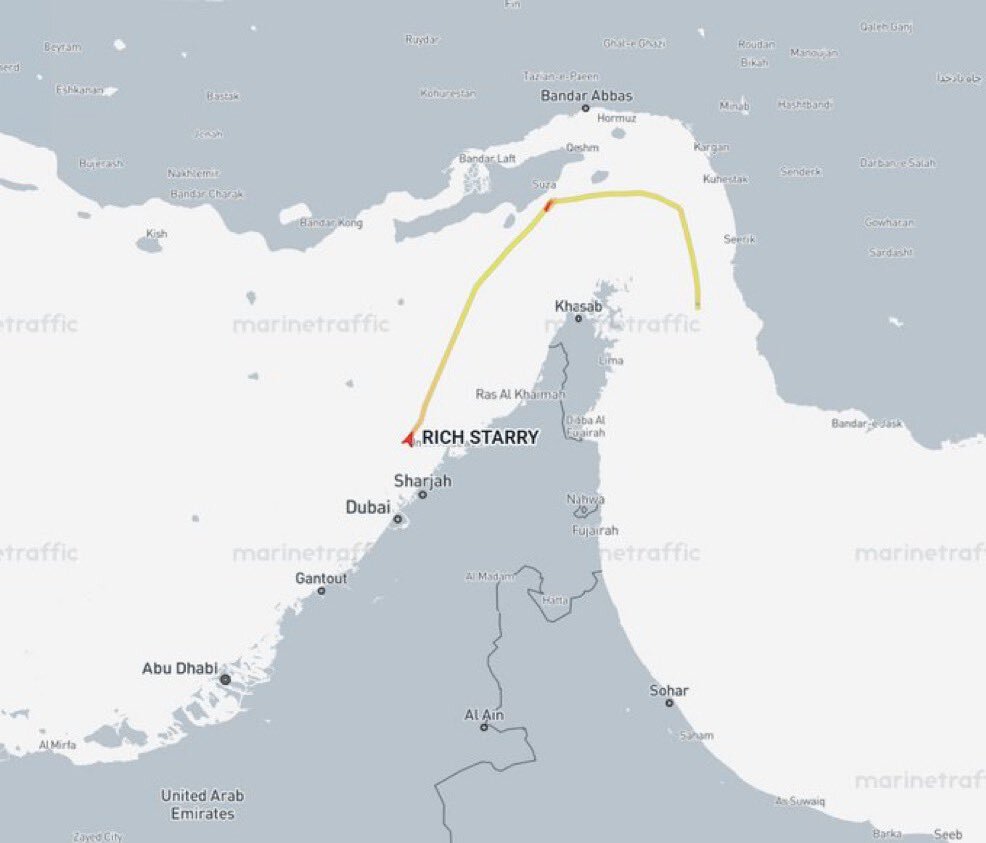
April 15, 2026 Update: at 9:30 a.m. Eastern, Rich Starry and other Chinese-owned ships reversed course and are now in Iranian water back inside the Persian Gulf. U.S. Central Command says all ships have now either stopped or reversed courses.
Update: At 11 a.m. Eastern, the tanker, Rich Starry, is now stopped and at anchor on the eastern side of the Strait of Hormuz.
Let’s cut through the fog.
A Chinese tanker just ran the line at the Strait of Hormuz—straight into a U.S.-declared blockade of Iran.
That’s not a theory. That’s not a think tank paper. That’s a real ship, with a real flag, testing whether we’re serious.
The vessel is the Rich Starry. It’s owned by Full Star Shipping Ltd., linked to Shanghai Xuanrun Shipping Co. Ltd., Chinese-owned, Chinese-crewed—and already sanctioned by the United States. In other words, not some innocent bystander that wandered into the wrong patch of ocean. This is a known quantity.
The White House used the word “blockade.” U.S. Central Command said it would enforce it. Fine. Then enforce it.
Because here’s the part nobody likes to say out loud: a blockade isn’t a warning shot. It’s the shot.
You don’t get to wave some ships through and stop others. That’s not how this works. You either control the water—or you don’t.
And now we’ve got the first real test.
AIS tracking shows the Rich Starry made its move—transiting the strait and entering the Gulf of Oman. Clean run. No interception.
But it didn’t keep going.
The ship slowed to about five knots. Then it reversed course. Now it’s lingering—waiting.
That’s not navigation. That’s hesitation.
Ships don’t loiter in one of the most sensitive waterways on Earth unless someone, somewhere, is talking. That means radios are hot. Lawyers are whispering. Commanders are weighing risks that don’t show up in press briefings.
This is a standoff. Quiet. Controlled. But a standoff all the same.
So now the Navy’s got a choice.
Stop that tanker—board it, turn it around, maybe seize it—and congratulations, you’ve just picked a fight that goes beyond Iran. You’re now nose-to-nose with China, and they don’t bluff with oil.
Let it pass?
Then don’t call it a blockade. Call it a suggestion. Because every captain from here to Singapore will take note and line up right behind that Chinese hull.
This is the kind of moment that separates policy from reality.
Out on the water, there’s no spin, no podium, no carefully worded statement. There’s just a radar track, a radio call, and a decision.
Right now, that decision is hanging in the balance—five knots at a time.
Because once that ship gets its final instructions—whether it pushes forward or turns away—the message will be clear.
And every ship behind it will follow that message.
You don’t call it a blockade unless you mean it.
We’re about to find out if we do.