
There is an old American habit that goes something like this: If somebody says the Russians are ahead, build a missile. If somebody says the Chinese are ahead, build a data center.
Preferably one the size of Rhode Island.
We are now spending astonishing sums of money building the machinery for artificial intelligence — chips, servers, transmission lines, power plants and those enormous windowless data centers that keep appearing in places where the neighbors thought they were getting a soybean field.
The explanation is usually simple.
China.
We have to beat China to artificial intelligence.
Treasury Secretary Scott Bessent recently put the stakes about as high as they can be put: If China pulls ahead of the United States in AI, he said, “nothing else matters.” President Donald Trump has made much the same argument: “whoever wins AI wins.”
There is just one little problem.
What if there isn’t a finish line?
That is the intriguing argument Alvin Wang Graylin makes in a new Quincy Institute paper called The Wrong Race: The US, China, and AI Competition.
Graylin isn’t saying China isn’t a competitor. He isn’t saying artificial intelligence isn’t important. And he certainly isn’t saying we ought to unplug the computers and go back to carbon paper.
He is asking a much more useful question:
What exactly are we trying to win?
We remember the Manhattan Project
The American conception of technological competition is heavily influenced by the 20th century.
Build the atomic bomb first.
Put a man on the moon first.
Develop the better missile.
Get there before the other fellow.
There is a starting gun, a finish line and somebody standing there with a stopwatch.
Washington has largely applied that thinking to artificial intelligence. Graylin says the assumptions are that America and China are racing toward something called artificial general intelligence, or AGI; whichever nation gets there first gains an enormous strategic advantage; therefore America should develop AI as fast as possible while preventing China from getting the chips and technology necessary to catch us.
That sounds reasonable right up until you consider what AI actually is.
It isn’t a bomb.
You can lock a bomb in a bunker.
Software has this irritating habit of getting out.
Graylin notes that America’s nuclear monopoly lasted only four years. He argues that an AI lead could be considerably shorter because models, techniques and knowledge can be copied and transmitted far more easily than uranium enrichment plants.
In fact, he says the estimated gap between the best American and Chinese AI models has already shrunk from roughly 12 to 14 months to about two or three months despite increasingly elaborate American export controls.
So perhaps this isn’t the 100-yard dash.
Perhaps we’re running the mile.
And then another mile.
And another.
Forever.
Meanwhile, we’re building
This is where Graylin’s argument gets particularly interesting for anybody watching the data-center boom.
He estimates U.S. hyperscalers will spend roughly $725 billion on AI infrastructure this year, with total capital expenditures projected to exceed $1 trillion next year.
Think about that number for a moment.
A trillion dollars.
At some point numbers get so large that the human brain simply files them under “a lot.”
And much of that money ultimately becomes concrete, steel, transformers, generators, transmission lines, cooling equipment, semiconductor fabs and data centers.
We have been told this construction is necessary because demand for AI is going to be enormous.
It probably will be.
But Graylin makes a distinction Americans learned rather painfully about 25 years ago:
A technology can change the world without every investment in that technology being a good investment.
Remember the Internet.
Nobody today argues that the Internet was a fad.
But investors nevertheless managed to create one of the greatest investment bubbles in American history around it.
Graylin uses Cisco as his example. Cisco supplied much of the networking hardware underlying the Internet boom. Then the bubble burst, and the company’s market value fell nearly 90 percent. It took until 2025 to recover its turn-of-the-century valuation.
The Internet wasn’t the mistake.
The price people were willing to pay for a piece of it was.
There is a lesson in there somewhere.
Possibly written on the side of a $20 billion data center.
China may be running another race
 The most provocative part of Graylin’s argument is that China may not be trying to win the same race we are.
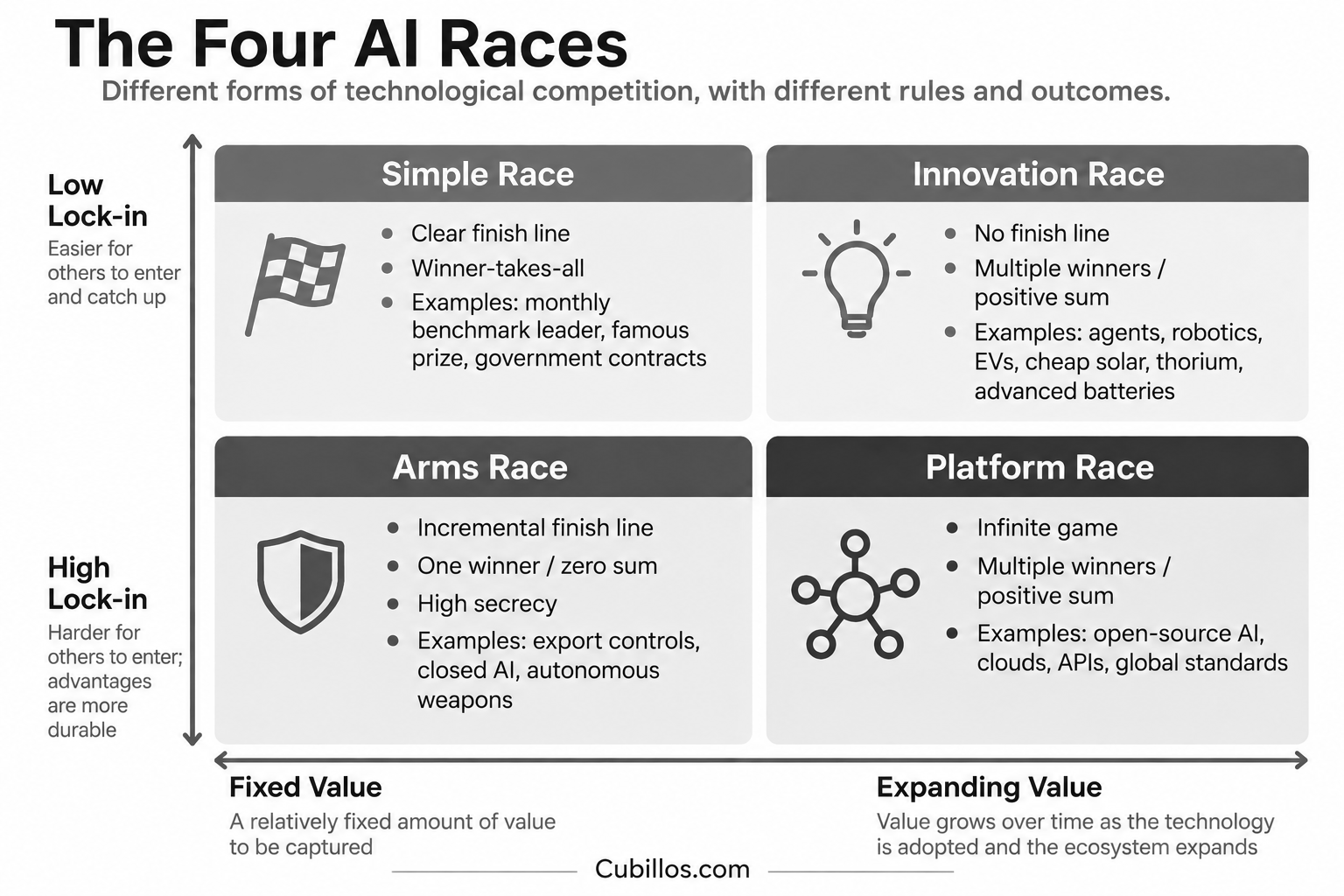
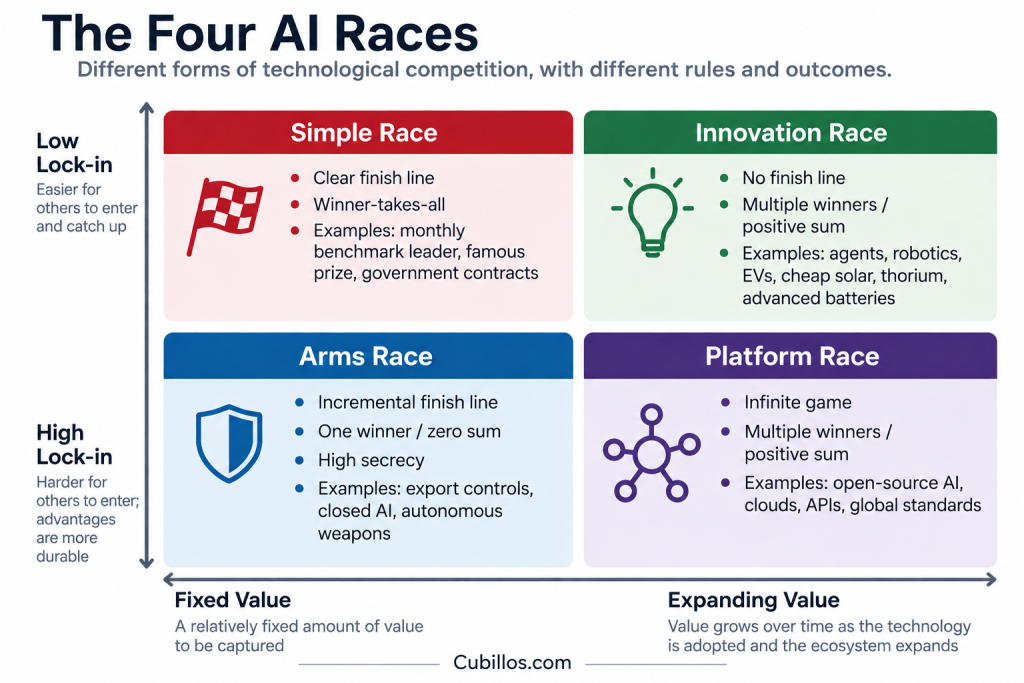
On page six of his report is a wonderfully useful little chart dividing technology competition into four kinds.
There is the simple race: somebody gets there first and wins.
There is the arms race: get there first and try to keep the other fellow from getting what you’ve got.
Then there is the innovation race, in which competitors continually leapfrog one another.
And finally there is the platform race, in which the real prize is getting everybody to use your technology, standards and ecosystem.
Graylin’s contention is that America is concentrating heavily on the first two while China is competing largely in the latter two.
That changes the question considerably.
America is trying to build the smartest AI.
China may be trying to make AI cheap enough that everybody uses it.
Chinese companies, Graylin writes, are deploying what he calls “good enough” AI at enormous scale. ByteDance’s Doubao chatbot passed 100 million daily users, while Alibaba’s Qwen platform surpassed three billion downloads.
There is nothing glamorous about “good enough.”
There wasn’t anything glamorous about the Toyota Corolla either.
They sold a few.
Then comes the uncomfortable question
Suppose AI intelligence becomes cheap.
Very cheap.
Graylin points to Chinese models approaching the performance of leading American models at dramatically lower prices. His conclusion is important: once intelligence becomes cheap and abundant, the advantage shifts from who makes the smartest model to who figures out how to use it throughout the economy.
Now look again at all those American data centers.
The land.
The substations.
The gas turbines.
The transmission lines.
The water.
The billions of dollars.
And ask a slightly different question.
Are we building all of this because customers have demonstrated that they will pay enough for AI services to justify it?
Or are we building some of it because nobody wants to be the fellow who tells Congress, Wall Street or the White House that perhaps we don’t need another 500-megawatt computer warehouse quite yet?
Graylin argues that the phrase “if we don’t, China will” performs a remarkable bit of political magic: It can simultaneously justify government support and arguments against regulation. He also notes that the companies making the argument have an obvious financial interest in the outcome.
That doesn’t mean they’re wrong.
It means we ought to check the arithmetic.
That’s what grown-ups used to do before spending a trillion dollars.
And the towns are beginning to notice
There is another warning buried in the report that will sound familiar to anyone following data-center development around the country.
Graylin says opposition to data-center construction has become widespread enough that the backlash itself could become a problem for American competitiveness.
That’s hardly surprising.
The AI race sounds wonderfully abstract in Washington.
It becomes considerably less abstract when somebody arrives at your county commission asking for hundreds of acres, a new power plant and enough electricity for a small city.
Then somebody asks who is paying for the transmission line.
Somebody else asks about the water.
And somebody in the back row asks what his electric bill is going to look like.
Suddenly artificial general intelligence has met the zoning board.
My money is on the zoning board making it stay until midnight.
Maybe the machine isn’t the prize
Graylin ends up making an argument that sounds almost old-fashioned.
Compete with China, certainly.
Protect genuinely sensitive military technology.
Develop better AI.
But don’t confuse building the biggest machine with winning the economic competition.
Because there may never be a moment when somebody blows a whistle and announces:
America wins AI. China goes home.
There will simply be another model next month.
And another one after that.
And cheaper ones.
And better ones.
And eventually artificial intelligence may become something like electricity or the Internet — enormously important precisely because nobody thinks very much about it anymore.
If that happens, the great economic prize won’t necessarily belong to the country with the most data centers.
It may belong to the country whose factories, hospitals, small businesses, schools, scientists and workers figure out how to use AI best.
Which leaves America with a question worth asking before we pour another few hundred billion dollars into concrete and GPUs:
Are we trying to win the AI race — or are we just trying to own the racetrack?