
Someone said something recently that I have heard more than once as communities begin pushing back against the enormous appetite of artificial intelligence for electricity, water and land:
Why don’t we just put the data centers in space?
I chuckled. Well, sure.
Let’s do that.
It has the wonderful advantage of solving several problems at once. No neighbors complaining about the noise. No county commission meeting. No fight over the water supply. No farmer wondering what happened to his land.
Just put the thing on a rocket and send it upstairs.
There are, however, a few details.
Let’s start small.
Really small.
Let’s build a one-megawatt data center and put it in low-Earth orbit.
One megawatt sounds like a lot until you compare it with what is being built on Earth.
The large data centers and AI campuses being proposed today are measured in hundreds of megawatts. Some projects are heading toward a gigawatt — 1,000 megawatts — or more.
Our space data center gets one.
And that one-megawatt comparison is worth stopping on for a moment, because it tells you how much engineering trouble we’re about to create for something that is actually fairly modest on Earth.
A one-megawatt terrestrial data center could fit into an ordinary industrial building.
Depending on the layout and density of the equipment, it might occupy something in the range of roughly 10,000 to 30,000 square feet, sometimes more once you include electrical rooms, cooling equipment, backup power, loading space, offices and security.
It might look like a small warehouse.
Low building.
Few windows.
Cooling equipment outside.
Transformers and switchgear behind a fence.
Backup generators nearby.
Fiber coming in underground.
You could drive past it in an industrial park and never give it a second look.
If it were using modern high-density AI equipment, much of that one megawatt of computing could be concentrated into perhaps a handful to a dozen or so extremely power-hungry racks, depending on the hardware and how much of the site’s electrical capacity goes directly to the computers.
On Earth, one megawatt is a manageable little data-center project.
In space, that same computing capacity may require tens of tons of equipment and nearly two acres of solar panels and radiators before the first processor even gets to work.
That is the comparison to keep in mind.
We’re not replacing Northern Virginia’s data-center industry.
We’re not eliminating the giant AI campuses being proposed in Texas, Arizona and elsewhere.
We’re trying to put the equivalent of one small industrial data-center building into orbit.
This turns out to require somewhat more planning than calling the moving company.
Google knows this.
Its Project Suncatcher is studying constellations of solar-powered satellites carrying Google’s Tensor Processing Units — specialized computer chips used for artificial intelligence — and connecting them with laser communications.
Google calls the project a research “moonshot.”
For once, the corporate terminology may be understated.
Google’s researchers have identified some of the fundamental problems: high-speed communications between spacecraft, keeping formations of satellites in precisely the right places, protecting computers from radiation, managing heat and designing a modular system in which a large number of spacecraft can behave like one computer. And it would require solar and radiators measured in miles, according to Nvidia.
And that’s before something breaks.
First, build the power plant
There isn’t an electrical outlet in orbit.
This is our first inconvenience.
Our data center has to bring its power supply with it.
The obvious source is the Sun.
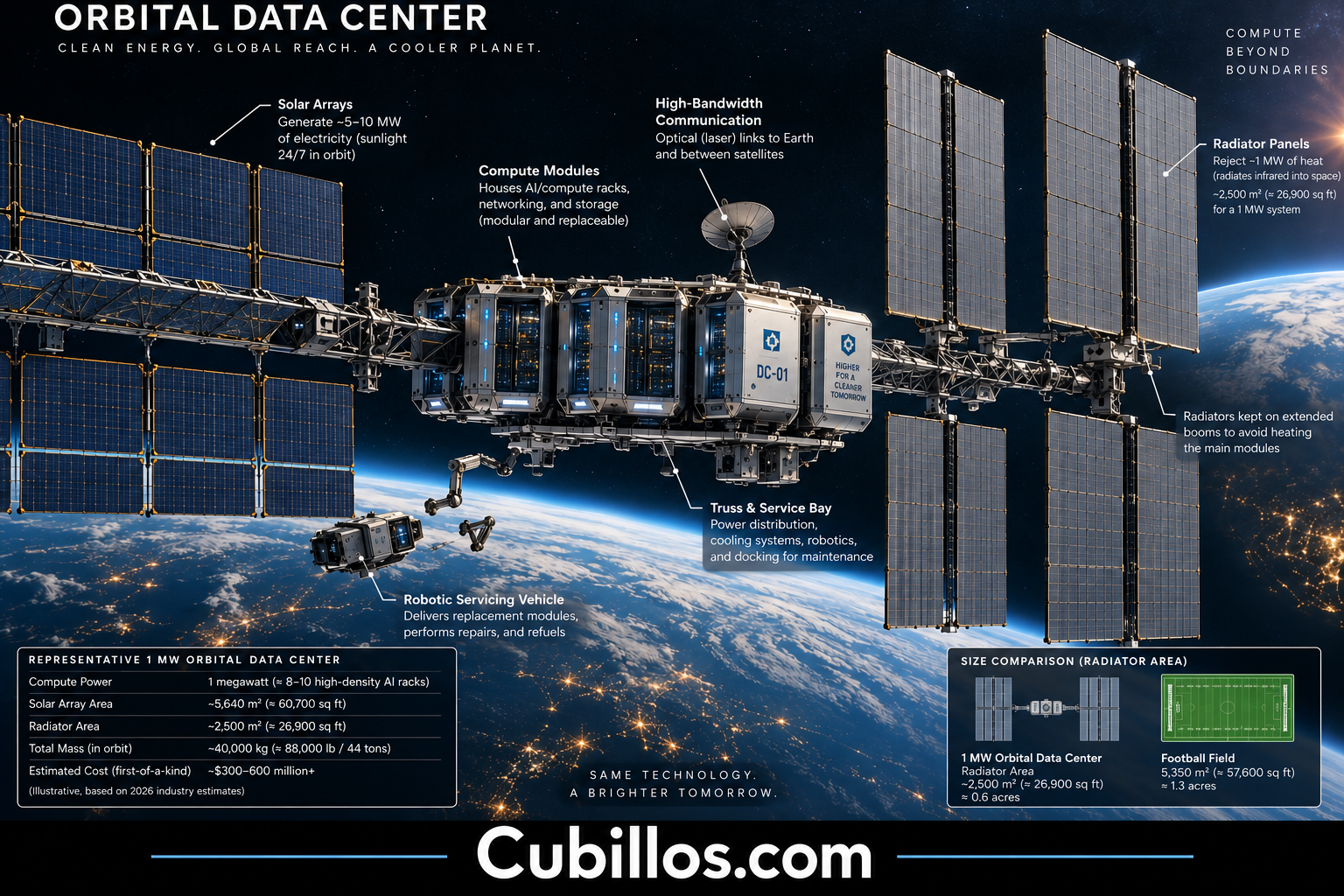
A 2026 engineering analysis by Slava G. Turyshev, an astrophysicist at the Jet Propulsion Laboratory, looked at the physical and economic requirements of orbital data centers. For a representative one-megawatt system, his estimate calls for about 5,640 square meters of solar panels.
Let’s translate that into something you don’t need a metric conversion table to picture.
That’s approximately 60,700 square feet.
Nearly 1.4 acres of solar panels.
For one megawatt of computing.
Those panels have to be folded into a launch vehicle, survive the vibration and acceleration of launch, unfold after reaching orbit and continue operating while exposed to radiation, tremendous temperature swings and assorted pieces of humanity’s previous adventures in space.
And depending upon the orbit, there is another problem.
Night.
A spacecraft in low-Earth orbit periodically passes behind Earth and into darkness.
Solar panels, being stubborn about these things, don’t produce much electricity without the Sun.
That means batteries, another power source or an orbit selected to minimize the time spent in Earth’s shadow.
Batteries mean weight.
Weight means rocket.
Rocket means money.
We haven’t turned on a computer yet.
We’ve merely arranged for electricity.
Now we have to get rid of the heat
Here’s one of the great little jokes physics has played on this proposal.
Space is cold.
Cooling a data center in space is difficult.
Both statements are true.
On Earth, we have something wonderfully useful surrounding us.
Air.
We also have water.
Data centers use fans, chillers, cooling towers, pumps, liquid cooling systems and various combinations of them to carry heat away from computers and eventually dump it into the environment.
Space has one small drawback in this regard.
There isn’t any air.
This is inconvenient.
A fan in a vacuum is mostly an expensive way of spinning a fan.
So the heat produced by the processors has to be collected and physically carried somewhere else.
NASA has been doing this aboard spacecraft for decades.
NASA describes spacecraft thermal-control systems using pumped fluid loops. A pump circulates liquid through tubing connected to heat-producing equipment. The liquid absorbs the heat, carries it away and eventually delivers it to a radiator.
NASA also uses heat pipes. Fluid at the hot end evaporates, travels toward the cooler end, condenses and returns.
The basic physics is well understood.
Unfortunately, moving the heat away from the computer doesn’t make it disappear.
Eventually we have to get it off the spacecraft.
The radiator problem
A car radiator dumps heat into passing air.
Our orbital radiator has no passing air.
Instead, it has to radiate the heat away as infrared energy.
Computer produces heat.
Coolant picks it up.
Coolant carries it through pipes.
Heat reaches radiator.
Radiator sends energy into space.
Simple.
Except for the size of the radiator.
Turyshev’s representative one-megawatt model estimates about 2,500 square meters of radiator surface.
That’s approximately 26,900 square feet.
More than half an acre.
Now add that to the solar panels.
Our little one-megawatt data center could have approximately:
60,700 square feet of solar panels.
26,900 square feet of radiators.
Together that’s about 87,600 square feet — roughly two acres of exposed surface.
And here’s the absurd contrast again.
The terrestrial version could sit inside a modest 10,000-square-foot industrial building, or slightly larger than a full basketball court.
The orbital version needs almost two acres just for the solar panels and radiators.
We haven’t counted the computers.
Or batteries.
Or communications equipment.
Or propulsion.
Or the structural framework holding all this together.
The radiators themselves probably need to extend away from the computers on booms or trusses. They have to reject heat without unnecessarily soaking up heat from the Sun, Earth or other parts of the spacecraft.
NASA is already researching lighter, higher-temperature spacecraft radiators because future high-power spacecraft will have to dispose of considerably more heat than conventional satellites.
So this isn’t an imaginary engineering problem.
It is merely one we would like to make several orders of magnitude larger.
Then somebody shoots a BB through the radiator
Not deliberately, we hope.
Space isn’t empty.
NASA’s Orbital Debris Program Office says more than 25,000 objects larger than four inches are known to be orbiting Earth.
There are hundreds of thousands of smaller pieces and vastly more tiny particles.
At orbital velocity, little things develop impressive personalities.
Our radiator therefore can’t be one enormous cooling loop where a single puncture dumps the coolant and shuts down the data center.
It would have to be divided into sections.
Suppose radiator section No. 14 gets hit.
Sensors detect the pressure loss.
Valves close.
Section 14 goes offline.
The remaining sections keep operating.
Perhaps engineers deliberately install 10 or 20 percent more cooling capacity than they need so the system can survive failures.
Think of watertight compartments aboard a ship.
A hole in one doesn’t sink the vessel.
Except this vessel has two acres of solar panels and radiators, is carrying liquid coolant through a vacuum and is circling Earth at about 17,000 mph.
Other than that, it’s straightforward.
Now put it on the bathroom scale
Turyshev estimates that a representative one-megawatt orbital system could require roughly 34 to 59 kilograms of spacecraft mass for every kilowatt of computing power.
That’s approximately 75 to 130 pounds per kilowatt.
Use a representative estimate of 40 kilograms per kilowatt and our one-megawatt data center weighs about:
40,000 kilograms.
Or:
88,000 pounds.
About:
44 tons.
These are estimates, not specifications from a machine waiting on a launch pad.
The actual number would depend upon the processors, batteries, solar technology, orbit, radiator temperature, structural design and how much redundancy engineers decide they would like between themselves and an extremely embarrassing congressional hearing.
But 44 tons gives us perspective.
Remember what we get for our 44 tons.
One megawatt.
A 100-megawatt terrestrial data center has 100 times the power demand.
A 300-megawatt campus has 300 times.
A gigawatt campus has 1,000 times.
That does not mean we simply multiply 44 tons by 1,000. Large engineering systems don’t necessarily scale that neatly.
But it does suggest that “put them in space” is not yet a national data-center siting policy.
Call the rocket company
Now we need transportation.
This is where reusable heavy-lift rockets become central to the whole idea.
SpaceX says its Starship-class system is intended to carry on the order of 100 metric tons to low-Earth orbit in a fully reusable configuration.
Our estimated 40-ton data center could therefore theoretically fit within the mass capacity of a single Starship-class launch.
The word mass is important.
We also have 60,700 square feet of solar panels.
And 26,900 square feet of radiators.
Those have to fit inside the rocket too.
Folded.
Then they have to unfold without getting stuck.
Anyone who has assembled patio furniture from a box will appreciate that we are adding a degree of difficulty here.
There are also batteries, processors, communications equipment, pumps, coolant, plumbing, propulsion and the structural framework.
And there is a good reason not to put everything aboard one rocket.
Rockets occasionally have bad days.
If our entire $300 million-or-more experiment is aboard one of them, everybody involved will have a particularly bad day.
A practical first-generation orbital data center therefore would probably be modular.
One launch could carry some combination of compute and communications equipment.
Another could carry additional power, radiator or structural modules.
Nobody has a final launch manifest because nobody has built this machine.
So saying it will require exactly two or three launches would be pretending.
But based upon the estimated mass, one Starship-class heavy-lift vehicle could theoretically carry the weight. A practical modular system could require two or more launches to build and commission it.
Then we need additional launches.
Because sooner or later something quits working.
Who changes the bad part?
Walk through a terrestrial data center and you’ll find something our orbital facility lacks.
People.
Technicians.
Electricians.
Engineers.
A power supply fails, somebody replaces it.
A drive dies, somebody swaps it.
A coolant pump starts making a noise pumps aren’t supposed to make, somebody investigates.
A network connection fails, somebody finds it.
Then Nvidia or somebody else produces a new processor that makes our four-year-old miracle of technology look like a pocket calculator.
Somebody rolls out the old equipment and installs the new.
Now put the building 250 or 300 miles overhead.
We aren’t sending an astronaut every time a power supply dies.
At that point it would probably be cheaper to send the chatbot a pension.
The orbital data center has to be designed around failure.
Things will break.
The trick is not letting one broken thing kill everything else.
A processor fails.
Software routes around it.
A communications unit dies.
A backup takes over.
A radiator leaks.
Valves isolate it.
An entire compute module fails.
Disconnect it.
Eventually, though, somebody has to replace things.
And our somebody is probably a robot.
Meet the repairman
A servicing spacecraft would eventually have to rendezvous with the data center carrying replacement equipment.
And here is another small complication.
We have to build the repairman, too.
There is no orbital service truck waiting up there with a mechanic and a socket set.
The servicing spacecraft itself has to be designed, manufactured, tested and launched.
It needs propulsion.
Navigation.
Cameras and sensors.
Robotic arms.
Replacement parts.
Tools.
Docking or capture equipment.
Software sophisticated enough to work around a structure several hundred miles above Earth.
Then we have to launch it into the correct orbit.
So now the maintenance system for our one-megawatt data center has become another spacecraft program.
Robotic servicing isn’t science fiction. We have used robotic arms in orbit for decades, and spacecraft routinely perform sophisticated rendezvous and docking operations.
But replacing a data-center module adds some interesting wrinkles.
The servicing spacecraft has to reach the correct orbit.
Match the data center’s trajectory.
Approach safely.
Dock or capture the structure.
Then the robot has to disconnect the old equipment.
Electrical connections.
Data connections.
Structural connections.
Possibly coolant connections.
That last one is worth thinking about.
The computer may be connected to a liquid cooling system moving enormous amounts of heat toward the radiators.
The robot has to disconnect that plumbing in a vacuum without losing the coolant.
Then it has to connect the replacement module.
Seal it.
Test it.
Start coolant flowing.
Apply power.
Establish communications.
Bring the processors online.
Anyone who has ever had a plumber leave a fitting a quarter-turn loose will appreciate that this particular fitting will be several hundred miles overhead.
And when the repair is finished, our robotic repairman has another problem.
What does it do with the bad part?
Bring it back to Earth?
Move it to a disposal orbit?
Attach a deorbit package?
Store it temporarily?
Eventually take it to some future orbital repair or recycling facility?
So even the act of fixing the data center creates another logistics chain.
We need the data center.
We need the spare parts.
We need the rocket carrying the spare parts.
We need the robotic repair spacecraft.
We need the rocket that launches the robotic repair spacecraft.
And eventually we need a way to repair the repairman.
At some point, “just put the data center in space” begins to resemble one of those home-improvement projects where replacing a faucet ends with half the kitchen missing.
The computer doesn’t even have to break
It can simply become old.
This may turn out to be one of the biggest economic problems.
Computing hardware advances rapidly.
Suppose we launch our magnificent AI processors in 2032.
By 2037 they may still work perfectly.
They may also be economically obsolete.
We aren’t going to throw away 60,000 square feet of perfectly good solar panels every time Nvidia introduces a better processor.
So the system almost certainly has to be modular.
Long-lived infrastructure:
Solar arrays.
Radiators.
Structural framework.
Power distribution.
Communications.
Propulsion.
Shorter-lived equipment:
Processors.
Storage.
Networking hardware.
Perhaps the orbital infrastructure lasts 15 years.
Perhaps compute modules get replaced every three to five.
Nobody knows yet.
But now we need replacements waiting on Earth.
Spare pumps.
Spare communications equipment.
Replacement radiator sections.
New computer modules.
Launch vehicles.
Servicing spacecraft.
Propellant.
Scheduling.
Inventory.
Congratulations.
We have invented the orbital parts department.
This isn’t a data center anymore
Or rather, it isn’t only a data center.
A terrestrial data center lives inside an enormous support system we rarely think about.
Roads.
Electrical grids.
Fiber networks.
Factories.
Warehouses.
Repair technicians.
Delivery trucks.
Airports.
Parts suppliers.
If a component fails in Virginia, nobody has to invent transportation before replacing it.
Space has none of that infrastructure waiting for us.
We have to build it.
Launch vehicles.
Ground facilities.
Tracking.
Communications stations.
Servicing spacecraft.
Robots.
Spare modules.
Propellant.
Orbital traffic management.
Eventually perhaps fuel depots and repair facilities.
If orbital computing ever reaches hundreds of megawatts, we will have done something considerably more important than putting data centers in space.
We will have begun building an industrial economy in orbit.
Now try talking to it
We still have another problem.
Communications.
And this one may prove tougher than the rocket.
A terrestrial data center is stitched together with fiber-optic cable.
AI processors don’t merely communicate with users. They constantly exchange enormous amounts of information with one another.
A 2026 paper by researchers Minghao Sun, Zehui Chen, Jinbo Hou, Kezhi Wang and Xiaoli Chu examined the communications problem facing orbital data centers.
They describe terrestrial data-center traffic operating at petabit-scale rates while ground-to-space links operate at much lower gigabit-scale capacity.
You don’t need to remember those terms.
Picture this instead.
We build a 12-lane interstate highway inside the orbital computer.
Then we connect it to Earth with a two-lane bridge.
The traffic jam is left as an exercise for the reader.
The researchers describe communications as a fundamental limitation for space data centers.
Lasers to the rescue — sort of
Google’s Project Suncatcher envisions connecting computing satellites with optical links.
One satellite points a tightly controlled beam toward another and transmits information through it.
Between spacecraft, this has a considerable advantage.
There isn’t much atmosphere to get in the way.
Now imagine dozens or hundreds of computing satellites talking to one another through a web of laser beams.
That’s an orbital network.
Eventually, however, some of that information has to reach us.
Unfortunately, we live at the bottom of an atmosphere.
Clouds matter.
Weather matters.
Atmospheric distortion matters.
A laser ground station in Florida isn’t going to accomplish much while one of our summer thunderstorms is sitting on top of it.
So we build another ground station.
And another.
Arizona.
California.
Hawaii.
Australia.
Europe.
Wherever geography, weather and orbital paths make sense.
When one station is cloudy, route the information somewhere else.
Then connect those ground stations to terrestrial fiber.
Add redundancy.
Add network operations.
Add backup power.
We now have a worldwide communications network supporting our one-megawatt data center.
You may notice that “just put it in space” has been accumulating footnotes.
Which raises the obvious question
Why are we doing this?
If the goal is to run an ordinary consumer chatbot, we probably shouldn’t.
Earth does that quite nicely.
Build a one-megawatt terrestrial data center.
Connect it to fiber.
Connect it to the electrical grid.
When something breaks, send Bob down the hall with a toolbox.
The strongest early case for orbital computing isn’t moving ordinary terrestrial computing into space.
It’s processing information that is already there.
Don’t bring everything home
Earth-observation satellites collect enormous quantities of information.
So do weather satellites.
Scientific spacecraft.
Military reconnaissance systems.
Astronomical instruments.
Much of that raw information ultimately has to be transmitted to Earth for processing.
That consumes communications capacity.
Put serious computing power in orbit and the sequence changes.
Today:
Satellite collects data → sends enormous dataset to Earth → terrestrial computers process it → useful information emerges.
Tomorrow:
Satellite collects data → orbital computers process it → useful information comes to Earth.
Suppose an imaging constellation takes 100,000 pictures.
Maybe we don’t need all 100,000 transmitted.
The orbital computer examines them.
Perhaps 47 contain what we’re looking for.
Send the 47.
Or send the analysis.
The same 2026 communications research points toward this approach: reduce the communications burden by transmitting compact, useful information rather than hauling every piece of raw data back to Earth.
Turyshev’s economic analysis similarly identifies space-native processing as one of the more credible early applications.
And suddenly our little one-megawatt data center makes considerably more sense.
Not because one megawatt is impressive compared with a terrestrial AI campus.
It isn’t.
It’s impressive compared with the computing capability normally carried aboard satellites.
When do we actually get one?
This is where the marketing department needs to leave the room for a minute.
We already have increasingly powerful computers operating in space.
Companies and researchers are experimenting with artificial intelligence processors, laser communications and distributed satellite systems.
Google’s Project Suncatcher is part of that work.
But none of this means we’re about to switch on a maintainable, commercially useful, one-megawatt orbital data center.
The rest of the 2020s are likely to be proving-ground years.
Processors have to survive radiation.
Laser links have to become highly reliable.
Thermal systems have to demonstrate increasingly large heat loads.
Satellites have to maintain precise formations.
Robotic servicing has to improve.
Heavy reusable rockets have to achieve high flight rates.
Launch prices have to fall.
Then all of those technologies have to work together.
The early 2030s could plausibly bring larger clusters of computing spacecraft.
Instead of one giant satellite, imagine modules working together:
Compute.
Power.
Cooling.
Communications.
Storage.
If launch costs fall substantially and thermal and communications systems mature, a genuinely useful megawatt-class orbital computing facility sometime in the 2030s is conceivable.
That’s not a scheduled opening date.
It’s an engineering horizon.
A 100-megawatt orbital data center?
Much harder.
Five hundred megawatts?
Now we’re well into speculation.
A gigawatt?
Anybody giving you the ribbon-cutting date should also provide next week’s lottery numbers.
Too many technologies first have to work separately and then work together at a scale nobody has demonstrated.
Eventually, our data center dies
There is one last detail in “just put it in space.”
We have to take it down.
Low-Earth orbit isn’t supposed to be a landfill.
NASA’s Orbital Debris Program Office notes that the amount of time an object remains in orbit depends heavily upon altitude.
Below roughly 600 kilometers — about 370 miles — debris normally falls back into the atmosphere within several years.
At approximately 800 kilometers — about 500 miles — orbital decay can take centuries.
Above 1,000 kilometers, NASA says debris can remain in orbit for a thousand years or more.
The Federal Communications Commission has also tightened the disposal requirement for covered satellites in low-Earth orbit, replacing the old 25-year guideline with a requirement for disposal within five years after the end of the mission.
Our estimated 44-ton data center therefore needs a retirement plan before we launch it.
Turning it off and wishing it well is not a retirement plan.
How long does it live?
That depends upon how we design it.
The orbit itself doesn’t necessarily determine the operating life because an active spacecraft can use propulsion to maintain altitude.
Perhaps the infrastructure is designed for 10 or 15 years.
Perhaps the computing modules are replaced several times during that period.
That’s probably the economically sensible model.
The computers have relatively short useful lives.
The infrastructure lasts longer.
Solar panels.
Radiators.
Structural framework.
Power distribution.
Communications.
Keep those.
Replace the computers.
Eventually, however, even the infrastructure wears out.
Solar panels degrade.
Radiators accumulate damage.
Pumps wear.
Structures age.
Propulsion systems consume fuel.
Then we have tens of tons of machinery we don’t want wandering around Earth indefinitely.
Taking it down
Some parts might be reused.
Someday we may recycle hardware in orbit.
Individual modules could be deorbited.
A propulsion system could lower components into an orbit where atmospheric drag eventually finishes the job.
But large structures create another problem.
Not everything necessarily burns up.
NASA has studied this problem for decades. Its Orbital Debris Program Office uses computer models to predict which spacecraft components will burn up during atmospheric reentry and which may survive to reach the ground. NASA notes that components made from high-melting-point materials such as titanium and stainless steel can survive reentry, which is why spacecraft disposal plans include an assessment of the risk that falling debris could pose to people below.
So engineers may have to perform a controlled deorbit rather than simply letting tens of tons of machinery fall wherever orbital mechanics happens to take it.
That means steering the remains toward an unpopulated region of ocean.
Which requires:
Propulsion.
Fuel.
Navigation.
Communications.
Command systems.
And those systems need to work reliably at the end of perhaps 10 or 15 years in space.
Even dying properly has to be designed into the data center before it is born.
And what will all this cost?
Nobody knows.
That’s worth saying plainly.
There isn’t an operational one-megawatt commercial orbital data center whose invoice we can examine.
We have engineering studies.
Cost models.
Proposed systems.
Launch-cost projections.
But anybody quoting an exact price for the first one is forecasting.
A first operational megawatt-class facility could readily become a hundreds-of-millions-of-dollars undertaking once development, processors, spacecraft, solar arrays, radiators, communications equipment, launch, ground stations, testing and operations are included.
The first one is also paying for all the things that don’t yet exist.
The specialized robotic connectors.
The servicing procedures.
The deployment mechanisms.
The ground network.
The software.
The maintenance system.
The second one should be cheaper.
If orbital data centers become common, costs could eventually fall dramatically.
Standard solar modules.
Standard radiator modules.
Standard robotic connectors.
Standard compute modules.
Routine launches.
Routine servicing.
That’s how extraordinary infrastructure eventually becomes ordinary.
Railroads once looked extraordinary.
So did electric grids.
So did undersea communications cables.
So did launching communications satellites.
There is no reason orbital industrial infrastructure must remain exotic forever.
But today it is.
Let’s return to that little word
Communities looking at giant proposed data centers are asking reasonable questions.
Where will the electricity come from?
Who builds the power plants?
Who pays for the transmission lines?
How much water will be consumed?
Will electric rates rise?
What happens to the land?
And somebody eventually says:
Why don’t we just put the data centers in space?
Maybe someday we will put very large ones there.
There are serious people working on it.
Google is studying orbital computing.
Researchers are publishing detailed engineering papers.
NASA has decades of experience moving and rejecting heat aboard spacecraft and continues working on better radiator systems.
Engineers are developing increasingly capable laser communications.
Reusable heavy-lift rockets could fundamentally change what it costs to put large amounts of machinery into orbit.
There is nothing silly about the idea.
For some applications — particularly processing information already being generated in space — it may make excellent sense.
But remember what our estimated little one-megawatt data center requires.
On Earth, it could fit into an ordinary grocery store that most people would drive past without noticing.
In orbit, the same computing capacity may require:
About 44 tons of equipment.
About 88,000 pounds.
About 60,700 square feet of solar panels.
About 26,900 square feet of radiators.
Nearly two acres of combined solar-panel and radiator surface.
Potentially two or more heavy-lift launches for a practical modular installation, even though a Starship-class vehicle could theoretically carry the estimated mass in one flight.
A liquid cooling system moving enormous amounts of heat.
Radiators capable of dumping that heat into a vacuum.
Redundant systems capable of surviving equipment failures and debris strikes.
Laser communications between spacecraft.
Ground stations around the world.
Robotic servicing spacecraft.
Replacement computer modules.
Replacement pumps.
Replacement communications equipment.
A launch and supply system to keep it running.
Propulsion to maintain its orbit.
And eventually a carefully planned operation to dismantle, recycle or deorbit tens of tons of machinery without creating a cloud of space junk or dropping a surviving chunk of our magnificent orbital computer through somebody’s roof.
All that engineering.
All that infrastructure.
All that logistics.
For one megawatt.
Meanwhile, down here on Earth, that same megawatt can sit inside a small building with a road, a power line, fiber and a maintenance crew.
So yes.
We can put data centers in space.
I suspect eventually we will.
But the next time somebody says, “Why don’t we just put them in space?”
Pay attention to that one little word.
Just.