
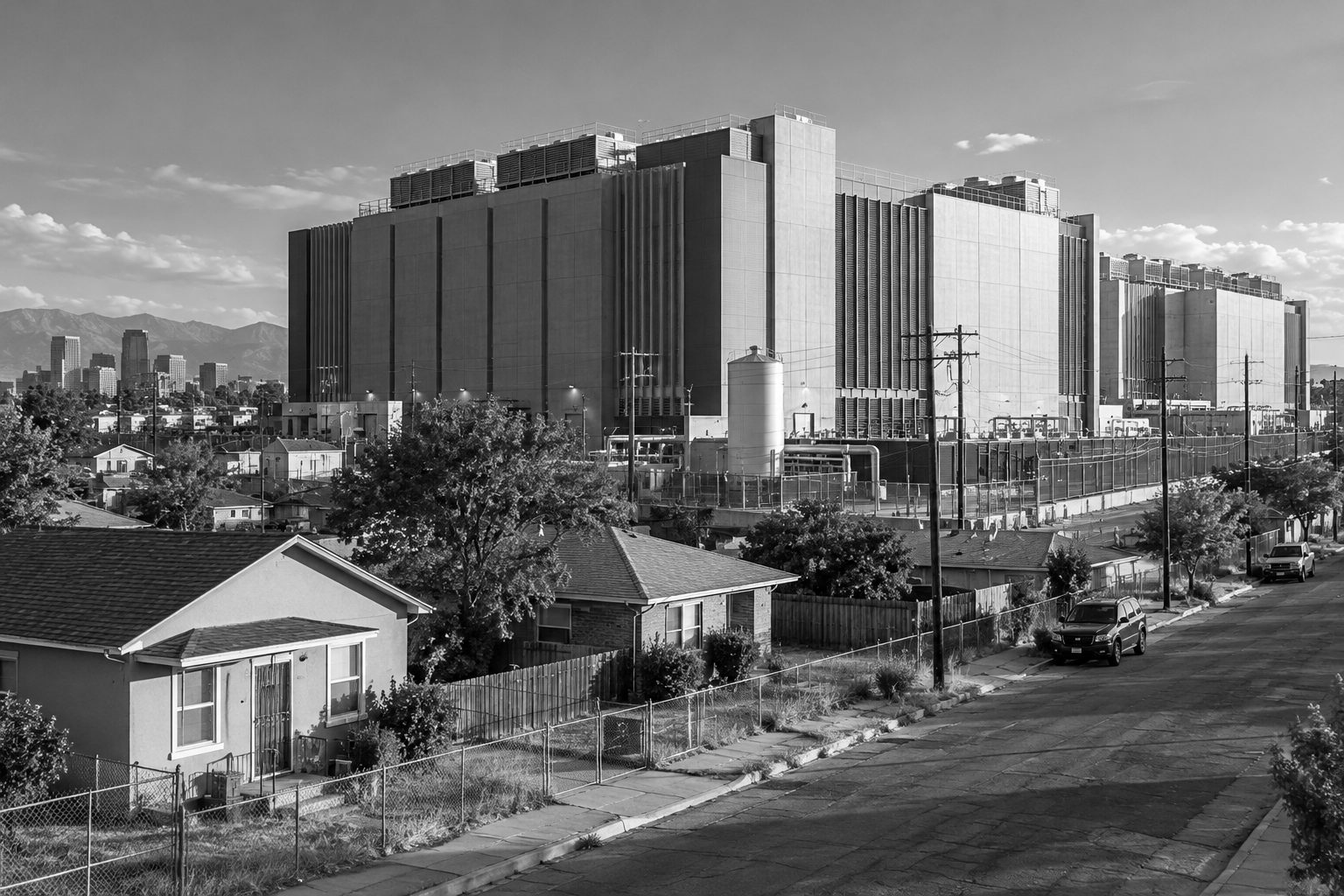
I’ve seen this neighborhood before.
Not just in Denver, but in San Diego, where we called it Barrio Logan.
Railroad tracks. Abandoned industrial buildings. A few businesses trying to hang on. Freeways cutting through neighborhoods where working people raised their families.
In Denver, it’s called Elyria-Swansea.
I-70 runs through it. Railroad lines crisscross the area. Industrial buildings stand alongside homes where generations of families have lived, worked and raised their children.
It’s a predominantly Hispanic, working-class neighborhood.
The kind of place where people aren’t particularly interested in becoming part of somebody else’s grand vision of the future. They’re too busy making a living.
But the future has arrived anyway.
And wouldn’t you know it, it brought diesel generators.
Welcome to the Future, Amigos
CoreSite, a major data center operator, is completing a 170,000-square-foot facility in Elyria-Swansea.
The company calls it DE3.
The building is part of a planned three-building campus that will support the digital economy, including cloud computing and potentially artificial intelligence.
Modern technology. High-speed connections. The infrastructure of tomorrow.
All very impressive.
The first building is projected to use approximately 115,000 gallons of water daily.
That’s roughly 42 million gallons annually.
Its cooling system recirculates water, but relies on evaporation to remove heat. CoreSite acknowledges that approximately 75 percent of the water used for cooling evaporates.
Then there are the 14 diesel backup generators.
Nothing says twenty-first-century technological progress quite like burning diesel fuel next to somebody’s apartment.
CoreSite says the generators will operate only during emergencies and periodic testing.
That’s reassuring, unless you happen to be home when they’re testing.
In July, residents complained about the noise. A nearby community health official described it as deafening.
Apparently, the digital future sounds a lot like an eighteen-wheeler idling outside your bedroom window.
We’ve Seen This Before
Barrio Logan in San Diego has its own history with industrial progress.
Shipyards. Warehouses. Railroad tracks. Interstate 5. The Coronado Bridge.
For decades, Mexican-American families lived alongside the industries that helped make San Diego prosperous.
The neighborhood wasn’t just a collection of houses sitting on cheap land.
It was a community.
Churches. Schools. Small businesses. Families who knew one another. People who worked hard and expected little more than a fair shake.
When the San Diego-Coronado Bridge and I-5 were built, they carved through the community.
Residents eventually fought back, creating Chicano Park beneath the bridge, a place that became a symbol of cultural identity and resistance to decisions imposed from outside.
Elyria-Swansea has a different history, but the geography feels mighty familiar.
Railroads and factories came. Highways followed. Industrial zoning became part of the landscape.
And the families stayed.
Some because they wanted to.
Others because moving somewhere else wasn’t an option.
That’s something people who talk casually about industrial neighborhoods sometimes forget.
Those aren’t empty spaces on a planning map.
They’re people’s homes.
The Land Was Already Zoned
Now, CoreSite didn’t sneak into Denver under cover of darkness.
The company purchased approximately 13.6 acres of industrial property in 2022 for $33 million.
The land was zoned for industrial development.
Under Denver’s regulations, a data center was a permitted use.
No rezoning was necessary.
No City Council vote was required to approve the project.
The company submitted its plans, obtained permits and began construction.
All perfectly legal.
And there’s the rub.
Because legal and right aren’t always the same thing.
The industrial zoning that made the property attractive to CoreSite was established long before anyone imagined enormous buildings filled with computers processing artificial intelligence.
Zoning tells a developer what can be built.
It doesn’t necessarily tell the city what another industrial operation will mean to the people already living next door.
That distinction ought to matter.
Especially in a neighborhood that has spent generations breathing the consequences of everybody else’s economic development.
They Asked Questions
The residents weren’t silent.
At community meetings in 2024, people raised concerns about air pollution, water consumption, noise and public health.
These weren’t people imagining problems that didn’t exist.
Elyria-Swansea already has a documented history of industrial contamination and environmental health concerns.
Asthma hospitalization rates have been higher than Denver’s average.
The neighborhood has lived with highway traffic, freight operations and industrial pollution for decades.
Residents wanted to know what another large industrial facility would add to those burdens.
In February 2026, community organizations submitted a Good Neighbor Proposal to CoreSite, supported by 215 residents.
They asked for cleaner generators, disclosure of water and electricity consumption, and a community health study.
Imagine that.
People asking whether the air their children breathe might get worse.
People asking how much water a new industrial facility will consume.
People asking whether somebody ought to study the health consequences before adding another burden to an already burdened neighborhood.
Radical stuff.
Colorado air-quality regulators subsequently urged CoreSite to hold a public meeting under the state’s environmental justice procedures.
But the company wasn’t legally required to hold that meeting.
There’s that word again.
Legally.
The Price of Progress
To be fair, data centers are necessary.
The internet doesn’t run on good intentions. Neither does artificial intelligence.
Computers require electricity. They generate heat. They need cooling. And when the power fails, backup generators keep the machinery running.
There are legitimate engineering reasons for using evaporative cooling. In some circumstances, it consumes less electricity than alternatives.
But closed-loop systems paired with non-evaporative heat rejection can dramatically reduce water consumption.
They can also cost more or require additional electricity.
Those are trade-offs worth discussing.
The trouble begins when the discussion takes place after the decisions have effectively been made.
CoreSite isn’t responsible for every environmental problem Elyria-Swansea has experienced.
And there’s no evidence the company chose the neighborhood because its residents are Hispanic or working-class.
It chose industrial property where zoning permitted the development.
But that explanation only takes us so far.
Because the zoning itself is part of a much longer history.
And that history raises a question nobody seems particularly eager to answer.
Why do the same kinds of neighborhoods keep getting the same kinds of developments?
A Familiar American Arrangement
For generations, Mexican Americans helped build the cities of the Southwest.
They worked the railroads, factories, construction sites, farms and shipyards.
They raised families in neighborhoods close to those jobs, often because housing opportunities elsewhere were limited by economics and discrimination.
They built churches, opened businesses and created communities that survived despite the industrial landscape surrounding them.
Then came the highways.
Then came urban renewal.
Then came another generation of industrial development.
And now come the data centers.
Different industry.
Same old barrio.
The companies change. The technology changes. The promises of economic progress change.
But the neighborhoods expected to accommodate that progress look remarkably familiar.
And here’s something worth remembering.
When an industrial building closes, the workers lose their jobs.
When a neighborhood business fails, another family loses its livelihood.
But the industrial zoning remains.
Years later, a developer looks at the property and sees an opportunity.
The people living next door see another chapter in a story they’ve been living for decades.
Who Gets the Bill?
Denver has imposed a moratorium on new data center approvals while officials reconsider how these facilities should be regulated.
That’s a sensible development.
But CoreSite’s project was already permitted.
The building was already going up.
The generators were already being tested.
And the residents were still asking questions.
There’s nothing wrong with technological progress.
I’ve spent enough years watching technology change journalism to appreciate what computers can accomplish.
But progress ought to improve people’s lives, not simply move the costs of doing business into somebody else’s neighborhood.
A company can calculate the price of land, construction, electricity, water and equipment.
What it can’t easily put on a balance sheet is the cost of another industrial operation in a neighborhood that has already lived with generations of them.
The noise.
The additional emissions.
The uncertainty.
The feeling that the future is something other people get to decide.
I’ve seen that neighborhood in Denver.
And I’ve seen its cousin in San Diego.
The names are different. The highways have different numbers. The industries have changed.
But the people living there deserve the same consideration as those in the expensive neighborhoods in Cherry Creek.
Here’s a thought.
Before approving the next great technological marvel, city officials ought to ask themselves whether they’d be comfortable putting it next to their own homes.
If the answer is no, perhaps they should reconsider putting it next to somebody else’s.
Because progress always has a price.
And the people of Elyria-Swansea have been paying for a mighty long time.