
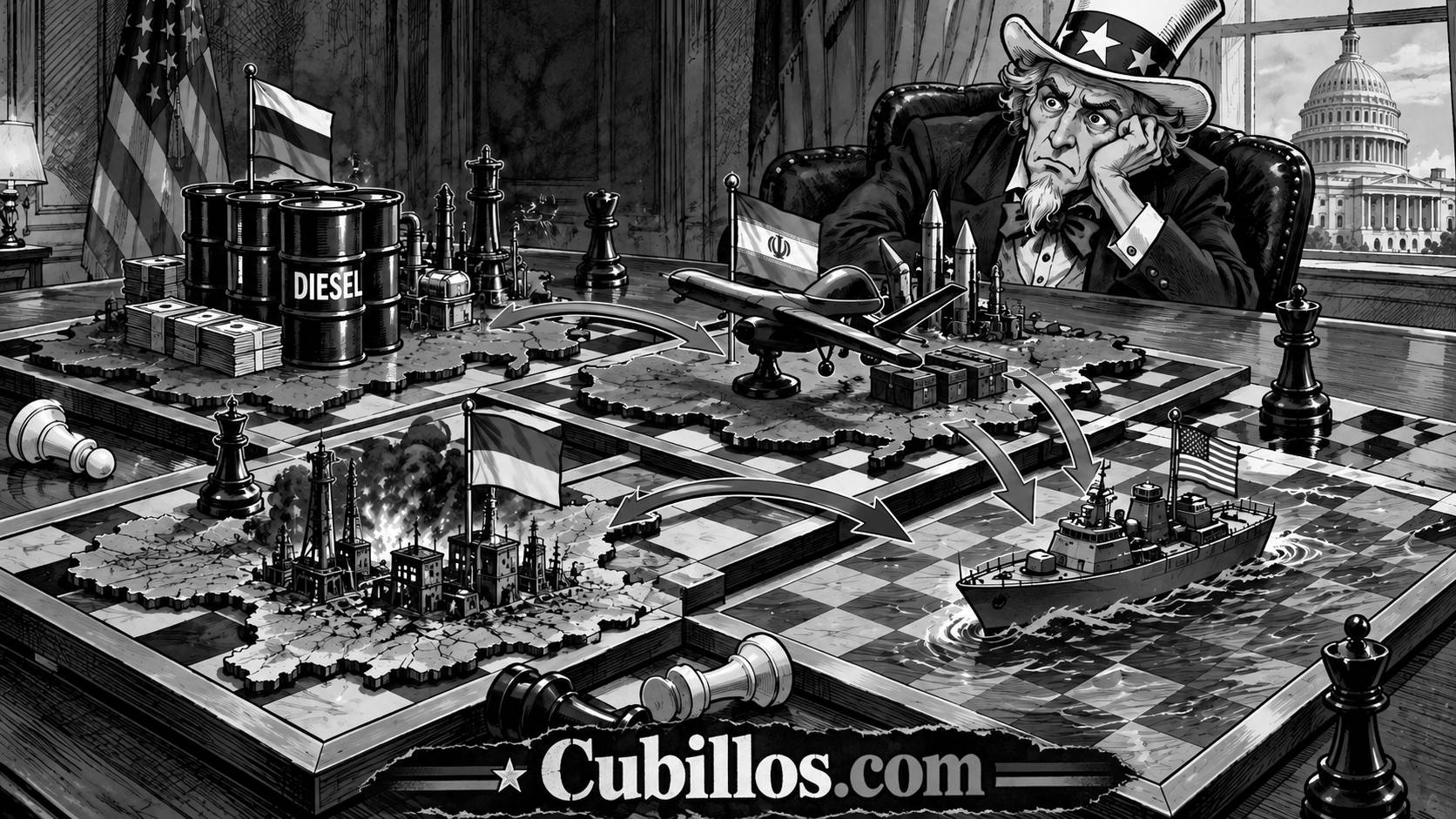
Washington has discovered a remarkable new approach to foreign policy: Fight one country, do business with its military partner, and hope nobody notices the connection.
An editor once told me I connect dots.
I always figured that was the job.
Trouble is, sometimes the dots connect to something so ridiculous you have to check twice to make sure you haven’t wandered into a political cartoon.
Take Russian diesel, Iranian drones and American sailors still risking their necks in the Persian Gulf.
Now, I don’t particularly enjoy wandering into presidential politics. I’ve spent enough years covering the military to know there’s usually more nonsense to investigate at the Pentagon than one reporter can handle in a lifetime.
But sometimes Washington makes a decision so peculiar that you can’t avoid the politicians. They’re the ones holding the pen.
And this latest business with Russian diesel is a beauty.
President Donald Trump has arranged to let more Russian diesel onto the international market. The idea, we’re told, is to bring down fuel prices and perhaps persuade Vladimir Putin to get serious about ending his war against Ukraine.
Russia invades Ukraine, bombs its cities, attacks its electrical infrastructure and spends four years grinding away at a country that had the nerve to remain independent.
And now we’re offering Moscow a little economic relief.
Apparently, the theory is that if you make things sufficiently pleasant for Mr. Putin, he’ll eventually decide to behave himself.
That’s an interesting theory. History hasn’t been particularly kind to it.
A Little Money Among Friends
The first Russian diesel shipment reportedly involves more than 300,000 metric tons. Additional proposed shipments could bring the total to 4.8 million tons.
At estimated market prices, the whole arrangement could represent roughly $6.4 billion in gross fuel sales.
Now, before somebody gets excited, that isn’t $6.4 billion in Russian government profit, and it doesn’t mean American taxpayers are personally mailing Putin a check.
But Russian exporters stand to make money, and the Russian government can benefit from the economic activity.
That’s generally why countries sell things.
And Russia happens to need money for a rather expensive hobby called invading Ukraine.
Which brings us to Iran.
Iran supplied Russia with Shahed attack drones and helped Moscow establish the means to manufacture them. The arrangement involved substantial payments in gold and technology transfers.
Those drones have been used to attack Ukrainian cities and infrastructure.
Russia now manufactures its own versions, but the Iranian connection helped make that possible.
So here’s the arrangement.
Russia sells fuel.
Russia has paid Iran for military technology.
Iran is fighting American forces.
And Trump is trying to make the first transaction easier while American sailors deal with the consequences of the third.
If that sounds a little backward, congratulations. You’re paying attention.
Meanwhile, Back at the Persian Gulf
While the diplomats rearrange the furniture, American military personnel are still out there doing what their country ordered them to do.
The Navy is enforcing a blockade against Iranian maritime commerce. Sailors are standing watch. Aviators are flying missions. Commanders are making decisions where mistakes can cost lives.
Those people don’t get to negotiate the geopolitical contradictions.
They get to carry them out.
I’ve covered enough military operations to know that the people at the sharp end seldom have much influence over the brilliant ideas being hatched back in Washington.
They’re expected to make the policy work, even when the policy looks like it was assembled by three committees that never met.
Now, nobody has established that money from these particular diesel sales will finance an Iranian drone or missile.
That’s an important distinction.
But money has a wonderful ability to move around. Revenue from one business can free resources for another.
That’s why economic sanctions were invented.
Which makes it reasonable to ask whether somebody at the Pentagon has considered the consequences of easing economic pressure on Iran’s Russian military partner.
One hopes so.
Hope, however, is not a substitute for an answer.
The President Was Asked
On October 13, Reuters asked Trump whether Russia might use the proceeds from the diesel arrangement to buy more bombs.
The president didn’t answer.
Instead, he explained that the diesel was being released into international markets rather than necessarily being sold to the United States.
Well, that’s nice to know.
But the question wasn’t where the diesel was going.
It was where the money might go.
Those are two different things, although apparently not different enough to produce two different answers.
And now the Russians are talking about expanding the relationship.
On October 16, Putin’s investment envoy, Kirill Dmitriev, said Russia’s sovereign wealth fund was working with the U.S. Treasury on payment issues involving the diesel arrangement.
He also described discussions about joint economic projects, including nuclear-powered data centers.
Data centers!
Here we are, trying to figure out whether Russian energy revenue could help sustain military cooperation with Iran, and somebody has decided this might be a fine time to discuss building computer facilities together.
To be fair, Dmitriev’s statements don’t establish that any such projects have been approved.
But they do suggest Moscow sees the diesel arrangement as an opening for broader business.
And why wouldn’t it?
The Russians have always understood that diplomacy and commerce make excellent traveling companions.
Especially when somebody else is paying the security bill.
And Then There’s Ukraine
Ukraine has been attacking Russian refineries and energy infrastructure because Russia needs fuel and money to wage war.
That seems a reasonably straightforward military calculation.
But Trump has pressed Ukraine to stop hitting Russian energy targets, partly because those attacks contribute to higher fuel prices.
So Ukraine is supposed to stop damaging the Russian war economy while the president makes it easier for Russia to sell fuel.
I suppose there’s a diplomatic explanation for this.
There usually is.
Perhaps the administration believes that economic concessions will bring Putin to the negotiating table. Perhaps it hopes to drive a wedge between Moscow and Tehran.
Either would be a worthwhile objective if it could be accomplished.
But what has Putin actually agreed to do?
Stop bombing Ukrainian cities?
Withdraw his troops?
End military cooperation with Iran?
Nobody has publicly produced a verified agreement delivering those results.
And the Russians seem quite pleased with the new business opportunities.
That ought to tell us something.
Somebody Explain the Plan
Here’s what bothers me.
Not that Trump is involved. Any president making these decisions deserves the same questions.
Not that diplomacy involves compromise. It always has.
And not even that the administration might make an economic deal with an adversary. Countries have been doing that since somebody invented money.
What bothers me is the apparent absence of a clearly explained strategy.
Are we trying to lower diesel prices?
End the war in Ukraine?
Weaken Iran?
Improve relations with Russia?
All four?
Because accomplishing one of those things might make another considerably harder.
And somewhere in the middle of this grand diplomatic experiment are American sailors and aviators whose lives depend on Washington getting the calculations right.
I’ve never believed that every questionable government decision is evidence of some sinister conspiracy.
Sometimes it’s just bad planning.
Sometimes one department doesn’t know what another department is doing.
And sometimes politicians become so enchanted with solving today’s problem that they forget they’re creating tomorrow’s.
But the public deserves to know which problem we’re actually trying to solve.
Before Washington helps Moscow collect another dollar, somebody ought to explain how the arrangement advances American security, what concessions Russia has made, and whether the Pentagon has assessed the consequences for our people confronting Iran.
An editor once told me I connect dots.
Here’s what these dots tell me.
We’re fighting Iran, easing economic pressure on its Russian military partner, urging Ukraine to stop attacking Russian refineries, and discussing new business ventures with Moscow.
Maybe there’s a brilliant strategy behind all this.
But from where I’m sitting, it looks like the White House is playing checkers on three different boards and congratulating itself for winning at chess.