
President Donald Trump said something the other day that caused an uproar in California.
Talking about Iran and the price of war, Trump said: “They can take out a city. Let ’em take out Los Angeles. Let ’em take out San Diego.”
San Diego Mayor Todd Gloria fired back.
“San Diego is not collateral damage. We are not expendable.”
Trump’s White House says the president was misunderstood—that he was describing what a nuclear-armed Iran might someday be capable of doing, and arguing that the war is intended to prevent it.
Fine.
But listening to Trump and Gloria argue about San Diego, I kept thinking the same thing:
Neither side seems to understand what San Diego represents.
I grew up there.
We knew.
San Diego wasn’t just another American city sitting peacefully beside the Pacific Ocean.
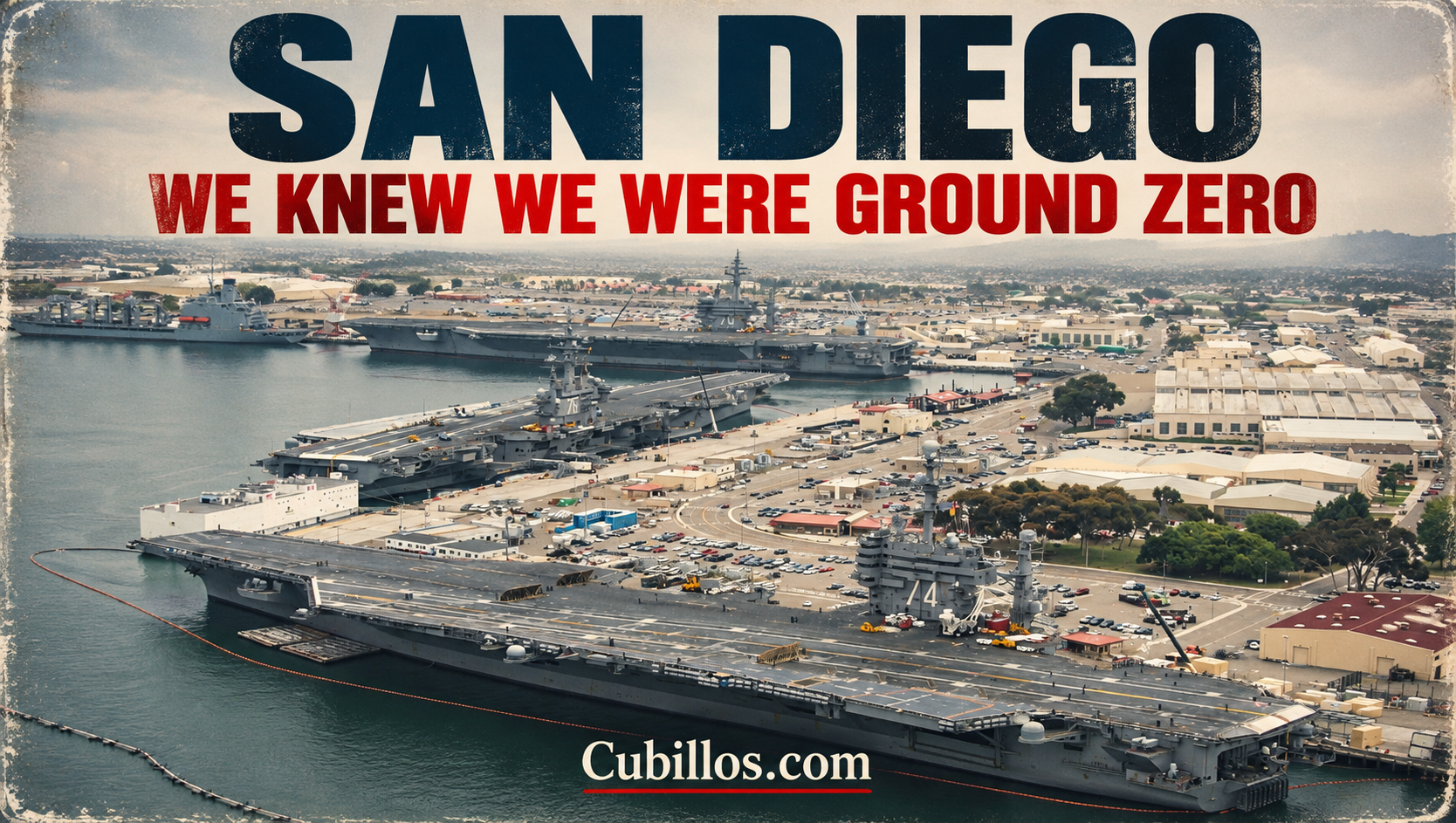
It was a Navy town.
It was ships and sailors and Marines.
It was Naval Air Station North Island across the bay. It was 32nd Street. It was the 11th Naval District. It was Point Loma and submarines. It was Marine Corps Recruit Depot. It was Miramar. Camp Pendleton was up the coast.
The military wasn’t something we occasionally saw on television.
It was part of the landscape.
And during the Cold War, that meant something else.
We were a target.
Nobody had to explain it to us.
If the Russians ever launched their nuclear missiles at the United States, San Diego wasn’t going to be overlooked.
Quite the opposite.
We figured we were going to be vaporized.
First the bomb. Then the cartoons.
People who didn’t grow up during that period may have difficulty understanding how ordinary all of this became.
We saw government civil-defense films.
Television stations would run them on Saturday mornings.
Then came the cartoons.
Think about that for a moment.
Nuclear war.
Mushroom clouds.
What you were supposed to do if the bomb dropped.
And then Mighty Mouse and Uncle Russ.
We absorbed it.
There wasn’t much else to do.
We didn’t spend our childhood walking around terrified that the Russians were coming.
We played.
We went to school.
We went to the beach.
We lived our lives.
The possibility that everything around us could disappear one afternoon was simply somewhere in the background.
Then came October 1962.
Dad had a plan.
I was in the fifth grade during the Cuban Missile Crisis.
For 13 days, the United States and Soviet Union came frighteningly close to nuclear war over Soviet missiles in Cuba.
My father gave me instructions.
If things went bad, I was to leave school.
Didn’t matter what the teachers said.
Leave.
He told me which streets to walk down.
My job was to get my little sister one floor down from me.
I was a fifth-grader in Mrs. Jessop’s class.
And if the United States and Soviet Union started a nuclear war, I had an assignment:
Get your sister and come home.
Damn the teachers.
Dad had given me my orders. We didn’t argue with my dad.
There were no cellphones.
There were no text messages from the school district.
There was no family group chat telling everybody where to meet.
Dad made a plan, told his son what his responsibility was, and expected me to do it.
I knew the route.
I knew where my sister was.
I knew what Dad expected of me.
And somewhere inside that fifth-grade head, I also understood something else.
If the missiles really came, none of this was likely to matter.
This was San Diego.
Dust to dust.
Why San Diego mattered
That’s the part missing from today’s political argument.
An enemy wouldn’t choose San Diego because the city was expendable.
An enemy would choose San Diego because it was indispensable.
That distinction matters.
Today, Naval Base San Diego describes itself as the Navy’s premier Pacific Fleet surface-force installation. It supports 54 homeported ships and more than 150 tenant commands.
The region also contains submarine forces at Point Loma, aviation at North Island, Marine Corps installations and commands responsible for preparing forces for operations across the Pacific.
San Diego isn’t merely a large American city that happens to have some military bases.
It is one of the great concentrations of American military power on the Pacific.
And geography hasn’t changed.
Look west from San Diego and there is a very large ocean.
On the other side of it is Asia.
That mattered during World War II.
It mattered during Korea.
It mattered during Vietnam.
It mattered during the Cold War.
And with American military strategy increasingly focused on the Indo-Pacific, it matters today.
That doesn’t excuse Trump’s words.
A president talking flippantly about an American city being “taken out” is going to get a reaction.
It should.
There are more than a million people living in San Diego, not chess pieces on a military map.
Sailors and Marines have families there.
So do teachers, mechanics, nurses, restaurant workers and fifth-graders who probably don’t spend much time contemplating nuclear targeting.
Gloria is right about one thing.
They aren’t expendable.
But saying San Diego isn’t expendable misses the strategic point.
Its importance is precisely what makes it a target.
That was true when I was a boy.
It remains true today.
And Trump’s remark misses that same point from the opposite direction.
You don’t casually throw San Diego into a sentence about an enemy taking out an American city.
Not this city.
Not if you understand what sits there.
Destroying San Diego in a major war wouldn’t simply mean destroying houses and freeways and beaches.
You would be striking at a major American military complex and one of the gateways through which the United States projects naval power into the Pacific.
That’s why an enemy would care about San Diego in the first place.
We knew.
That’s what I find so strange about this whole argument.
Trump talks about San Diego as though it were an interchangeable city in a hypothetical attack.
Gloria responds as though putting San Diego on an enemy’s target list is an outrageous concept.
Meanwhile, I’m remembering being a kid in San Diego more than 60 years ago.
We already knew.
We knew what those ships meant.
We knew what those bases meant.
We knew what the mushroom clouds in those government films meant.
And during the Cuban Missile Crisis, my father made sure I knew exactly what I was supposed to do.
Leave school.
Walk the route.
Get your little sister.
Come home.
I was in the fifth grade.
Dad didn’t have to explain why.
This was San Diego.
We were ground zero.
We knew it.
And then we went outside and played.