
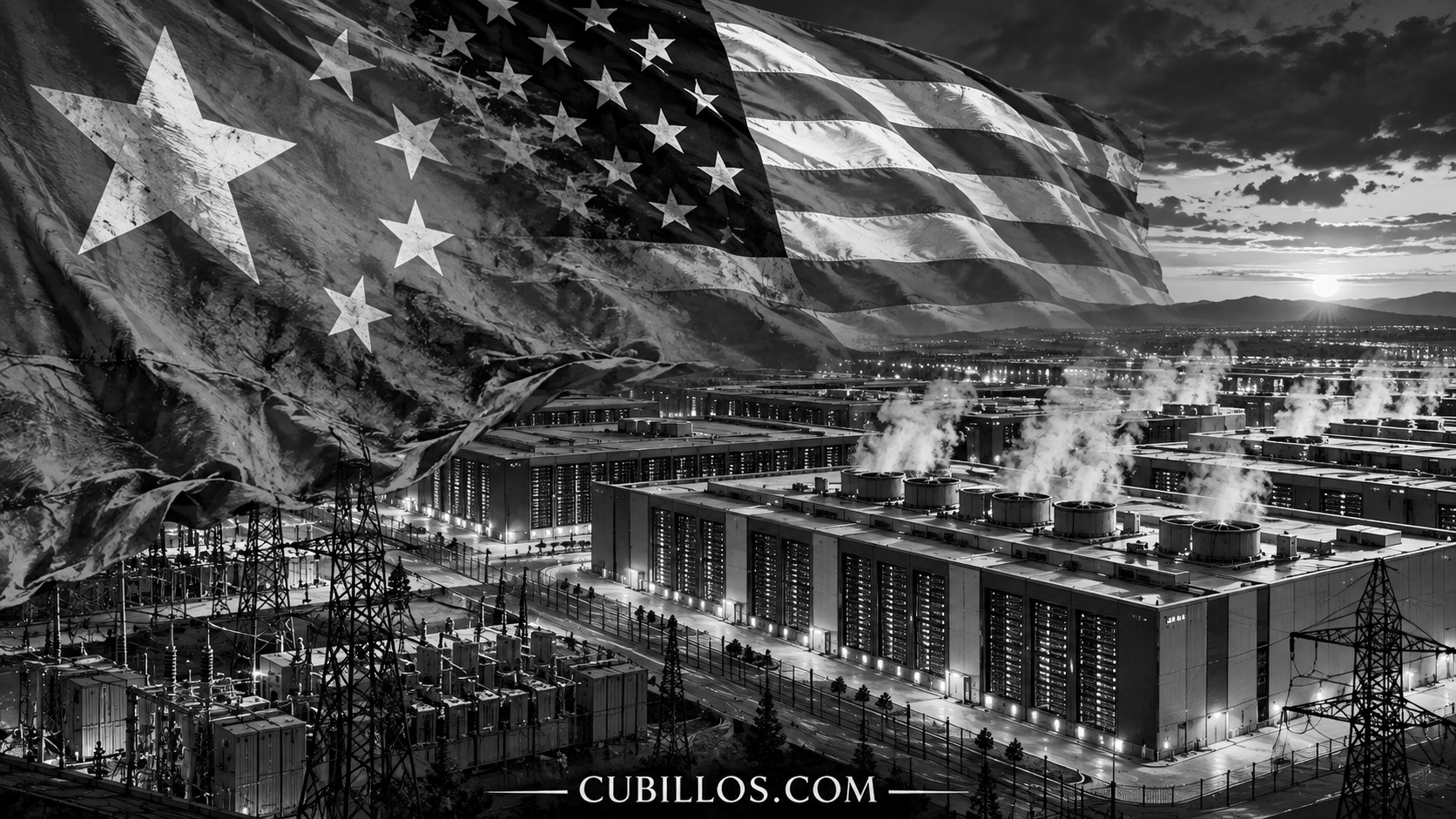
The Chinese are coming! The Chinese are coming!
And apparently, they’re coming to a zoning board meeting near you.
According to some enthusiastic defenders of America’s artificial intelligence industry, anybody complaining about a data center’s electricity consumption, water demands or environmental consequences might be doing the bidding of Communist China.
Who knew asking questions about your electric bill could make you an enemy of the state?
Here’s the uncomfortable part.
There really is a Chinese influence operation targeting Americans over data centers. It has been documented, investigated and disrupted.
But before we start checking the passports of everybody attending a county commission meeting, we ought to examine what the Chinese actually did, what they accomplished and what the rest of us can learn from it.
Because there’s a considerable difference between China trying to manipulate Americans and Americans being manipulated.
And that distinction seems to have gotten lost somewhere between the propaganda and the politics.
The Chinese operation
In June 2026, OpenAI, the American company behind ChatGPT, disclosed that it had banned accounts associated with an apparent Chinese influence operation.
The campaign had a rather revealing name: Data Center Bandwagon.
Investigators found that the operators were using ChatGPT to manufacture social media content criticizing American AI infrastructure.
They weren’t producing elaborate intelligence assessments or stealing technological secrets.
They were making cartoons.
One depicted ordinary Americans struggling with electricity bills while wealthy technology executives benefited from the expansion of data centers.
Other posts criticized the electricity demands of AI facilities and suggested that American families were being forced to subsidize the industry’s enormous appetite for power.
The operators used artificial intelligence to write comments, generate images and create the appearance of ordinary Americans expressing their concerns.
They even studied how Facebook worked, developing strategies for creating believable accounts, building audiences and avoiding detection.
OpenAI concluded that the operators likely worked for a private Chinese technology company serving provincial-level government clients.
In other words, this wasn’t some teenager in Shanghai amusing himself between video games.
It appeared to be an organized influence operation.
And it was directed at a legitimate American debate.
A little propaganda with your electric bill
The Chinese understood something about American politics that plenty of Americans seem determined to forget.
You don’t have to invent a grievance when there’s already one sitting on the kitchen table.
Electricity prices are a concern.
Water availability is a concern.
The construction of enormous industrial facilities near residential neighborhoods is a concern.
And when a technology company proposes building a multibillion-dollar data center, residents are entitled to ask who will provide the electricity, where the water will come from and who gets stuck paying for the infrastructure.
The Chinese didn’t invent those questions.
They simply tried to exploit them.
Their strategy was straightforward: Take an existing American disagreement, insert yourself into the conversation, exaggerate the divisions and hope everybody starts fighting.
It’s an old intelligence technique dressed up in new technology.
The Russians have used variations of it. So have other governments.
Now the Chinese are using artificial intelligence to make the process cheaper and easier.
Instead of hiring an army of propagandists to write thousands of messages, they can ask a computer to do the work.
The irony is almost delicious.
China was using American artificial intelligence to attack American artificial intelligence.
Somewhere in Beijing, somebody probably thought that was terribly clever.
There’s just one problem
It didn’t appear to work.
OpenAI’s investigators found no evidence that the operation achieved meaningful reach beyond its own accounts.
Reuters reported in June that the Chinese efforts appeared to have little or no effect.
In August, X identified approximately 200 accounts within a much larger suspected Chinese bot network that had posted material intended to influence the American debate over AI and energy policy.
Again, the evidence suggested limited engagement.
That’s an important distinction.
The Chinese were trying to influence Americans.
That doesn’t mean they succeeded.
Nor does it mean the thousands of Americans questioning data center construction are unwitting agents of Beijing.
In fact, researchers examining the opposition movement have found that the debate is overwhelmingly domestic.
Americans were arguing about these projects long before Chinese propagandists decided to join the conversation.
And Americans will probably continue arguing about them long after the Chinese accounts disappear.
We’re rather good at that.
The American opposition is real
In September, PolitiFact examined claims that China was responsible for the growing opposition to American data centers.
The investigation found evidence of Chinese influence attempts but little support for the notion that Beijing was directing the American opposition movement.
A University of Pennsylvania survey conducted during June and July found that 61% of American adults opposed data center construction in their local areas.
The opposition crossed party lines.
Republicans didn’t like the idea of enormous industrial facilities appearing in their neighborhoods any more than Democrats did.
Independents weren’t particularly enthusiastic, either.
That’s a fairly remarkable political achievement in modern America.
We can’t agree on much of anything, but apparently we can find common ground when somebody proposes putting a massive electrical substation and a warehouse full of computers down the road.
The opposition also has a distinctly local character.
Residents worry about noise, water consumption, property values, electricity costs and the transformation of agricultural or residential land into industrial developments.
Those concerns aren’t necessarily arguments against artificial intelligence.
They’re arguments about where facilities should be built, how they should operate and who should bear their costs.
And those are perfectly legitimate questions in a country where local governments are supposed to represent the people living in their communities.
Follow the money. And the electricity.
Here’s where the debate becomes especially interesting.
Some defenders of data center construction insist that the facilities consume only a tiny fraction of America’s land and water resources.
They compare the industry’s national water consumption with agricultural irrigation and conclude that the environmental concerns are exaggerated.
There’s some truth in those comparisons.
Agriculture consumes vastly more water nationally than data centers do.
But national averages can conceal local problems.
A data center in a region with abundant water presents a different challenge from one drawing on a stressed aquifer.
A facility connected to an electrical grid with surplus capacity is different from one requiring substantial new generation and transmission infrastructure.
And a project built on an isolated industrial site is different from one constructed beside a residential neighborhood.
Those distinctions matter.
Lawrence Berkeley National Laboratory estimated that American data centers directly consumed approximately 17.4 billion gallons of water in 2023.
The laboratory also documented substantially greater indirect water consumption associated with generating the electricity those facilities require.
And it projected that direct water consumption could increase significantly as the industry expands.
Those aren’t Chinese numbers.
They’re American government laboratory estimates.
Microsoft, meanwhile, has developed new data center cooling designs intended to eliminate water evaporation during cooling.
That’s encouraging.
But the company announced those designs precisely because reducing water consumption matters.
And its first facilities employing the new approach aren’t expected to begin operating until late 2027.
Technology is improving.
That doesn’t mean the environmental questions have disappeared.
It means engineers are working to address them.
Which is what engineers are supposed to do.
National security is not a blank check
Now, there is a legitimate national security dimension to all this.
The United States and China are engaged in an increasingly consequential competition over artificial intelligence.
AI is already influencing military planning, intelligence analysis, autonomous systems, logistics, cybersecurity and weapons development.
The country that develops the most capable systems, and possesses the infrastructure necessary to operate them, could gain substantial economic and military advantages.
China understands that.
So does the Pentagon.
And China certainly has an interest in slowing American technological progress.
But recognizing that competition doesn’t require Americans to surrender their right to question how the necessary infrastructure is developed.
Quite the opposite.
A resilient national AI infrastructure requires reliable electricity, sufficient water, secure communications and communities willing to accommodate the facilities.
Building data centers without adequately considering those requirements doesn’t strengthen national security.
It can create new vulnerabilities.
An electrical grid strained beyond its capacity isn’t an advantage.
Neither is a community forced to compete with an industrial facility for limited water resources.
And neither is a population that comes to distrust technological development because companies and government officials dismiss legitimate questions.
National security requires more than building things quickly.
It requires building them intelligently.
When propaganda becomes a political weapon
There’s another danger here, and it has nothing to do with Chinese computers.
Once the existence of a foreign influence campaign becomes public, it’s tempting to use that discovery to discredit everybody who disagrees with you.
Don’t like a proposed data center?
Chinese propaganda.
Concerned about electricity prices?
Chinese propaganda.
Want an environmental impact assessment?
Well, comrade, perhaps you’d prefer to move to Beijing.
It’s a convenient argument.
It also happens to be nonsense.
In June, businessman Kevin O’Leary acknowledged that he had no evidence supporting earlier accusations connecting specific Utah organizations and individuals to Chinese government funding.
The episode illustrates how quickly suspicion can outrun evidence.
And how damaging those accusations can become.
A foreign government attempting to exploit an American controversy doesn’t make the controversy illegitimate.
It makes the foreign interference illegitimate.
Those are two entirely different things.
Americans should be capable of distinguishing between them without requiring assistance from either Beijing or Silicon Valley.
What China really wants
The most revealing aspect of the Chinese operation may not be the propaganda itself.
It’s the objective.
China’s operators weren’t necessarily trying to convince Americans that artificial intelligence was bad.
They were trying to deepen divisions over the infrastructure required to support it.
That’s a subtler strategy.
If Americans become so consumed by accusations, suspicions and political arguments that they cannot make reasonable decisions about critical infrastructure, an adversary benefits without having to sabotage a single power line.
But there’s another side to that equation.
If Americans become so frightened of foreign propaganda that they stop questioning corporations and government officials, an adversary has helped undermine democratic accountability.
Either outcome damages the country.
The answer isn’t to silence criticism.
It’s to distinguish legitimate criticism from deliberate manipulation.
That requires evidence, transparency and a willingness to listen to people whose concerns may differ from our own.
Not every person opposing a data center is an environmental expert.
Not every company proposing one is a villain.
And not every social media post criticizing the industry originated in China.
Sometimes a person complaining about electricity prices is simply a person complaining about electricity prices.
Imagine that.
The real lesson
China has been caught attempting to manipulate American opinion about AI data centers.
That’s a fact.
The operation used fake identities, artificial intelligence and coordinated social media activity to exploit existing public concerns.
That’s also a fact.
But investigators found little evidence that the campaign succeeded.
And there’s no credible basis for treating ordinary Americans who question data center construction as Chinese collaborators.
The United States needs artificial intelligence infrastructure.
It needs the technological and military advantages that infrastructure can provide.
It also needs responsible development, reliable public information and communities that have a meaningful voice in decisions affecting their lives.
Those objectives aren’t contradictory.
They’re complementary.
The Chinese would undoubtedly prefer that Americans spend their time accusing one another of treason rather than figuring out how to build a stronger country.
And judging by some of the arguments circulating on social media, we may be giving them more assistance than their little propaganda operation ever managed.
China tried to turn America’s data center debate into a shouting match.
We shouldn’t do its work for it.