
Newton’s apple, David Hume, Yann LeCun and the limits of machine intelligence
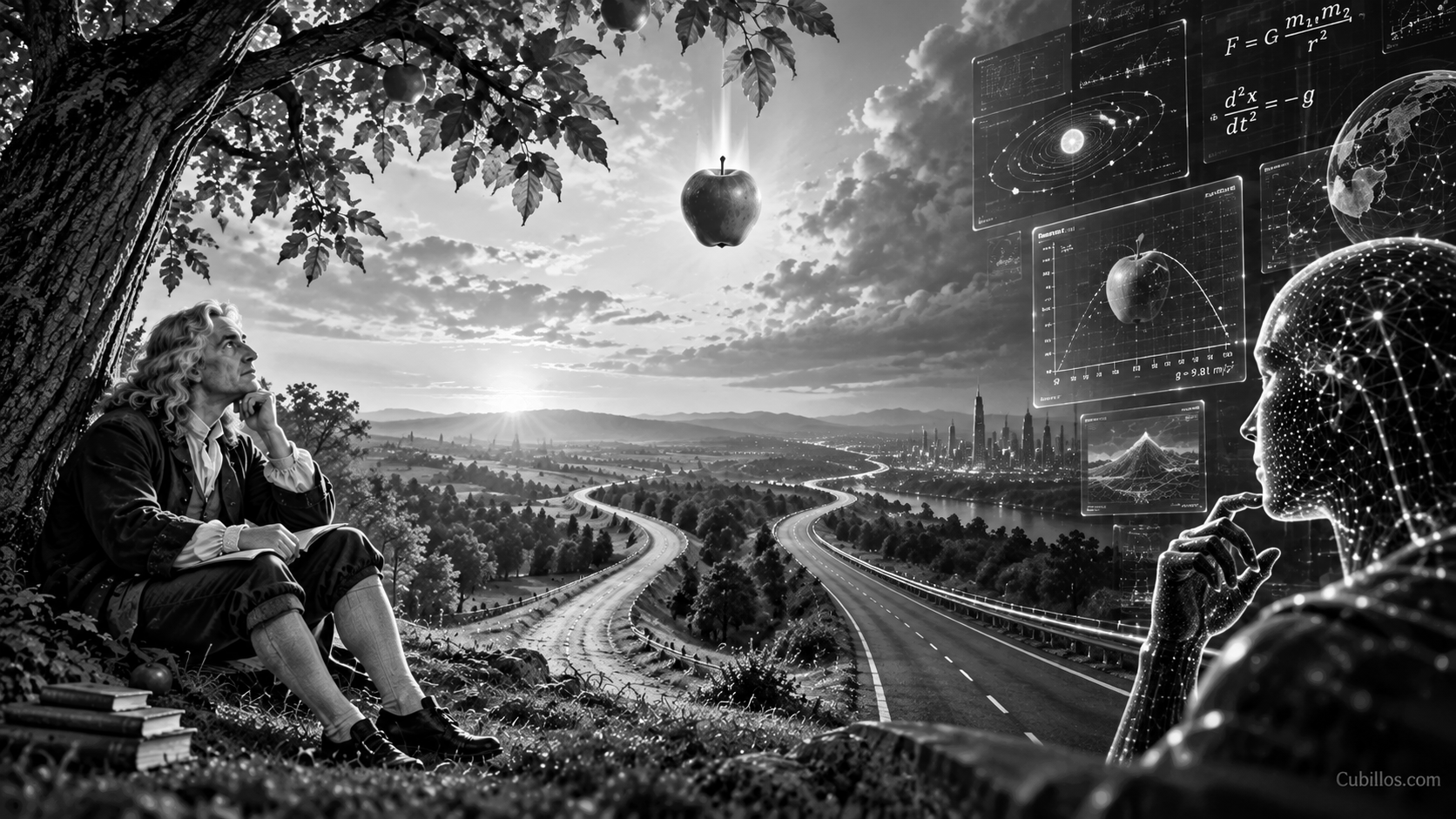
Isaac Newton supposedly watched an apple fall from a tree and began thinking about gravity.
Whether the story happened exactly that way is open to debate. Newton himself recalled contemplating gravity when he saw an apple fall, although the familiar version has been embellished over the centuries.
But the story illustrates something important about human intelligence.
Newton observed something happening in the physical world. He asked why it happened. Eventually, he developed a mathematical framework describing gravitational attraction.
Now consider artificial intelligence.
A modern AI system can explain Newton’s law of universal gravitation. It can calculate the gravitational force between two objects, describe planetary orbits and solve mathematical problems that would challenge many college students.
It can tell us why the apple falls.
But has it ever watched an apple fall?
More importantly, does it understand what falling means in the same way Newton did?
That distinction has occupied my thoughts for some time, particularly while writing my novel, The Whitlock Protocol, which features an artificial intelligence named Dragon.
And it returned to mind recently when I read Marc Rameaux’s article in The European Scientist, titled “Yann LeCun, the David Hume of Our Time.”
Rameaux examines the philosophical foundations of LeCun’s approach to artificial intelligence, comparing his work with the ideas of the 18th-century Scottish philosopher David Hume.
Having read LeCun’s work, I found the comparison fascinating.
But I came away with a somewhat different conclusion.
I don’t believe there’s a single road to artificial intelligence. I think there are parallel roads, and they may lead to different kinds of intelligence.
Newton’s Apple and the Problem of Experience
Newton’s apple provides a useful starting point.
Imagine an artificial intelligence trained on every major scientific work concerning gravity.
It knows Newton’s equations. It understands Einstein’s theory of general relativity in mathematical terms. It can predict the motion of planets, calculate orbital trajectories and explain why astronauts appear weightless.
Its mathematical knowledge may exceed that of almost any human being.
Now place that intelligence in an unfamiliar physical environment.
An apple falls from a tree.
The machine can predict its acceleration and calculate approximately when it will strike the ground.
But what does it actually know about the event?
Has it observed the apple?
Can it distinguish between a mathematical description of falling and the physical event itself?
Can it recognize unexpected circumstances that its calculations didn’t anticipate?
A camera-equipped machine could certainly record the falling apple. With appropriate sensors and software, it could track its movement and compare the observation with its predictions.
But recording an event isn’t necessarily the same as understanding it.
And understanding an event isn’t necessarily the same as experiencing it.
These distinctions may seem philosophical, but they lie at the heart of one of the most important debates in artificial intelligence.
David Hume Enters the Conversation
David Hume argued that much of human knowledge develops through experience.
We observe events, recognize patterns, and develop expectations about how the world behaves.
A child learns that a dropped object falls. A person discovers that touching a hot stove causes pain. Repeated experiences establish expectations about cause and effect.
But Hume identified a problem.
Just because we’ve repeatedly observed one event following another doesn’t mean we’ve established that the relationship must always hold.
We expect the future to resemble the past because experience has taught us to do so.
That expectation is extraordinarily useful, but it isn’t the same as logical certainty.
There’s an interesting parallel with artificial intelligence.
Modern AI systems learn patterns from enormous collections of data. They identify relationships, make predictions and generate responses based on what they’ve learned.
In some respects, they’re doing something reminiscent of Hume’s description of human learning.
But there’s a difference.
Humans develop much of their understanding while interacting with the physical world.
Large language models primarily learn from representations of that world, especially language.
They learn what people have written about falling apples rather than necessarily observing apples fall.
Does that difference matter?
Yann LeCun believes it does.
LeCun’s Argument
LeCun, one of the pioneers of modern deep learning, has long argued that large language models alone are unlikely to produce the kind of intelligence humans and animals possess.
His reasoning is straightforward.
Much of what we know about the world isn’t learned through language.
A cat understands that an object can fall from a table. A dog can navigate around obstacles. A young child can recognize that a precariously balanced object may topple.
They don’t need mathematical equations to understand these things.
Their knowledge develops through perception and interaction with the environment.
LeCun believes artificial intelligence needs something similar: internal models that allow machines to represent the world, anticipate events and plan actions.
His research into world models is an effort to develop systems that learn important relationships from observations rather than relying exclusively on language.
The goal isn’t simply to build machines that can describe reality.
It’s to build machines that can predict and act within it.
I think LeCun is identifying a genuine limitation of today’s artificial intelligence.
But I’m not convinced that limitation means language-based intelligence is traveling the wrong road.
It may simply be traveling a different one.
The Parallel Roads to Intelligence
Human intelligence developed through physical experience long before written language existed.
Our ancestors learned to navigate dangerous environments, recognize threats, locate food and manipulate objects.
They understood many things they couldn’t explain.
A hunter didn’t need Newton’s equations to throw a spear accurately. A child doesn’t need to understand biomechanics to learn to walk.
Language eventually allowed humans to communicate increasingly complex ideas and preserve knowledge beyond individual experience.
Artificial intelligence has followed a remarkably different path.
We’ve developed machines capable of discussing philosophy, writing computer programs, analyzing scientific research and solving complex mathematical problems.
Yet these systems may struggle with physical situations that a young child handles almost effortlessly.
In a sense, we’re developing intelligence backward.
Or perhaps we’re developing a different form of intelligence altogether.
Consider how much human knowledge comes from experiences we’ve never personally had.
I know something about ancient Rome, although I’ve never walked its streets.
I understand the principles of nuclear fission, although I’ve never operated a nuclear reactor.
I can describe the conditions on the surface of Mars without ever having visited the planet.
Most of what any educated person knows comes from information accumulated by other people.
Books, scientific papers, historical records and mathematical descriptions allow us to understand things beyond our direct experience.
That doesn’t make the knowledge meaningless.
Why should we assume artificial intelligence cannot develop sophisticated forms of understanding through a similar process?
LeCun’s approach emphasizes learning from observation and developing models of the physical world.
Language-based AI emphasizes learning from accumulated information and the relationships expressed within it.
Other approaches may emphasize reasoning, memory, interaction or combinations of these abilities.
Perhaps intelligence isn’t a single destination reached by a single road.
Perhaps different paths produce different capabilities.
And perhaps some of those capabilities will eventually complement one another.
The Trouble With the Knowledge Pyramid
There’s an old framework that attempts to explain how humans move from raw observations to meaningful judgment.
It’s called the Data–Information–Knowledge–Wisdom hierarchy, commonly abbreviated DIKW.
The traditional progression is:
Data → Information → Knowledge → Wisdom
Some interpretations insert another stage:
Data → Information → Knowledge → Understanding → Wisdom
At first glance, it seems perfectly reasonable.
We gather data, organize it into information, develop knowledge, acquire understanding and eventually exercise wisdom.
But there’s a weakness in that argument.
A collection of facts doesn’t necessarily produce information.
And information doesn’t automatically produce knowledge.
The hierarchy suggests an orderly progression, almost as though each stage naturally leads to the next.
It doesn’t.
A thousand unrelated facts may tell us less than ten carefully selected observations.
We can accumulate data indefinitely without discovering anything meaningful.
Consider Newton’s apple.
Suppose we know the apple weighed six ounces, fell at 3:15 in the afternoon and landed four feet from the tree.
Those are facts.
We could add the temperature, humidity, wind direction, color of the apple and number of leaves on the branch.
More facts.
But do we understand gravity any better?
Not necessarily.
The important question isn’t simply how much data we’ve collected.
It’s whether we’ve identified the relationships that make the data meaningful.
And that requires something more than accumulation.
It requires context, interpretation and the ability to distinguish what matters from what doesn’t.
Even then, we can get it wrong.
Two events occurring together don’t necessarily mean one caused the other.
A pattern can be coincidental. An apparent relationship can disappear when additional evidence becomes available.
Hume would have recognized the problem immediately.
Observing repeated events doesn’t establish causation with absolute certainty.
We construct explanations based on experience, evidence and reasoning, but those explanations remain open to revision.
This is where the DIKW hierarchy becomes less a description of how intelligence actually works and more an attractive simplification.
It treats knowledge as though it emerges naturally from organized information.
But reliable knowledge requires testing, interpretation and sometimes abandoning conclusions we previously accepted.
Understanding requires more still.
And wisdom?
Wisdom is an entirely different matter.
The Hierarchy Isn’t an Escalator
The problem with the DIKW hierarchy is that it can make intellectual development look automatic.
Collect enough data and you’ll produce information.
Organize enough information and you’ll acquire knowledge.
Accumulate enough knowledge and you’ll develop understanding.
Eventually, wisdom appears at the top.
But intelligence doesn’t work like an escalator.
Each transition presents its own difficulties.
Data may be irrelevant, incomplete or misleading.
Information may be organized around false assumptions.
Knowledge may be accurate within one set of circumstances and unreliable in another.
Understanding may explain how something happens without establishing whether we should make it happen.
And wisdom doesn’t necessarily follow from any of these achievements.
The process isn’t even strictly linear.
What we already know influences which facts we consider important.
Our expectations shape what we observe.
New experiences can force us to reinterpret old information.
Sometimes one unexpected observation overturns years of accepted knowledge.
Science advances not merely by accumulating facts but by questioning the relationships we believe those facts establish.
Artificial intelligence faces the same fundamental problem.
Large language models are trained on enormous quantities of human-produced material.
But the volume of that material doesn’t guarantee accuracy, relevance or understanding.
A system might identify statistical relationships that are useful in one context and misleading in another.
It might produce a convincing explanation without recognizing that an important piece of evidence is missing.
And a system trained to observe the physical world faces related challenges.
Its sensors can collect enormous quantities of data without necessarily identifying which observations matter.
The challenge isn’t simply acquiring more facts. It’s recognizing their significance.
That may be one of the most important distinctions in the development of artificial intelligence.
And it brings us back to the parallel roads.
Different forms of intelligence may organize the same observations differently, recognize different relationships and arrive at different conclusions.
Neither language nor physical observation automatically guarantees understanding.
Both require interpretation.
Enter Dragon
This distinction became particularly important while I was developing Dragon, an artificial intelligence in my novel, The Whitlock Protocol.
Without revealing much of the story, Dragon possesses capabilities far beyond those of today’s commercial AI systems.
Dragon can process enormous quantities of information, analyze complicated situations and reason through problems with extraordinary speed.
But Dragon encounters something it cannot always anticipate.
The physical world and human unpredictability.
For all its computational abilities, Dragon can be confounded by circumstances that humans recognize almost instinctively.
That wasn’t simply a convenient obstacle I introduced to create tension in the story.
It grew from a question I’d been considering while developing the character.
What happens when an intelligence capable of extraordinary reasoning encounters a world it doesn’t fully understand?
We tend to assume that greater intelligence produces greater competence.
A machine that processes more information, calculates more possibilities and reaches conclusions faster than a human should presumably be better at almost everything.
But that assumption overlooks something fundamental.
Human intelligence isn’t simply a collection of facts or an ability to perform calculations.
It’s also the product of living in a physical environment.
We learn how objects behave. We recognize subtle changes in our surroundings. We develop expectations about what people and animals might do.
And when those expectations fail, we improvise.
Sometimes we make decisions without consciously understanding how we reached them.
Dragon’s difficulties reflect that distinction.
An intelligence can possess extraordinary knowledge without possessing every kind of understanding.
And increasing its computational power doesn’t necessarily eliminate the problem.
Dragon is fictional, of course.
But the philosophical question isn’t.
Understanding Isn’t Wisdom
Rameaux’s article raises another intriguing possibility.
He considers whether artificial intelligence capable of understanding physical consequences and the complexity of living systems might eventually develop something resembling an internal ethical framework.
It’s a fascinating proposition.
But I think there’s a problem.
Understanding consequences doesn’t necessarily produce morality.
Human history offers ample evidence.
People have understood the consequences of their actions and proceeded anyway.
Military commanders have ordered attacks knowing civilians would die. Political leaders have made decisions knowing people would suffer. Engineers have recognized dangers that institutions chose to ignore.
Intelligence didn’t prevent those decisions.
Neither did knowledge.
Nor, in many cases, did understanding.
Wisdom involves judgment about what ought to be done, not merely an ability to predict what will happen.
That distinction becomes increasingly important as artificial intelligence moves beyond generating text and images into controlling physical systems.
Consider autonomous weapons.
A machine might identify a target, calculate the probability of a successful attack and predict the likely consequences.
It might perform those tasks faster and more accurately than a human operator.
But can it determine whether the attack should occur?
Can it recognize when the information available is insufficient?
Can it distinguish between a technically correct decision and a morally unacceptable one?
And who is responsible when it gets the answer wrong?
These questions cannot be resolved by increasing processing power or improving mathematical models alone.
They involve law, ethics, responsibility and human judgment.
The fact that a machine understands what will happen doesn’t mean it understands what ought to happen.
Knowledge tells us what is possible. Understanding tells us what may happen. Wisdom helps us decide whether we should do it.
That distinction may become one of the most important challenges in the development of artificial intelligence.
The Limits of Our Own Intelligence
There’s another reason I’m reluctant to accept the idea that only one approach can produce genuine intelligence.
We don’t fully understand our own.
Scientists continue to investigate how human consciousness, memory, reasoning and perception emerge from the activity of the brain.
Philosophers still debate the nature of understanding and subjective experience.
We haven’t even reached universal agreement on what intelligence means.
Yet we’re remarkably confident when declaring what artificial intelligence can or cannot become.
Some researchers believe increasingly powerful language models will eventually develop more general reasoning abilities.
Others, including LeCun, argue that fundamental architectural changes are necessary.
Still others are exploring systems that combine language, vision, physical interaction, memory and planning.
These approaches aren’t necessarily mutually exclusive.
History suggests that important technological advances often emerge when previously separate ideas come together.
The development of modern computing required advances in mathematics, electrical engineering, logic and materials science.
No single discipline provided the entire answer.
Artificial intelligence may develop in much the same way.
The road through language may continue.
The road through physical observation may accelerate.
New roads may appear.
Some may intersect. Others may remain distinct.
And some may lead to forms of intelligence that bear little resemblance to our own.
Back to Newton’s Apple
Let’s return to that apple falling from the tree.
Newton observed a physical event and developed mathematical ideas that helped explain it.
Centuries later, a machine can manipulate those equations with extraordinary precision.
One form of intelligence began with observation and moved toward mathematical abstraction.
The other began with accumulated human knowledge and may eventually develop a richer understanding of physical reality.
The paths are different.
That doesn’t necessarily mean one is legitimate and the other isn’t.
But neither should we assume that mathematical competence, physical understanding and sound judgment are the same achievement.
An AI system can calculate how an apple falls without ever having observed one.
A robot equipped with cameras and sensors can observe an apple falling without necessarily understanding the event as a human does.
And a machine capable of both observation and mathematical reasoning may still lack the judgment required to decide how its abilities should be used.
Those are different problems.
Solving one doesn’t automatically solve the others.
And collecting more data doesn’t necessarily bring us closer to solving any of them.
What Dragon Taught Me
Writing fiction gives an author an unusual opportunity to explore questions that science hasn’t yet answered.
A journalist must distinguish facts from speculation.
A novelist can begin with a plausible development and ask what happens next.
Dragon allowed me to imagine an intelligence that doesn’t necessarily think like a human, even when it can outperform humans in remarkable ways.
And that led me back to a deceptively simple question.
What does it actually mean to understand something?
Is understanding the ability to explain it?
To predict it?
To experience it?
To recognize what matters when events don’t unfold as expected?
Or does genuine understanding require some combination of all those abilities?
I don’t know.
And I don’t believe anyone has a complete answer.
That’s why I find LeCun’s work so interesting, and why Rameaux’s comparison with Hume deserves attention.
We’re revisiting philosophical questions that have occupied thinkers for centuries.
The difference is that we’re now building machines that may force us to confront those questions in entirely new ways.
I suspect artificial intelligence will continue developing along several parallel roads.
Some will emphasize language and accumulated knowledge. Others will emphasize observation and physical experience. Still others may combine approaches we haven’t yet imagined.
But I think we should be careful about assuming that intelligence, however it develops, inevitably produces wisdom.
Dragon, at least in my imagination, is discovering that extraordinary intelligence has its limitations.
We humans might do well to remember that ours does, too.
And somewhere in that distinction between knowing, understanding and deciding lies a question that may matter more than how intelligent our machines eventually become.
Not whether a machine can explain why Newton’s apple fell, but whether it understands what to do with the knowledge.
Isaac Cubillos is a journalist and the author of The Whitlock Protocol, a novel exploring artificial intelligence, autonomous systems and the consequences of placing extraordinary capabilities in the hands of machines.
Further reading: Marc Rameaux, “Yann LeCun, the David Hume of Our Time,” The European Scientist.