
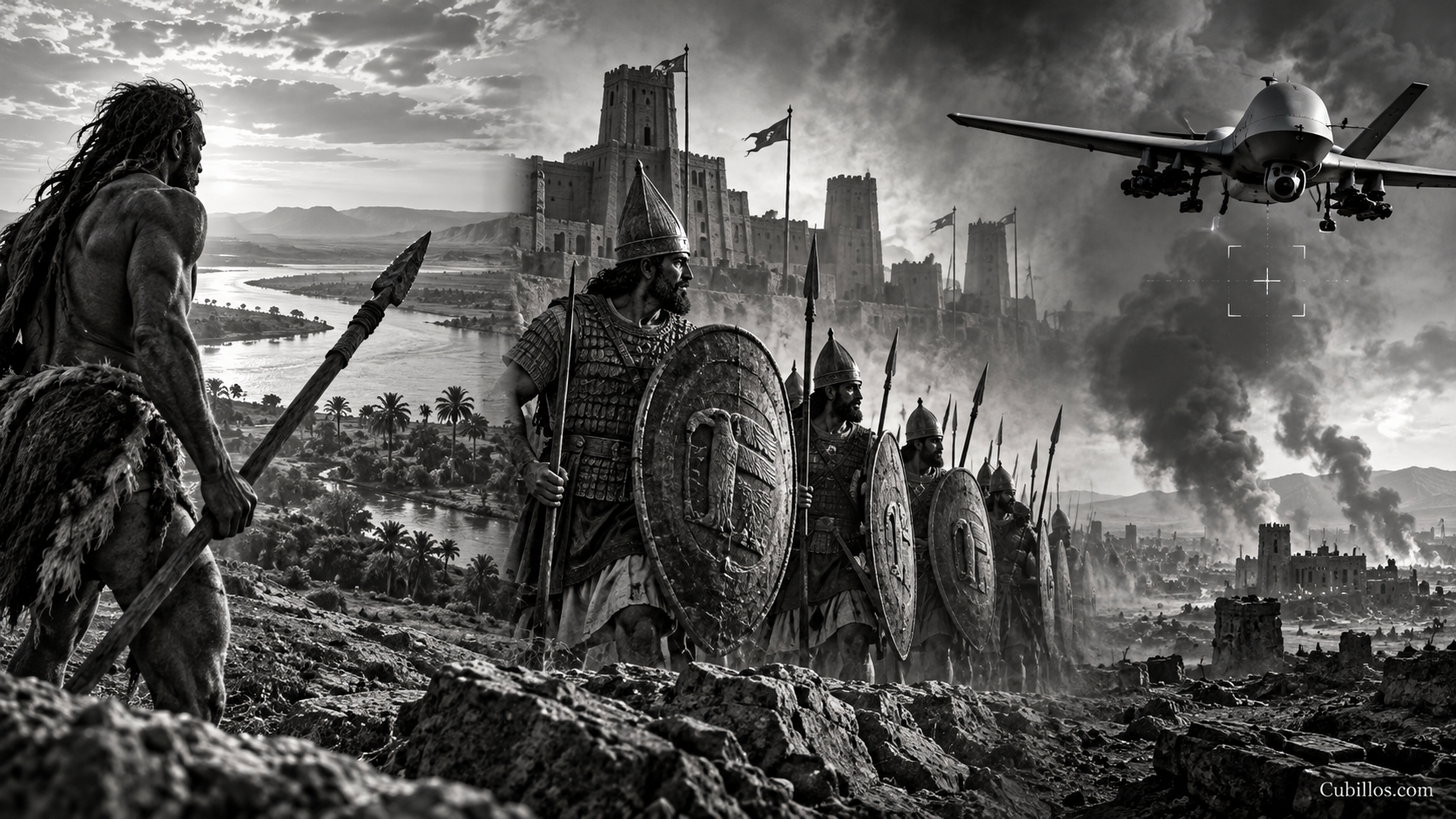
Human beings have been killing one another for so long that archaeologists have to dig through thousands of years of dirt just to find the evidence.
And wouldn’t you know it, we’re still at it.
More than 13,000 years ago, along the Nile in what is now Sudan, people were killing one another with stone-tipped weapons.
At a place called Jebel Sahaba, archaeologists uncovered a prehistoric burial ground containing the remains of 61 men, women, and children.
Many had suffered violent injuries. Some had survived earlier attacks, only to be wounded again.
A 2021 study published in Scientific Reports identified more than 100 previously undocumented injuries. The evidence suggested repeated episodes of violence, probably raids, ambushes, and smaller confrontations rather than one great battle.
But the researchers also identified something that ought to sound familiar.
Environmental change.
The region was experiencing major climatic changes that may have intensified competition for the resources necessary to survive.
Water. Food. Land.
People may have been killing one another over the necessities of life thousands of years before anyone invented the nation-state.
There were no historians to record the fighting. No monuments celebrating victory. No surviving speeches explaining why the killing was necessary.
Just the dead.
And the weapons that helped put them there.
By around 2700 BCE, warfare was beginning to appear in the surviving historical record. The accounts were fragmentary, sometimes mixing legend with history, but the names of kings and their conflicts were beginning to survive.
By approximately 2450 BCE, the Sumerian city-states of Lagash and Umma were fighting over agricultural land and irrigation rights.
Water. Food. Land.
Again.
Their conflict was commemorated on the Stele of the Vultures, a stone monument depicting soldiers advancing in formation, carrying shields and weapons under the command of their ruler.
Here were organized armies fighting over disputed territory and access to resources.
The Sumerians had developed cities, governments, laws, irrigation systems, and written language.
They had also developed organized warfare.
Civilization was making remarkable progress.
Human nature apparently wasn’t keeping up.
By the time Jesus was born, warfare was already an ancient profession.
The Egyptians had fought their wars. So had the Assyrians, Babylonians, Persians, Greeks, and Romans.
Empires had risen and fallen. Armies had marched across continents. Generations of young men had died for rulers whose names most people couldn’t remember today.
And then Jesus came along preaching peace.
Humanity has been arguing about that ever since.
I continued studying it in college and eventually began reporting on the military. Over the years, I’ve followed the wars, the weapons, the strategies, and, most importantly, the men and women expected to carry out the orders.
After all that reading, studying, and reporting, I’ve reached a rather depressing conclusion.
We still haven’t figured out how to stop.
My friend Army Lt. Col. Antonio Salinas recently got me thinking about this again.
Antonio is a combat veteran and an expert on ancient warfare. That’s a combination worth paying attention to.
He understands the history of men fighting thousands of years ago, but he also knows something that cannot be learned entirely from books.
What happens when somebody starts shooting at you.
His reflections on warfare reminded me that beneath all the military technology, elaborate strategies, and grand speeches, war remains a contest of human wills.
And human beings haven’t changed nearly as much as their weapons.
The Bible got to the heart of the matter early.
Cain killed Abel.
There were no competing nations. No disputed international boundaries. No military-industrial complex. No defense appropriations bill.
Just two brothers, and one killed the other.
You don’t have to accept Genesis as literal history to appreciate what that story says about human nature.
We have a remarkable capacity for kindness, generosity, sacrifice, and compassion.
We also have an extraordinary talent for finding reasons to kill one another.
Sometimes those reasons involve survival. Sometimes territory, religion, power, or fear.
And sometimes plain old human ambition.
The people buried at Jebel Sahaba may have been fighting over dwindling resources. The Sumerians fought over agricultural land and irrigation rights.
Today, nations still regard access to water, energy, food, and territory as matters of national security.
The motivations haven’t disappeared.
We’ve simply developed increasingly sophisticated ways of settling the arguments.
Wars are not all the same, and neither are the people who fight them.
There is a world of difference between invading another country and defending your home against an invader.
Soldiers don’t necessarily choose the wars they fight. Often, they are the people who pay the highest price for decisions made far from the battlefield.
That’s something worth remembering whenever political leaders start talking enthusiastically about military action.
The people making the speeches generally aren’t the ones who have to crawl through the mud.
The people who do are usually young enough to be their children.
And while the reasons for war may be familiar, the weapons have undergone an astonishing transformation.
Stone-tipped spears gave way to bronze swords. Bronze gave way to iron. Gunpowder transformed the battlefield.
Industrialization brought machine guns, long-range artillery, tanks, and aircraft.
Then we split the atom.
One of humanity’s greatest scientific achievements became the foundation for weapons capable of destroying entire cities.
That ought to have given us something to think about.
Instead, we built more.
We developed missiles capable of crossing continents, submarines capable of remaining hidden beneath the oceans, and bombers capable of delivering destruction from halfway around the world.
We created military academies, war colleges, strategic doctrines, and libraries filled with studies of past conflicts.
We’ve studied Hannibal, Alexander, Caesar, Napoleon, Grant, Sherman, Patton and Schwarzkopf.
We’ve examined their victories, dissected their mistakes, and tried to understand what made them successful.
And what have we learned?
Quite a lot, actually.
Mostly about how to fight the next war.
Artificial intelligence and autonomous weapons are beginning to change the battlefield.
Drones already conduct reconnaissance, track potential targets, and attack enemy forces. Some are remotely operated by human beings. Others have varying degrees of automated navigation, tracking, and targeting capability.
Those distinctions matter.
A drone controlled by a human operator is not the same thing as an autonomous weapon capable of selecting and engaging a target without further human intervention.
But the technology is moving toward systems capable of making more decisions on their own.
And that ought to make everybody just a little nervous.
For thousands of years, human beings have made the decisions that sent armies into battle.
Kings ordered attacks. Generals directed campaigns. Soldiers aimed their weapons.
Modern warfare has already complicated that picture. Mines, automated defensive systems, and other weapons can operate without a human approving every individual engagement.
But artificial intelligence introduces the possibility of delegating increasingly complex decisions to machines.
We are approaching a world in which software may determine which human being is a target, when to attack, and how to carry out that attack.
Think about that for a moment.
At Jebel Sahaba, someone had to launch a spear or arrow.
At Lagash, soldiers advanced under the command of their ruler.
At Gettysburg, men aimed rifles and artillery at other men.
At Iwo Jima, Marines fought their way across volcanic terrain against an enemy determined to resist.
The weapons changed. The distances changed. The scale of destruction changed.
But human beings remained directly involved in the decisions and actions that killed other human beings.
Now we’re developing weapons that may increasingly make those decisions without a person approving every individual attack.
The military advantages are obvious.
Machines don’t get tired. They don’t need sleep. They can process enormous amounts of information faster than human beings. They can operate in environments too dangerous for soldiers.
Autonomous systems may help protect American troops and, if properly designed and employed, could reduce some of the mistakes that cost innocent lives.
Those are legitimate military objectives.
But there’s another side to this.
Machines don’t possess human moral judgment.
They don’t understand grief.
They don’t have families waiting for them at home.
They don’t carry memories of the people they’ve killed.
And they don’t have to live with the consequences of a terrible decision.
Human soldiers do.
Ask a combat veteran.
Ask Antonio Salinas.
We have spent thousands of years trying to make warfare more efficient.
We have developed increasingly sophisticated methods of finding the enemy, reaching the enemy, and destroying the enemy.
But the fundamental problem remains exactly where it was when Cain raised his hand against Abel.
Human nature.
The archaeological evidence from Jebel Sahaba suggests that environmental pressures may have contributed to repeated violence more than 13,000 years ago.
The historical record from Lagash and Umma shows organized armies fighting over agricultural land and irrigation rights thousands of years later.
Today, the world’s militaries are preparing for conflicts involving artificial intelligence, autonomous weapons, and machines operating at speeds beyond human reaction times.
Yet the underlying disputes remain painfully familiar.
Territory. Resources. Power. Fear. Survival.
Technology didn’t create our willingness to fight.
It simply gave us better tools.
And now we’re preparing to give some of those tools the ability to make decisions once reserved for human beings.
There’s an irony in that.
We haven’t figured out how to keep ourselves from going to war, but we’re getting remarkably close to building machines that can help us fight one with less direct human involvement.
Somewhere, a defense contractor is probably preparing a PowerPoint presentation explaining why that’s progress.
And from a purely military standpoint, parts of it may well be.
A weapon that protects American troops deserves serious consideration. A system that improves defensive reaction times or reduces civilian casualties shouldn’t be dismissed simply because it uses artificial intelligence.
But effectiveness is not the same thing as wisdom.
And technological capability is not the same thing as moral judgment.
The question isn’t simply whether we can build autonomous weapons.
We can.
The question is how much authority we’re willing to give them, under what circumstances, and who answers when something goes terribly wrong.
Those questions belong to commanders, lawmakers, engineers, and the public.
They certainly shouldn’t be left entirely to the people selling the equipment.
They marched into battle carrying shields and spears, fighting over land and water.
We send aircraft carriers across oceans, launch missiles from submarines, and deploy machines that can search for targets from the sky.
Our weapons would seem like magic to them.
Our reasons for fighting probably wouldn’t.
Nearly five thousand years of recorded warfare, and the list hasn’t changed all that much.
After a lifetime studying military history and reporting on the people who fight our wars, I’ve learned enough to be suspicious of anyone who claims to have a simple solution.
There are times when fighting is necessary. History has demonstrated that plainly enough. Refusing to resist aggression doesn’t guarantee peace. Sometimes it merely guarantees defeat.
But recognizing the necessity of military force is not the same as accepting endless warfare as humanity’s inevitable destiny.
We ought to be capable of something better.
And perhaps that’s what bothers me most.
We can put human beings on the moon. We can explore distant planets. We can build computers capable of performing tasks that once required years of human study.
Yet we still haven’t solved a problem that predates recorded history.
How to keep human beings from killing one another.
And here we are.
Still fighting.
Still burying our dead.
Still promising the next generation that somehow, someday, things will be different.
Thirteen thousand years of evidence that human beings can kill one another, and we still haven’t figured out how to stop.
Now we’re teaching machines how to do it for us.