
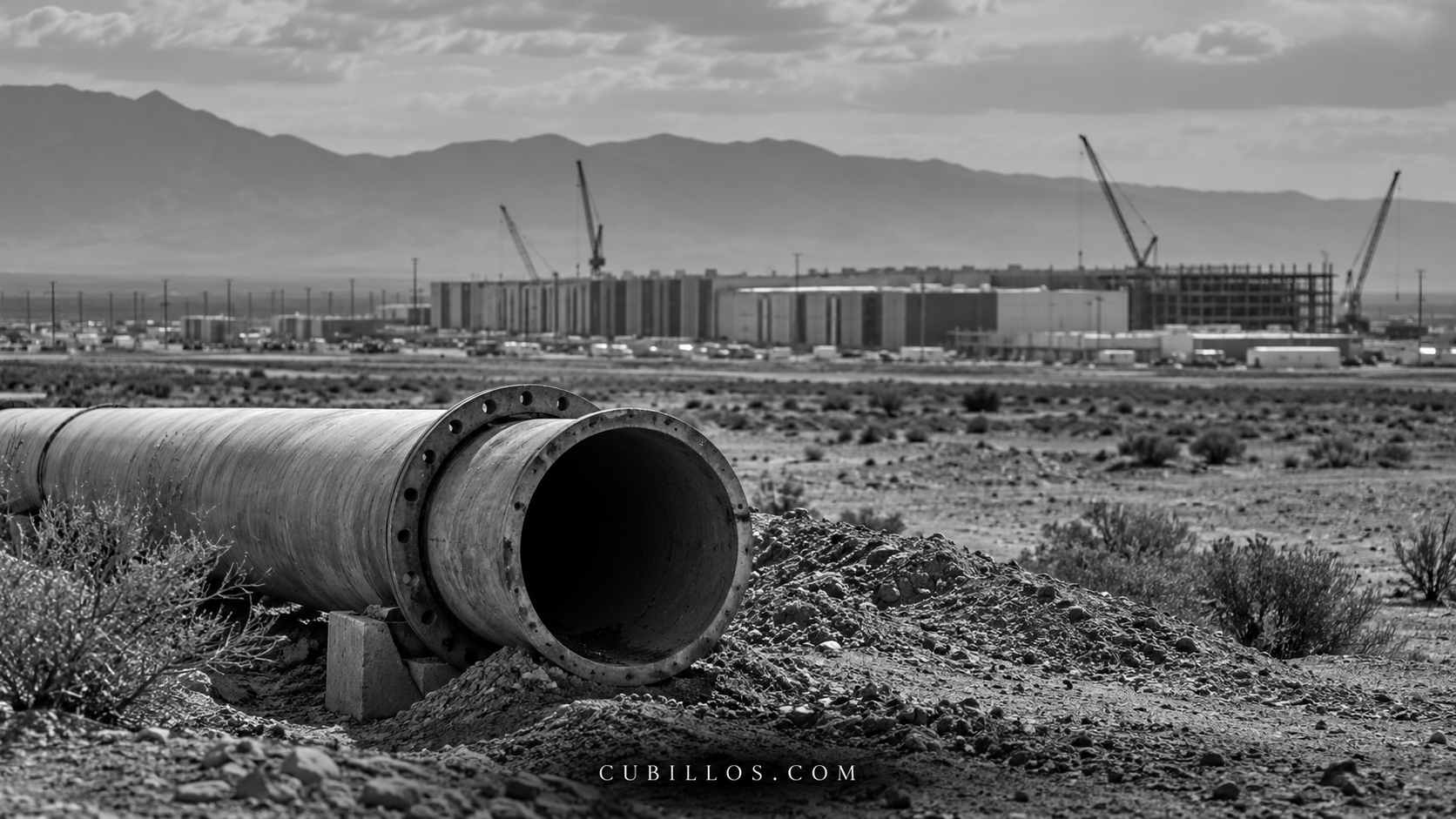
Imperial Valley’s controversial AI project has already produced lawsuits over water rights and environmental review. Now a federal civil rights case raises another question: What happened to a water agreement the city said it was preparing?
The City of Imperial, California, had something a developer wanted.
Water.
Not Colorado River water delivered directly from the Imperial Irrigation District. Not water taken from farmers. Not even drinking water.
Treated wastewater.
The developer of a proposed $10 billion artificial intelligence data center wanted to purchase reclaimed water from the city to cool its enormous computer complex.
The developer offered to pay for the engineering, treatment-system upgrades and infrastructure needed to deliver it.
City officials initially appeared interested.
Engineers went to work. Meetings were held. Emails were exchanged.
Months later, the city manager was still talking about preparing a water-service agreement.
Then the agreement never materialized.
And now the whole thing is part of a federal civil rights lawsuit.
Welcome back to Imperial Valley, where a proposed data center has managed to turn water, zoning regulations and government paperwork into a growing collection of court cases.
The latest question is a simple one.
What happened to the water agreement?
First, a little history
I’ve written twice about this project.
In June, I examined the developer’s lawsuit against the Imperial Irrigation District, which had denied an application for approximately 287 million gallons of Colorado River water annually.
The public discussion suggested an enormous AI company was trying to grab water from an already stressed river.
The lawsuit told a different story.
The developer argued that the irrigation district had rejected its application using a regulation intended for a different type of water service.
Whether that argument holds up is for a judge to decide.
But it raised an interesting question about government agencies and the regulations they use.
Then, in September, I wrote about a California judge ordering a full environmental review of the proposed data center.
That project isn’t exactly a neighborhood computer repair shop.
We’re talking about a facility approaching one million square feet, requiring 330 megawatts of electricity, an enormous battery system and 132 natural-gas generators.
The judge concluded that Imperial County could not avoid examining the environmental consequences of the larger development.
Fair enough.
If somebody proposes building an industrial complex of that magnitude next to your neighborhood, asking what it will do to the environment seems reasonable.
But there’s another story running through these disputes.
It concerns the City of Imperial itself.
And it began well before the irrigation district’s water denial or the judge’s environmental ruling.
The city wanted to talk
According to a 52-page federal complaint filed January 9, 2026, Imperial Valley Computer Manufacturing began discussing its project with Imperial officials in 2024.
The company initially wanted to build on industrial land inside the city.
By Feb. 2025, developer Sebastian Rucci was asking city officials about zoning compliance and purchasing reclaimed wastewater.
The city’s initial response sounded encouraging.
City Planner Yvonne Cordero wrote that officials looked forward to working with the developer.
On March 4, representatives of the company met with city officials, including Community Development Director Othon Mora and City Engineer David Dale.
According to the complaint, the city expressed considerable interest in selling reclaimed wastewater.
There were conditions.
The developer would have to pay for the engineering, treatment-system improvements and infrastructure necessary to provide the water.
The developer says it agreed.
The following day, city officials discussed hiring an engineering consultant to prepare the required California Title 22 recycled-water documentation.
Title 22 establishes standards governing the treatment and use of recycled wastewater.
This wasn’t simply a matter of connecting a garden hose to a wastewater plant.
There were engineering requirements, regulatory approvals and infrastructure questions to resolve.
The developer retained Webb and Associates to begin the work.
So far, this sounds like an ordinary negotiation between a city and a prospective industrial customer.
Then the zoning fight began
The relationship between Imperial and the developer deteriorated over a different issue.
The developer believed its data center qualified as a permitted industrial use under existing zoning regulations.
The city disagreed.
Imperial officials maintained that the project required additional review, including public consideration of its environmental impacts.
City Manager Dennis Morita subsequently explained that city leaders wanted neighboring residents to have a voice in the approval process.
That’s a legitimate concern.
A nearly million-square-foot data center, with enormous electrical requirements and substantial backup-generation equipment, is going to affect the surrounding community.
The developer, however, argued that the city was attempting to impose discretionary approval requirements that its own municipal code did not authorize.
That disagreement eventually drove the developer to withdraw its original city application in August 2025 and pursue the project on neighboring county land.
But here’s where the story becomes interesting.
The water negotiations apparently continued.
The developer no longer wanted to build the facility inside Imperial.
It still wanted to buy the city’s reclaimed wastewater.
Those are two separate transactions.
A city can oppose a development proposal while negotiating to sell a utility service to a project outside its boundaries.
Whether it must provide that service is another question.
And that question is now tangled up in federal court.
The engineer said the water was available
On June 16, 2025, city engineers and representatives of the developer held a video meeting about reclaimed wastewater.
According to the federal complaint, City Engineer Dale said the proposed 750,000 gallons per day was within Imperial’s recycled-water capabilities.
The following day, Dale discussed how the city would calculate the price.
That correspondence is revealing.
Dale explained that the city could not simply charge whatever it wanted. The cost would have to reflect treatment expenses, including additional personnel, disinfection, pumping and pipeline maintenance.
In other words, the city wasn’t promising free water.
It was working through the costs of providing an industrial utility service.
By Aug. 14, the engineering work had progressed further.
Dale forwarded a reclaimed-water report outlining the infrastructure needed to deliver water from the city’s wastewater treatment plant.
The proposal included approximately two miles of recycled-water pipeline.
Four days later, Dale confirmed that he had forwarded the proposed pipeline route to the engineering consultant.
Those details matter.
They suggest the negotiations had moved beyond an informal conversation about whether water might someday be available.
There was engineering work underway.
There was a proposed pipeline.
There were discussions about treatment requirements and pricing.
None of that establishes that the city had entered into a binding agreement.
But it does establish that the developer’s proposal was receiving serious consideration.
At least according to the correspondence reproduced in the federal complaint.
Nov. 26: A curious day
By November, the developer was becoming impatient.
On Nov. 12, company representatives emailed City Attorney Katie Turner, complaining that the reclaimed-water request had been pending for months.
They asked the city to say directly if it did not want to sell the water.
That’s a reasonable request.
If the answer is no, say no.
On Nov. 20, the developer’s representative, Tom Dubose, asked City Manager Morita about the draft water-service agreement.
Morita responded that he understood the draft would be ready shortly.
Six days later, on Nov. 26, Morita sent another message.
The city was still working on the reclaimed-water agreement, he said.
He also mentioned that Imperial was contacting the neighboring City of El Centro.
That detail becomes important.
Because on the same day, Imperial published a public notice expressing concerns about the proposed data center, now planned for land outside the city limits.
The notice warned residents about the project’s unprecedented size and encouraged public participation in the county approval process.
There’s nothing inherently improper about that.
Cities routinely comment on developments outside their boundaries when those developments could affect their residents.
And a 330-megawatt data center certainly qualifies as something worth examining.
But consider the sequence.
In the morning, the city manager was discussing a water-service agreement.
That afternoon, the city was publicly raising concerns about the project.
The two positions are not necessarily contradictory.
A city can be willing to sell water while opposing the way a project is being approved.
But it raises an obvious question.
Was Imperial still genuinely interested in supplying reclaimed water, or had the negotiations become another front in its opposition to the development?
The federal lawsuit alleges the latter.
The city disputes the developer’s broader account of its conduct.
And the available correspondence doesn’t establish which interpretation is correct.
Then El Centro entered the picture
The developer wasn’t relying exclusively on Imperial.
It had also approached neighboring El Centro about purchasing reclaimed wastewater.
According to the federal complaint, El Centro issued a conditional will-serve letter indicating that water service might be available subject to further requirements.
Imperial officials subsequently requested a copy of that document.
The developer provided it.
On Dec. 12, El Centro publicly clarified that it had made no binding commitment to supply reclaimed water to the project.
The federal complaint alleges that Imperial improperly interfered with the developer’s negotiations with El Centro.
That’s a serious accusation.
But the chronology alone doesn’t prove it.
A conditional will-serve letter is not necessarily a final contract.
El Centro’s statement could have been a routine clarification of its legal obligations.
It could also reflect concerns that emerged during discussions with Imperial.
We don’t know.
What we do know is that the developer was pursuing reclaimed wastewater from two cities and ultimately failed to secure a finalized agreement with either.
That failure would have consequences.
Because the developer still needed cooling water.
And its next stop was the Imperial Irrigation District.
From wastewater to the Colorado River
This is where the federal lawsuit connects directly to my June column, The AI Water Grab That Might Not Be.
After the reclaimed-water negotiations failed, Imperial Valley Computer Manufacturing sought water service from the Imperial Irrigation District.
The district denied the application.
The developer sued.
The complaint argued that the district had applied the wrong regulation and that the property already possessed certain water-service rights.
Suddenly, a project originally proposing to use reclaimed wastewater was seeking hundreds of millions of gallons annually from the Colorado River.
And the headlines practically wrote themselves.
An AI data center wanted Colorado River water.
Technically true.
But the history behind that application was considerably more complicated.
The developer says it first tried to purchase treated wastewater.
It offered to finance infrastructure improvements.
It hired engineers.
It negotiated with two municipalities.
Those negotiations failed.
Only then did it turn to the irrigation district.
That sequence doesn’t automatically entitle the company to Colorado River water.
Nor does it establish that the cities acted improperly.
But it belongs in any serious discussion about how the project ended up seeking river water in the first place.
Otherwise, we’re examining the last chapter while ignoring the preceding ones.
The federal lawsuit
On Jan. 9, 2026, Imperial Valley Computer Manufacturing filed a federal civil rights lawsuit against the City of Imperial and several officials.
The case was filed in the U.S. District Court for the Southern District of California.
The company alleges violations of its First and Fourteenth Amendment rights under 42 U.S.C. § 1983.
That’s the federal statute allowing civil lawsuits against government officials accused of violating constitutional rights.
The developer’s allegations go well beyond the water negotiations.
The complaint accuses city officials of deliberately delaying permit applications, imposing unauthorized approval requirements, retaliating against the company for asserting its legal rights and interfering with its efforts to obtain utilities.
The company also alleges that the city breached an implied agreement to provide reclaimed water.
Those are allegations.
They are not findings by a court.
The city has sought dismissal of the lawsuit, arguing, among other things, that its review procedures were discretionary and that the developer’s constitutional claims are legally insufficient.
That distinction is important.
A developer doesn’t acquire a constitutional right to build something merely because it believes the zoning code permits it.
And a city doesn’t acquire unlimited authority to disregard its own ordinances merely because officials dislike a proposed development.
The law establishes boundaries for both.
The federal court must determine whether the developer has stated legally sufficient claims and, if the case proceeds, whether the evidence supports them.
The city filed its motion to dismiss in March. The parties completed briefing in April.
An Aug. 5 City Council agenda continued to identify the federal case as existing litigation.
What about the city’s explanation?
Here’s what I find particularly interesting.
Imperial has publicly explained its objections to the data center’s approval process.
City officials wanted environmental review.
They wanted residents to participate.
They questioned whether existing zoning permitted a development of this magnitude without additional scrutiny.
Those are understandable positions.
And the subsequent state court ruling requiring a full environmental review gives considerable weight to concerns about the county’s approval process.
But that is not the same question as whether Imperial should sell reclaimed wastewater.
The city’s wastewater system required improvements.
The developer says it offered to pay for them.
The city engineer discussed the necessary treatment, infrastructure and pricing.
The city manager subsequently said a draft agreement was being prepared.
Yet no final agreement emerged.
In the publicly available records I’ve examined, I have not found a definitive city explanation identifying the particular engineering, financial, regulatory or policy obstacle that prevented the agreement from being completed.
The Salton Sea argument
There’s another wrinkle.
The developer claims its reclaimed-water proposal would have produced environmental benefits beyond cooling the data center.
According to the federal complaint, the company proposed purchasing as much as six million gallons of reclaimed wastewater daily from Imperial and El Centro.
Only about 750,000 gallons would be needed for cooling.
The remaining treated water, the company says, could be directed toward the watershed feeding the shrinking Salton Sea.
The developer also proposed financing substantial improvements to municipal wastewater facilities.
That sounds attractive.
The Salton Sea desperately needs water.
As it shrinks, exposed lakebed contributes to dust and air-quality problems affecting nearby communities.
But there’s an important qualification.
Wastewater from Imperial Valley communities already contributes to the Salton Sea watershed.
Treating that water and redirecting it doesn’t necessarily create a new water supply.
The environmental benefit depends on how much additional water actually reaches the sea, how much is consumed by the data center, and what would have happened to the wastewater otherwise.
Those calculations require independent examination.
The developer’s proposal may have merit.
It may also be considerably less beneficial than advertised.
That’s precisely the sort of question an environmental review is supposed to answer.
Three lawsuits, three different questions
Imperial Valley’s proposed AI data center has now produced three major legal disputes.
The first concerns the Imperial Irrigation District and whether it lawfully denied the developer’s request for Colorado River water.
The second concerns Imperial County and whether officials improperly approved the development without adequate environmental review.
A judge has already ruled that the county must conduct a full review.
The third concerns the City of Imperial and whether its treatment of the developer violated federal constitutional protections.
Those cases overlap.
But they ask different questions.
And they shouldn’t be confused.
The state environmental ruling does not establish that Imperial violated the developer’s civil rights.
The federal lawsuit does not establish that the data center is environmentally acceptable.
And the irrigation district’s water denial does not establish that the developer has no lawful claim to water service.
Each dispute has its own legal standards and evidence.
Which is why I keep returning to the chronology.
The developer approached the city.
The city discussed selling reclaimed water.
Engineers began working on the proposal.
The developer agreed to finance improvements.
The city manager said an agreement was being prepared.
The agreement never materialized.
The developer sought another water source.
That application was denied.
And everybody went to court.
The question nobody has answered
There are legitimate reasons to oppose this data center.
Its electrical demands are enormous.
Its backup-generation system raises environmental questions.
Its water requirements deserve scrutiny.
And residents living near the proposed development have every right to know what may be built next door.
There are also legitimate reasons to question how government agencies exercise their authority.
Rules should mean something.
Approval procedures should be followed.
And government decisions should be explainable.
That’s not an argument for the developer.
It’s an argument for accountable government.
Perhaps Imperial had an entirely legitimate reason for not completing the reclaimed-water agreement.
Perhaps the engineering didn’t work.
Perhaps the financial terms were unacceptable.
Perhaps the city’s legal obligations made the arrangement impractical.
Or perhaps the developer’s allegations of administrative obstruction will eventually find support in the evidence.
We don’t know.
But after examining the correspondence and the chronology, I keep coming back to something rather ordinary.
On Nov. 26, 2025, the city manager said Imperial was working on the reclaimed-water agreement.
Nearly a year later, we still don’t have a clear public explanation of why it wasn’t completed.
Meanwhile, the developer is fighting over Colorado River water, the county has been ordered to conduct a full environmental review, and a federal civil rights lawsuit has placed the city’s conduct under scrutiny.
For a project supposedly about the future of artificial intelligence, an awful lot of this comes down to an old-fashioned question.
If the city wasn’t going to sell the water, why didn’t it just say so?
And if it was going to sell the water, what stopped it?
Those seem like reasonable questions.
Somebody in Imperial ought to answer them.