
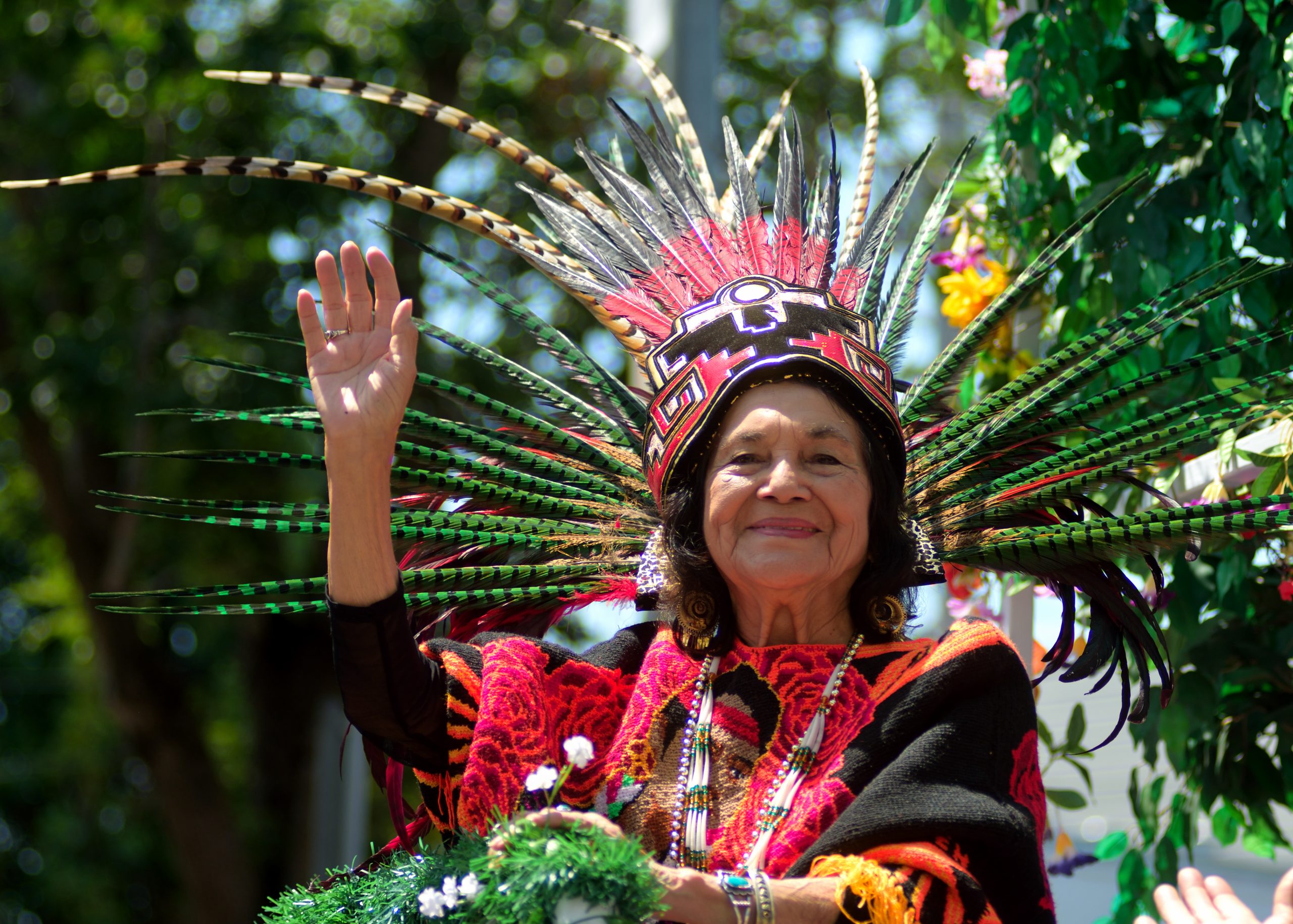
The last time I saw Dolores Huerta, she was standing on an outdoor stage in San Diego, speaking to a few hundred people about immigration and the Republican Party.
It was August 1996, and I was covering the Republican National Convention for La Prensa San Diego.
The Republicans had come to town to nominate Bob Dole for president. Huerta, one of the most important figures in the Chicano civil rights and American labor movements, had come to challenge the party’s immigration policies.
The authorities had thoughtfully provided a place for her to exercise her constitutional right to free speech.
Behind a chain-link fence.
Across the trolley tracks from the convention center.
Far enough away that the delegates wouldn’t have to hear what she had to say.
Now, there’s a fine American arrangement. You can say anything you want, provided you say it somewhere nobody important has to listen.
I was covering both the convention and the protests for La Prensa San Diego. Inside, Republican delegates were conducting the business of nominating a presidential candidate and presenting their vision for America.
Outside, Huerta was telling a different story.
I remember perhaps 200 to 300 people gathered around the outdoor stage. San Diego police stood outside the chain-link fence. Other officers watched from nearby rooftops.
And there was Huerta, speaking about immigration and the policies of a political party whose delegates were safely beyond the reach of her voice.
I don’t remember her exact words. Thirty years will do that to a fellow’s memory.
But I remember the fence.
And I remember her.
She was born in Dawson, N.M., in 1930 and grew up in Stockton, Calif. She became a teacher, but what she encountered in her classroom changed the direction of her life.
Children arrived at school hungry. Some lacked shoes or decent clothing. Their parents worked in the fields, producing the food that filled American dinner tables, yet often couldn’t afford to feed their own families properly.
Huerta concluded that helping those children meant changing the conditions under which their parents worked.
So she became an organizer.
In 1962, she and César Chávez founded the National Farm Workers Association, which eventually became part of the United Farm Workers.
Chávez became the movement’s most recognizable public figure. Huerta was one of its principal architects.
She organized workers, negotiated contracts, helped lead boycotts and confronted politicians who would have preferred that farmworkers remain invisible.
She was also a woman operating in a movement, and a country, where men were generally expected to lead and women were expected to help.
Huerta had other ideas.
She helped turn the Delano grape strike into a national struggle over wages, working conditions and human dignity.
The grape boycott reached into American supermarkets and kitchens. Consumers thousands of miles from California’s vineyards began asking who picked their food and how those workers were treated.
That was the genius of the farmworker movement. It connected the people doing the labor with the people enjoying its benefits.
And Huerta understood something that remains true today: Political power doesn’t arrive as a gift. People have to organize to claim it.
She also gave the movement three words that would outlive generations of political campaigns.
Sí, se puede.
Yes, it can be done.
Those words weren’t a marketing slogan dreamed up by a political consultant. They were an expression of determination by people who had been told, repeatedly, that the changes they wanted were impossible.
Two years earlier, voters had approved Proposition 187, a measure intended to deny undocumented immigrants access to certain public services, including public education and nonemergency health care.
Republican Governor Pete Wilson had made illegal immigration a centerpiece of his political identity.
The measure was tied up in the courts, but the political damage was already being done.
For many Mexican Americans, the debate wasn’t simply about immigration enforcement. It was about belonging.
Families that had lived in California for generations were watching politicians build campaigns around suspicion of people who looked like them, spoke like them or carried Spanish surnames.
And there, in San Diego, was Huerta, challenging those policies from a stage surrounded by chain-link fencing.
The location of that stage was no accident.
The arrangements for protesters at the Republican convention had already become a constitutional controversy.
Convention organizers and city officials initially wanted demonstrators placed farther from the convention center. Civil liberties advocates challenged the restrictions, and a federal judge intervened.
The resulting protest area was roughly 400 feet from the delegates, separated by trolley tracks and surrounded by a 12-foot-high chain-link fence.
The Washington Post described the arrangement at the time.
The protesters had won the right to demonstrate closer to the convention.
Closer, mind you.
Not necessarily close enough to be heard.
I have often wondered what the people who designed that protest area thought they were accomplishing.
Perhaps they believed they were protecting the convention.
Perhaps they believed they were maintaining public order.
Or perhaps they understood perfectly well that a protest loses much of its political force when it is separated from the people it seeks to influence.
The First Amendment protects the right to speak. It doesn’t guarantee that anyone will listen.
But there is something profoundly cynical about creating a designated area for political dissent and arranging things so the people being protested can go about their business without interruption.
The delegates could nominate their candidate.
The protesters could exercise their constitutional rights.
The police could keep the two groups separated.
Everybody was happy.
Well, everybody except the people trying to make themselves heard.
Farmworkers had been told they were essential to the economy but not important enough to receive decent wages or safe working conditions.
Women had been told they could participate in political movements but should leave leadership to men.
Mexican Americans had been told they were part of the American story while politicians regularly treated them as outsiders.
Huerta refused to accept those arrangements.
She wasn’t alone, of course. The Chicano movement produced an extraordinary generation of organizers, activists, lawyers, journalists and political leaders who challenged institutions that had long taken their communities for granted.
Some worked through the courts. Others organized voters, marched in the streets, built community organizations or confronted politicians directly.
Huerta helped demonstrate that economic justice and civil rights were inseparable.
A farmworker’s wages, a child’s education, a family’s access to health care and a community’s political representation were not separate struggles.
They were different parts of the same fight over who counted in America.
And she understood that the struggle didn’t end with a legislative victory or a signed labor contract.
It required constant attention.
Constant organizing.
And sometimes the willingness to stand behind a chain-link fence and speak to whoever showed up.
In March 2026, Huerta publicly disclosed that Chávez had sexually assaulted her decades earlier. She said she had remained silent to protect the farmworker movement.
The revelation forced a painful reconsideration of a man long celebrated as a civil rights hero and raised difficult questions about the sacrifices women sometimes made to preserve movements larger than themselves.
It also reminded us that history is rarely as tidy as the monuments we build to commemorate it.
The achievements of the farmworker movement remain real. So do the injuries suffered by people within it.
Acknowledging one doesn’t erase the other.
For decades, Huerta’s contributions were often overshadowed by those of Chávez. Her organizing, negotiating and political work helped sustain a movement whose history was too frequently told through the accomplishments of one man.
Her own story deserves to be told without requiring her to stand in anyone else’s shadow.
She helped transform the lives of agricultural workers. She fought for women’s rights, political representation and economic justice.
And she continued organizing long after most people her age had retired from public life.
There were victories, setbacks, compromises and disappointments.
That’s how social change works.
It doesn’t arrive neatly packaged with a ribbon and a presidential signature.
More often, it comes from people who spend years knocking on doors, organizing meetings, challenging powerful institutions and refusing to accept that the way things have always been is the way they must remain.
Huerta understood that better than most.
For someone who had spent decades confronting governors, corporations and political institutions, speaking to a few hundred people behind a fence may have been just another day’s work.
But I remember it.
I had spent time inside the convention center, where political power was on display. There were delegates, speeches, television cameras and all the carefully orchestrated pageantry of a national political convention.
Outside was another America.
One whose people had come to challenge the policies being celebrated inside.
The distance between those two worlds wasn’t particularly great in physical terms.
But politically, it might as well have been a thousand miles.
Somewhere among my photographs from that convention, I may still have an image of Huerta standing on that stage.
I’ll have to find it.
What I remember without a photograph is a woman who had spent her life demanding that people in power listen to those who had been ignored.
And there she was, still demanding it.
The politicians were inside the convention center.
The police were watching.
The chain-link fence was doing its job.
And Dolores Huerta was speaking anyway.
Sí, se puede.