
I learned something about words a long time ago.
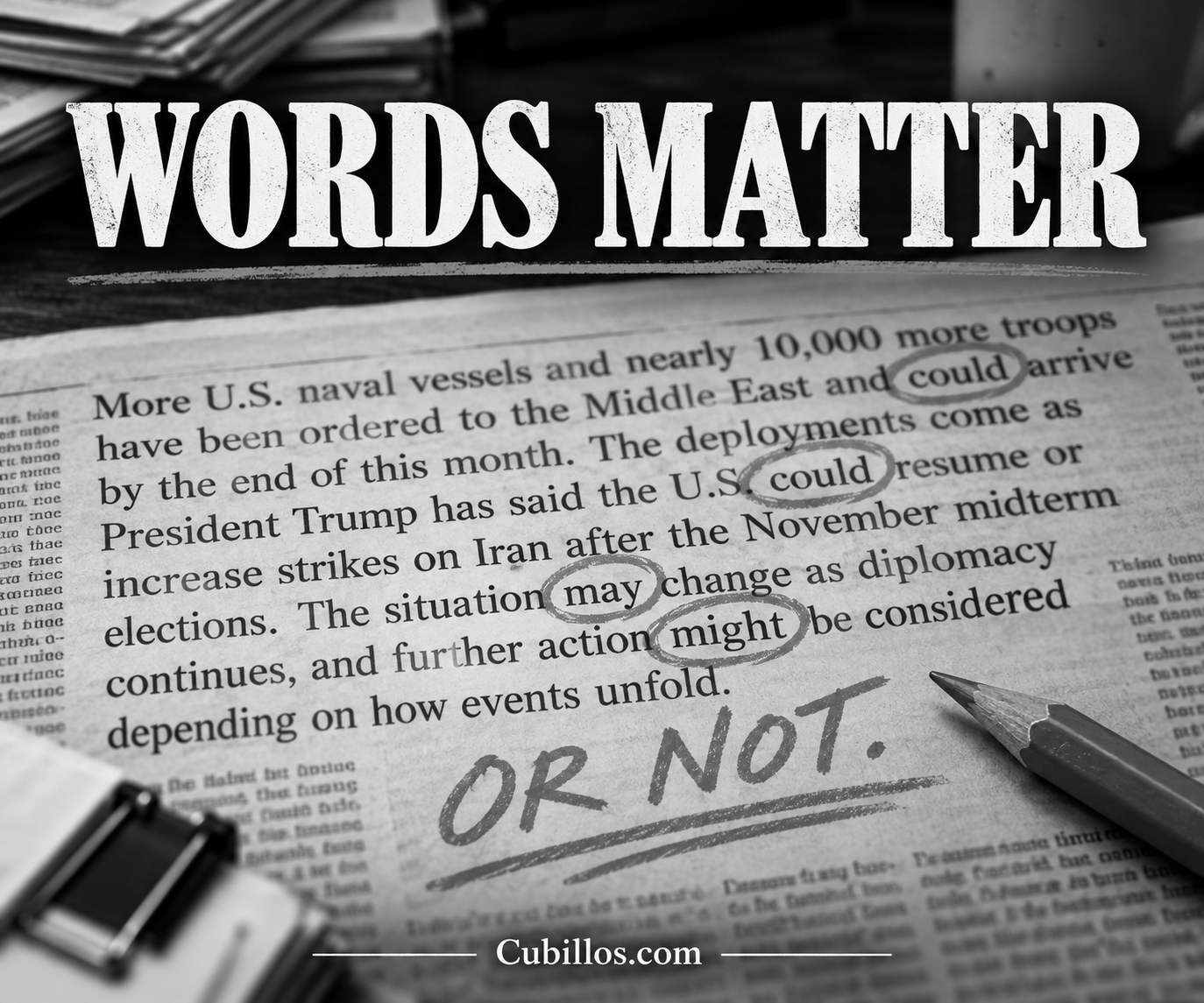
When you see the word “could” in a news story, add two words to it:
Or not.
The same goes for “may.”
May happen.
May not.
That isn’t a lesson in grammar. It’s a lesson in journalism.
CBS News gave us a fine example the other day.
The network reported:
“More U.S. naval vessels and nearly 10,000 more troops have been ordered to the Middle East and could arrive by the end of this month…”
Stop there.
There are two very different things in that sentence.
The troops have been ordered to the Middle East.
That’s a fact.
They could arrive by the end of the month.
That’s a possibility.
They could also arrive later. Their orders could change. Circumstances could change. Some could be delayed.
CBS then added:
“The deployments come as President Trump has said the U.S. could resume or increase strikes on Iran after the November midterm elections.”
There’s our word again.
Could.
The United States could resume strikes.
It also could not.
Those are not equivalent to saying the United States will resume strikes, plans to resume strikes or is sending those forces in order to resume strikes.
But put the sentences together and look at what the reader sees:
Nearly 10,000 more troops.
Middle East.
More ships.
Trump.
Strikes on Iran.
The words never quite say those troops are being sent there for another round of attacks on Iran.
They don’t have to.
The arrangement does the work.
And that’s the problem.
A fact followed by possibilities
We have already been following these military movements at The Military Report. And there is another important piece of context: deployment does not automatically mean reinforcement.
Military forces rotate.
Ships arrive. Ships leave. Units replace other units. Ten thousand people entering a theater does not necessarily mean the American military presence has increased by 10,000 people.
To determine that, you have to count the people and ships coming out, too.
That’s why I’ve been arguing that you have to follow the damn ships.
But this isn’t really a story about ships.
It’s about words.
There is nothing wrong with the word “could.”
Sometimes it’s exactly the right word.
There is nothing wrong with “may” or “might,” either. Uncertainty exists, and good journalism should tell readers when something isn’t certain.
The problem comes when possibility itself becomes the news.
A government official may do something.
A military deployment could mean something.
A policy might result in something.
An event could lead to something else.
All perfectly defensible sentences.
And none necessarily tells us what is actually going to happen.
CBS should understand that better than most
That’s what makes this example bother me.
This isn’t some guy sitting at his kitchen table banging out a Facebook post.
It’s CBS News.
For generations, those three letters carried enormous weight in American journalism.
Edward R. Murrow.
Walter Cronkite.
Eric Sevareid.
60 Minutes.
CBS helped establish the standard by which broadcast journalism was measured.
And one of the simplest parts of that standard was this:
Tell people what you know.
Tell them what you don’t know.
And don’t allow the second to masquerade as the first.
Maybe those distinctions sound quaint today.
They shouldn’t.
Because readers and viewers don’t diagram news sentences. They absorb the meaning created by the whole package—the headline, photograph, words and sequence in which the facts are presented.
Put a fact beside a possibility and the possibility can begin to feel like another fact.
Put several possibilities together and suddenly you’ve got a story about something that hasn’t happened.
Maybe it will.
Maybe it won’t.
That’s the point.
Words matter.
They always have.