
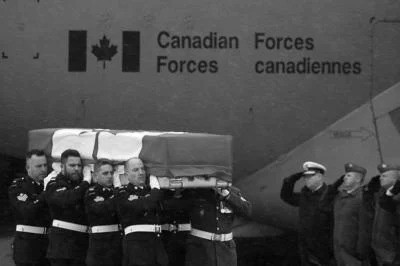
I didn’t put the story on A-2 of the local paper I worked at by accident.
It was a Canadian soldier, killed in Afghanistan. A young man. I put it where readers would see it — because Canadians are our neighbors for half the year. When the snowbirds are in town, they aren’t foreigners passing through. They were subscribers. Regular readers. People who bought the paper every morning and argued about local issues like anyone else.
I remember the photo. A flag-draped coffin, dead center in the frame. Winter. Snow coming down hard enough to blur the background. The kind of cold you can feel just looking at it. The prime minister stood there, rigid. The soldier’s parents were a few steps away, faces set in that stunned stillness families get when grief has gone past tears. No theatrics. No speeches in the frame. Just the cost, laid out in the open.
I remember sitting at the copy desk of the Stuart News, looking at that photo longer than usual. Not as an editor, but as someone who knew exactly who would see it in the morning. I knew it would hit hard for our Canadian neighbors — the ones who came every winter and read the paper over coffee like it was theirs. That’s not sentiment. That’s readership. That’s responsibility.
I’d seen it before.
The first U.S. Navy casualty of the Iraq War was Thomas Mullen Adams, a Navy officer from La Mesa, Calif. He was killed on the first night of the war in a British helicopter crash, flying a coalition mission. Different uniforms. Different flags stitched on the shoulders. Same aircraft. Same darkness. Same risk. When I interviewed his family back home, no one talked about whose helicopter it was. They talked about who he was — and about the men he was flying with.
That kid didn’t die for “Canada.”
Adams didn’t die for “Britain.”
They died fighting the same wars our kids were dying in.
Which is why all this talk, years later, about allies “not fighting,” or “not on the front lines” is nonsense.
Here’s the ledger. No speeches. No talking points.
-
United Kingdom — 457 dead
-
Canada — 158 dead
-
France — 90+ dead
-
Germany — 59 dead
-
Italy — 53 dead
-
Poland — 44 dead
-
Denmark — 43 dead
-
Australia — 41 dead
That’s not freeloading.
That’s blood.
And for every allied name etched into a casualty list, there were several more who came home wounded — thousands across the coalition — carrying injuries that never made a headline and never needed defending.
Here’s what the President missed: some of those countries lost a bigger share of their force than we did. Canada and Denmark didn’t posture. They went to Kandahar and Helmand — places where patrols were real, roads were bad, and casualty letters weren’t theoretical.
These weren’t show-the-flag deployments. These were riflemen walking bad ground.
Old newsrooms understood something Washington keeps forgetting. A-2 mattered. That page wasn’t for outrage or slogans. It was for readers who turned pages and understood that war didn’t belong to just one flag. When your neighbors fight and die in the same war, saying they weren’t on the front line is a lie.
You can argue budgets.
You can argue strategy.
You can argue whether Afghanistan or Iraq were ever winnable.
But you don’t get to say they didn’t fight.
Because somebody fought.
Somebody bled.
And somebody never made it home alive — they returned to a winter funeral under falling snow.
War gets simple once the shooting starts — it’s the lying afterward that gets complicated.
This is the part where the lies stop.