
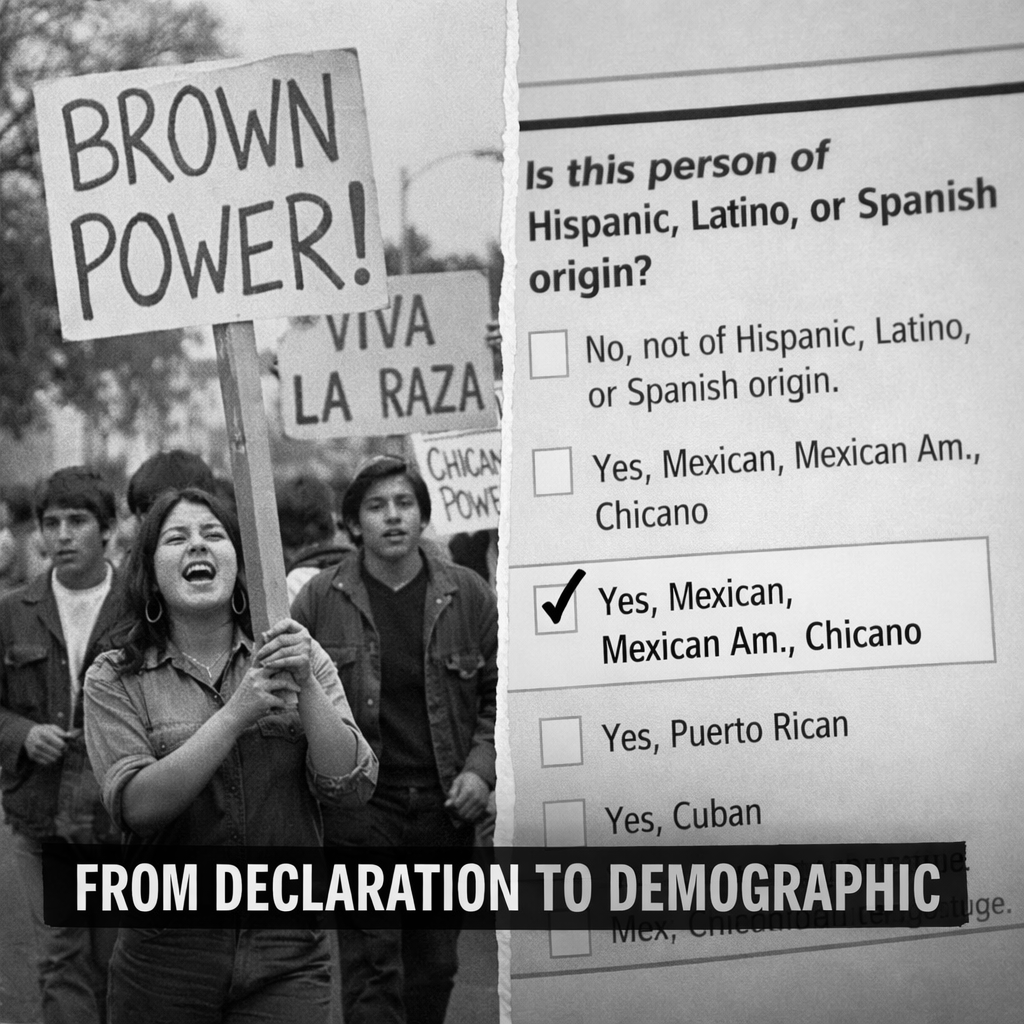
A few years ago, I saw the word Chicano on a University of California student application.
Not in a classroom.
Not in a movement space.
In a drop-down menu.
It was just another ethnic group.
That should bother anyone who knows where the word came from.
Chicano was never meant to be a neutral ethnic identifier. It was not shorthand for Mexican ancestry, Indigenous roots, or a variation of “Latino.” It was a political declaration, chosen deliberately by Mexican Americans who understood their place in U.S. history and rejected the polite fiction that assimilation would deliver equality.
Reducing it to a demographic category doesn’t honor that history. It erases it.
Assimilation was tried
Herman Baca, a San Diego organizer and one of my mentors, used to say it plainly:
Mexican Americans fought in World War II to prove they were Americans, too.
They enlisted in huge numbers. They fought in Europe and the Pacific. They came home in uniform — and were still denied housing, jobs, education, and dignity. Some couldn’t get served in restaurants while wearing the same jackets they had worn overseas. Many were excluded from the full benefits of the GI Bill. Redlining replaced welcome mats.
Service did not equal acceptance.
That realization was the turning point.
If loyalty, sacrifice, and bloodshed were not enough, then assimilation was not the answer. That is the moment when a generation stopped asking to be included and started organizing on its own terms.
That is where Chicano comes from.
Not as ethnicity.
As refusal.
A political identity, not ancestry
Scholars like Prof. Armando Navarro have been clear on this point for decades: Chicano identity emerged from political consciousness, not genealogy. It named an understanding of history — conquest, labor exploitation, segregation, policing — and a decision to act collectively rather than wait patiently.
To call yourself Chicano was to say:
We know this system.
We know where we stand in it.
And we intend to organize.
That is not something you inherit at birth.
It is something you choose, and then live with.
How the word got domesticated
Institutions are very good at surviving pressure. One of their favorite tactics is absorption.
Radical language becomes administrative language.
Movements become departments.
Political identities become data points.
Once a word like Chicano is folded into institutional paperwork, the institution quietly claims the authority to define it. The edge disappears. The challenge evaporates. The history becomes optional.
A student checking “Chicano” on an application today is not being asked whether they understand the politics, the struggle, or the responsibility that once came with the word. They are being counted.
That is not recognition. That is neutralization.
Identity without memory is harmless
Even among those who still use the word, Chicano is increasingly treated as just another ethnic subgroup — Mexican, Indigenous, mixed ancestry — a matter of roots rather than position. Bloodlines instead of consciousness.
That version of the word is safe.
Comfortable.
Harmless.
And that should tell us something.
A Chicano identity stripped of political memory becomes cultural decoration. It asks nothing. It challenges nothing. It fits neatly into diversity frameworks precisely because it no longer threatens power.
When Chicano is reduced to ancestry alone, it becomes little more than Mexican-American with a different label — absent the political consciousness that once made it matter.
That is not what the word was built for.
Why the word still matters
Chicano remains relevant because the conditions that produced it never fully disappeared. What changed is that the system got better at offering symbolic inclusion in place of structural power.
The word matters only if it still carries its original lesson:
assimilation was attempted — and history rejected it.
If Chicano means nothing more than ancestry, it will fade, and deserve to. But if it is understood as a stance — shaped by history, refusal, and collective action — it remains one of the few political identities in American life that names an uncomfortable truth institutions still prefer to soften.
A checkbox can’t hold that.
Chicano was never a box.
It was a line drawn.
And it only survives if we insist on remembering why it was drawn in the first place.