
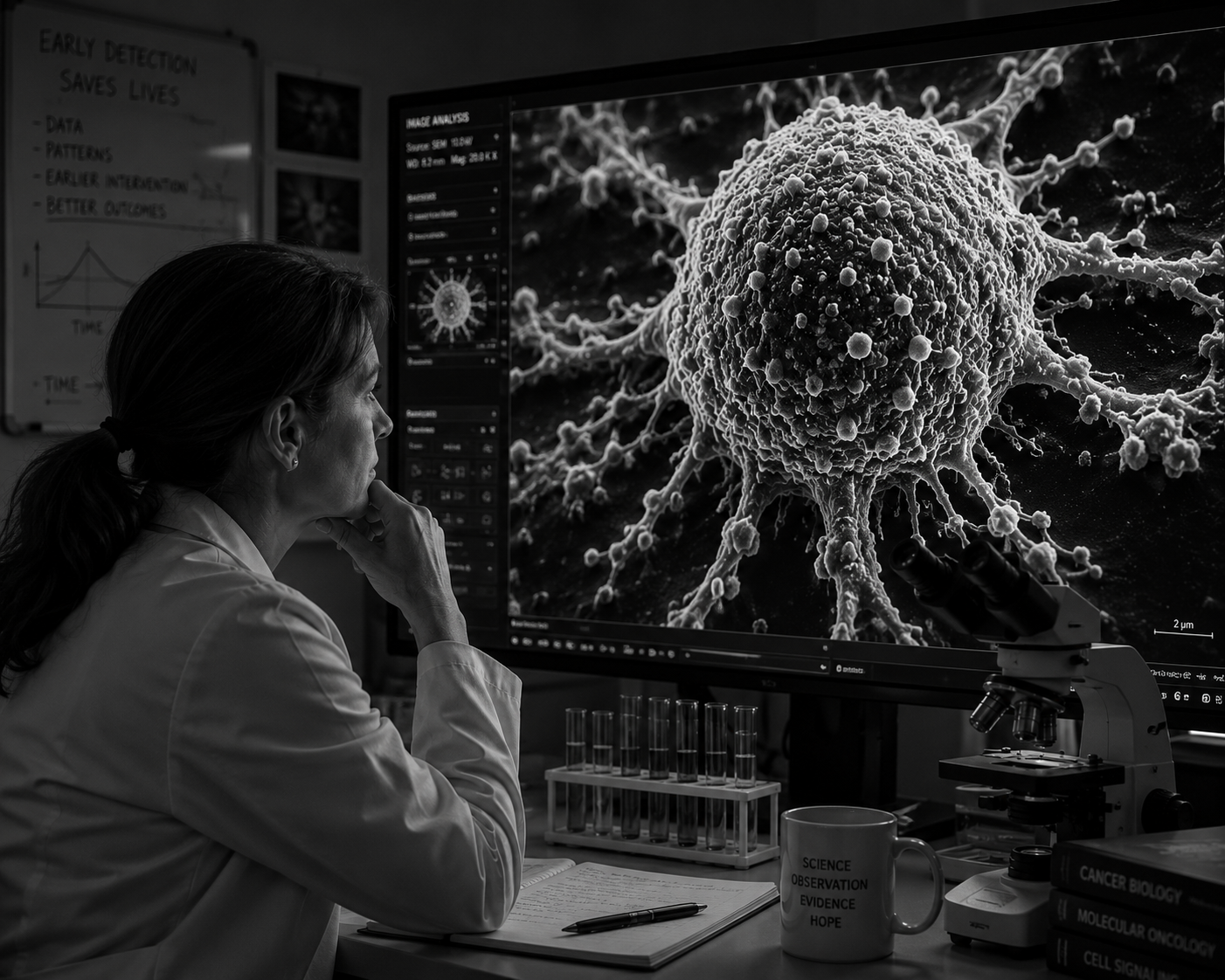
Last year, I watched a documentary about artificial intelligence and breast cancer.
Now, before half the internet starts screaming either “machines will save humanity” or “the robots are taking over,” let me explain what actually caught my attention.
It wasn’t flashy.
No glowing holograms.
No killer robots.
No billionaire standing onstage in black sneakers promising to reinvent civilization.
It was mammograms.
Thousands and thousands of mammograms.
Researchers had trained an AI system using scans from enormous numbers of women, teaching it to recognize tiny patterns associated with breast cancer.
And here was the remarkable part: The AI was detecting cancers months — and in some studies even years — before doctors could visually identify them on the images.
Not because the doctors were incompetent.
Far from it.
Radiologists are highly trained specialists doing incredibly difficult work.
But humans get tired.
Humans miss things.
Humans cannot mathematically compare millions of tiny pixel relationships the way machines can.
The AI wasn’t “thinking” like a doctor.
It was seeing patterns hidden inside vast oceans of data.
And sitting there watching that documentary, I had one of those moments where the entire AI debate suddenly became more complicated.
Because it’s easy to sneer at AI when it’s writing goofy emails or generating fake photos of Abraham Lincoln surfing in Hawaii.
It’s harder to sneer when it might help detect your wife’s cancer before it spreads.
That changes the emotional math.
And honestly, I think this is the part of the AI conversation we’re all struggling with right now.
The public discussion has become trapped between two cartoon versions of reality:
- AI will save humanity.
- AI will destroy humanity.
Most real life doesn’t work that way.
Most real life is messy.
And AI may turn out to be one of the messiest technological revolutions America has ever experienced because the benefits and the fears are arriving at exactly the same time.
On one side, people see:
- better medical diagnostics
- scientific breakthroughs
- faster research
- tools for small businesses
- language translation
- improved logistics
- personalized education
- assistance for the elderly
- and access to expertise that ordinary people could never previously afford
On the other side, they see:
- giant data centers
- rising electricity demand
- fears about jobs
- water consumption
- surveillance concerns
- misinformation
- and billionaires talking about “disruption” while ordinary people wonder if they’re about to be disrupted right out of a paycheck.
That tension is real.
And the infrastructure behind this revolution is becoming impossible to ignore.
America already has more than 3,000 operational data centers.
More than 1,500 additional facilities are now in various stages of planning or development.
Globally, nearly 100 gigawatts of additional data center capacity is expected to come online between now and 2030, effectively doubling worldwide capacity in just five years.
Three trillion dollars will be invested in this infrastructure boom before the decade ends.
Three trillion.
That’s not “app economy” money anymore. That’s industrial-era money.
And increasingly, these facilities are moving into rural America.
The South and Midwest are becoming prime targets because the AI race now revolves around one thing more than anything else: Electricity.
The industry is literally redrawing the map around:
- substations
- transmission corridors
- natural gas infrastructure
- and available megawatts
That backlash is already building.
That’s why the communication gap between the AI industry and ordinary Americans is becoming so dangerous.
People don’t necessarily oppose technology.
Americans generally love technology.
We just prefer knowing what the hell is happening before somebody pours a billion-dollar industrial facility outside town and tells us afterward it’s “transformational.”
And maybe that’s the real lesson buried inside that breast cancer documentary.
AI itself is not the villain.
AI is a tool.
An extraordinarily powerful one.
Like electricity.
Like nuclear power.
Like the internet.
Like aviation.
The danger usually comes from:
- who controls it
- who benefits from it
- who pays for it
- and whether ordinary people are included in the conversation before the consequences arrive.
Which circles me back to those mammograms.
Somewhere tonight, an AI system may help flag a tiny abnormality a doctor cannot yet see.
And somewhere else tonight, a rural county commission is probably debating whether to approve another giant data center that will consume enough power and water to reshape the local grid.
That’s the strange reality of this moment.
The same technology frightening people may also save lives.
And whether Americans fully realize it yet or not, both stories are now unfolding at the exact same time.