
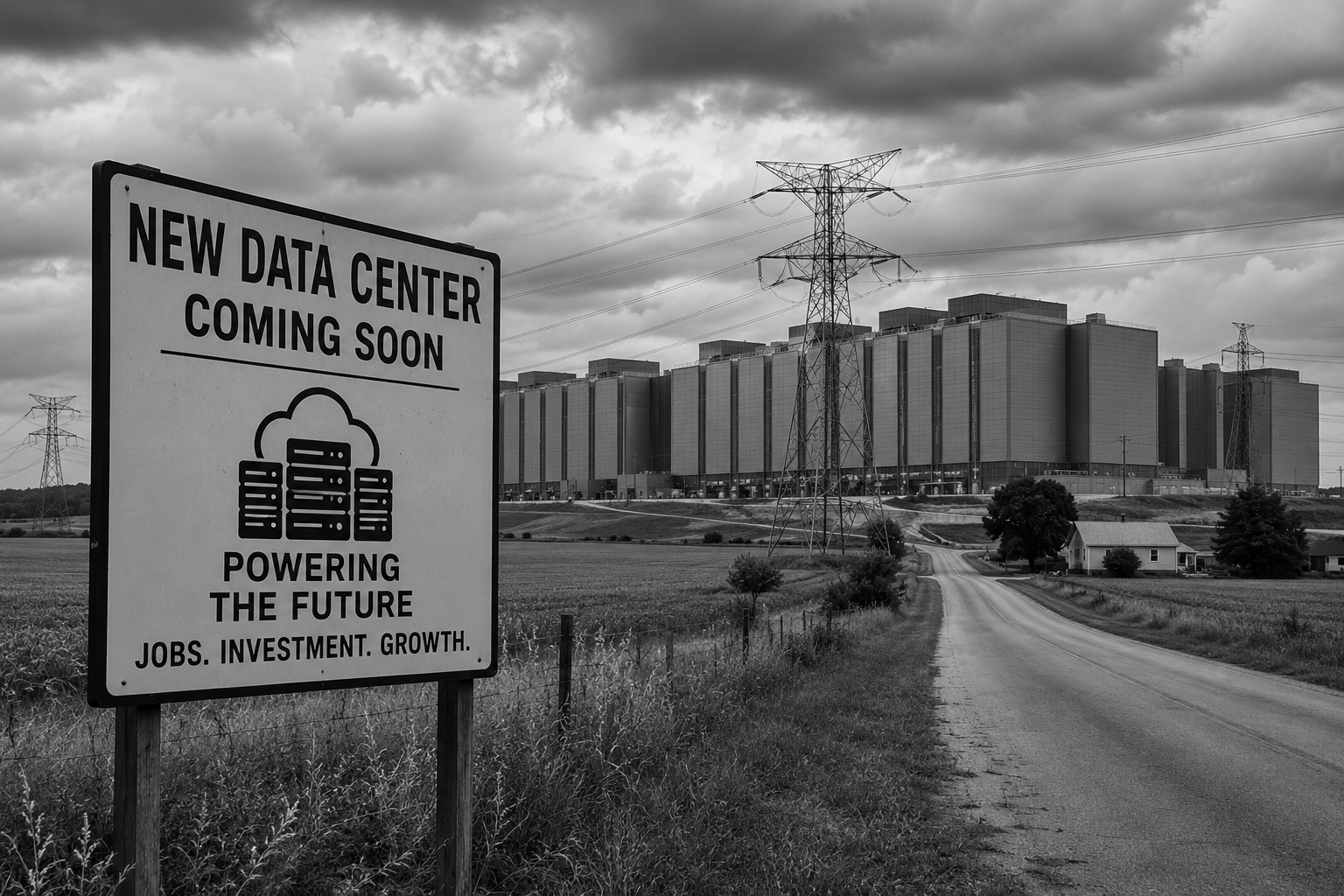
The AI companies are finally starting to tell us the truth.
Not directly, of course.
Nobody in Silicon Valley wakes up and says:
“Good morning shareholders, today we begin construction on the digital equivalent of steel mills and oil refineries.”
But the truth is leaking out anyway.
For years, the tech world sold artificial intelligence as something magical and weightless. “The cloud.” Digital transformation. Virtual everything. Just harmless software floating invisibly somewhere above America.
Then the utility bills arrived.
Now suddenly, the same industry is talking openly about:
- building private power plants
- bypassing public utilities
- installing giant battery systems
- using natural gas turbines on-site
- securing water rights
- and waiting four years just to connect to the electric grid
That’s when ordinary Americans started looking up from their monthly bills and asking:
“Hold on. What exactly are these things?”
Answer: They’re factories.
Enormous ones.
And according to the latest projections, the scale of this buildout is almost impossible to comprehend.
Nearly 100 gigawatts of new data center capacity is expected to come online globally between 2026 and 2030.
That will effectively double the size of the world’s data center infrastructure in just five years.
The sector is expected to grow roughly 14 percent annually through 2030 — an astonishing pace for physical infrastructure.
And the money involved is downright historic.
Analysts estimate the AI data center boom could trigger an infrastructure investment supercycle worth up to $3 trillion by 2030.
Three trillion dollars.
That’s not startup money anymore.
That’s interstate-highway money.
That’s postwar-industrial-boom money.
About $1.2 trillion is expected to go into the buildings themselves:
- giant campuses
- substations
- cooling systems
- transmission infrastructure
- industrial facilities
Then another $1 trillion to $2 trillion goes into the equipment inside:
- AI chips
- servers
- networking systems
- cooling hardware
- storage arrays
In other words, the AI economy is rapidly becoming one of the largest industrial construction projects of the modern era.
And the buildout inside the United States alone is staggering.
America already has more than 3,000 operational data centers.
Now add this: More than 1,500 additional data centers are currently in various stages of planning or development nationwide.
That’s not a trend anymore.
That’s a national infrastructure transformation.
And where they’re going matters politically.
About 87 percent of existing data centers are currently located in urban areas.
But roughly 67 percent of planned future centers are heading into rural America.
Even more striking: About 39 percent of planned data centers are proposed for counties that currently do not have a single data center at all.
Which means a lot of rural communities are about to encounter this industry for the first time.
Not through an app.
Not through advertising.
Through giant industrial campuses appearing near farmland, highways, and small towns.
And most of this construction is expected to hit the South and Midwest.
Together, those two regions account for roughly three-quarters of planned U.S. data center development, with the South alone representing nearly half.
That’s how deeply the geography of the country is beginning to shift around AI infrastructure.
And yet many tech executives still communicate with local communities like they’re opening a yoga studio with better Wi-Fi.
That disconnect is becoming politically dangerous.
Because local residents are seeing something very different.
They’re seeing giant windowless compounds appearing near neighborhoods and farmland while hearing phrases like:
- “behind-the-meter generation”
- “bring your own power”
- “private substations”
- “four-year utility interconnection delays”
Now the average person may not know exactly what all that jargon means, but they understand one thing immediately:
whatever this is, it’s huge.
And honestly, the tech industry has badly underestimated how much public trust matters once infrastructure starts competing for local resources.
Then there’s one of the most important shifts buried inside these new reports: Power availability is now becoming more important than land prices.
That’s a major change.
For years, companies chased cheap land.
Now they’re chasing electricity.
Because land without power is useless to AI.
You can practically see the map of America being redrawn around substations, transmission corridors, gas pipelines, nuclear plants, and available megawatts.
That’s one reason Texas is emerging as ground zero for this next phase.
Texas has:
- land
- energy infrastructure
- transmission systems
- industrial experience
- and room to expand
Industry projections suggest Texas could surpass Northern Virginia within four years as the largest concentration of data centers in the world.
Not the country.
The world.
And once power becomes the primary factor in site selection, entire regions of the country suddenly become strategic territory in the AI race.
That’s how deeply physical this industry has become.
The cloud, as it turns out, is made of:
- steel
- copper
- concrete
- substations
- turbines
- cooling towers
- water systems
- and staggering amounts of electricity
Then there’s the water issue.
Lord, the water fights are coming.
These facilities generate enormous heat, and cooling them often requires tremendous amounts of water.
Some companies are improving recycling systems.Some use reclaimed wastewater.
Some are moving toward advanced liquid cooling.
Good.
Because if local residents are told:
- shorten your showers
- conserve water
- let your lawn die
…while giant AI campuses consume millions of gallons cooling servers, the backlash is going to arrive at jet-engine speed.
Especially in fast-growing regions already struggling with strained infrastructure.
And here’s the irony buried inside all this:
The AI companies themselves increasingly seem to realize the old infrastructure model is breaking down.
For decades, the assumption was:
plug into the public grid and let utilities figure it out.
Now utilities are effectively saying:
“We cannot build fast enough.”
So the industry is shifting toward:
- private generation
- battery storage
- direct energy investment
- microgrids
- and “bring your own power” policies
In other words, Silicon Valley is slowly transforming into heavy industry.
Henry Ford would recognize half this business model instantly.
And that means the communication strategy has to change too.
The old Silicon Valley language about “moving fast” and “disruption” doesn’t work when communities think their water supply and electric bills are on the line.
People want honesty now.
Tell them:
- how much electricity projects require
- how much water they consume
- where the power comes from
- who pays for infrastructure upgrades
- whether recycling systems exist
- and what communities actually receive in return
Because whether people fully realize it yet or not, the AI race is no longer just about software.
It’s about power plants.
It’s about substations.
It’s about water systems.
It’s about noise.
It’s about industrial infrastructure.
Somewhere today, a county commissioner in rural Texas is staring at blueprints for a giant data center while constituents ask whether the wells will still hold out in August.
And somewhere in Silicon Valley, somebody is probably calling this “digital transformation.”
But out on that county road, with the transmission towers humming over soybean fields, it doesn’t feel virtual at all.
It feels industrial.
It feels permanent.
It is irreversible.
And whether Americans realize it yet or not, the AI age has already pouring concrete.