
That’s the uncomfortable part.
Not because their concerns are wrong. A lot of them are absolutely right.
The power demands are enormous.
The water consumption is real.
The strain on local infrastructure is real.
And yes, your electric bill may very well help pay for part of this AI boom, whether you asked for it or not.
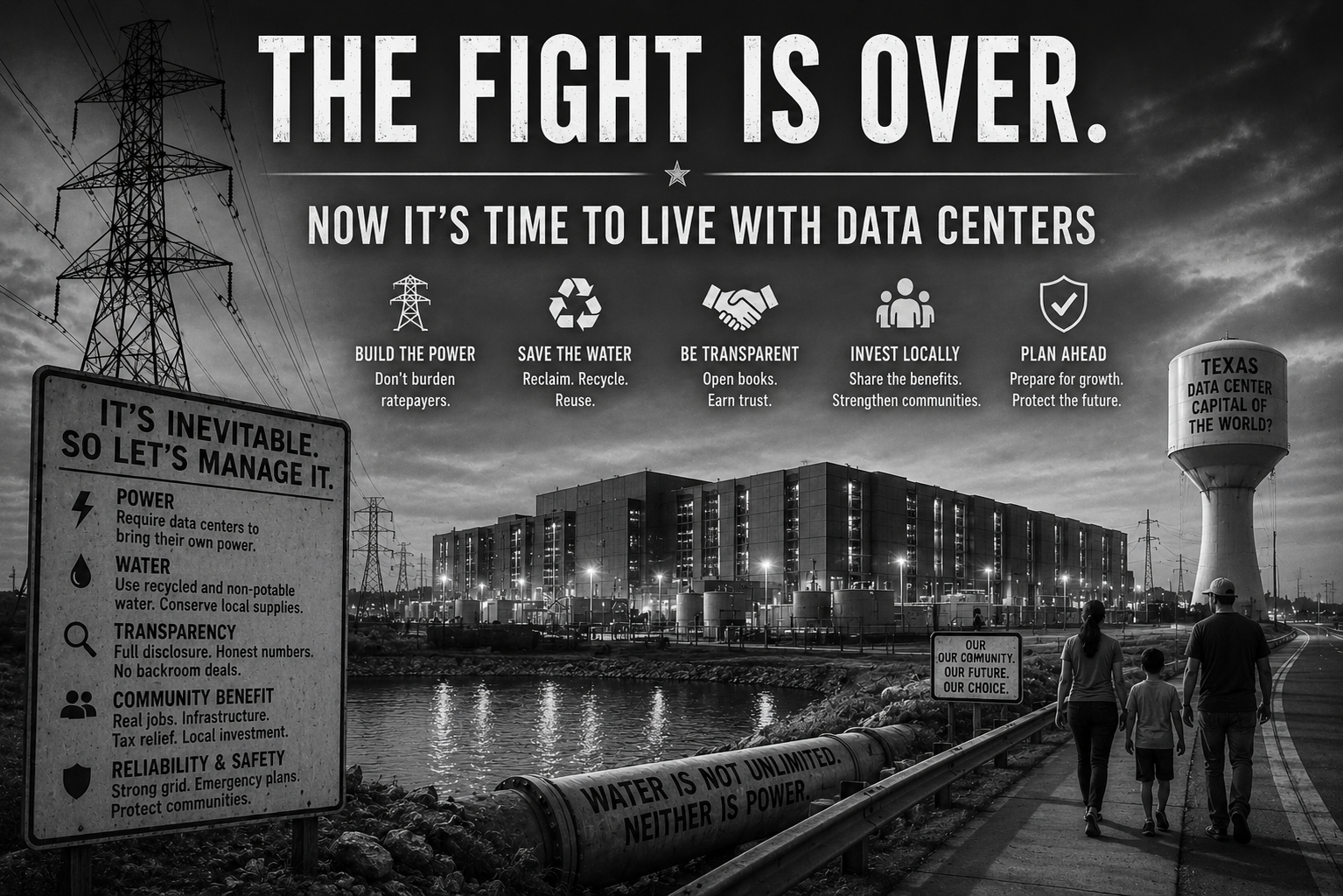
But the larger fight — whether America is going to build these things at all — is probably over.
That decision has effectively already been made.
Once Microsoft, Google, Amazon, Wall Street investors, defense planners, and Washington’s strategic competition with China all align around artificial intelligence, you are no longer dealing with a temporary tech trend.
You are dealing with national infrastructure policy.
That ship has sailed.
Probably at flank speed.
So the smarter conversation now is not:
“How do we stop data centers?”
It’s:
“How do we stop them from steamrolling communities and utilities?”
Because this buildout is accelerating fast.
Industry projections suggest Texas could surpass Northern Virginia within four years and become the largest concentration of data centers in the world.
That is not a small economic shift.
That is the equivalent of a new industrial era landing all at once.
And like every industrial boom before it, the danger is not merely the technology itself.
It’s what happens when growth outruns infrastructure and common sense.
The first mitigation step is straightforward: If AI companies need massive amounts of electricity, they should increasingly help build the power generation required to support it.
The recent PJM report hinted at exactly that idea.
Bring your own power.
Not because AI is evil.
Not because innovation should stop.
But because ordinary ratepayers should not quietly absorb unlimited infrastructure costs for trillion-dollar corporations.
If a company wants a gigawatt-scale AI campus, then it should help finance:
- natural gas generation
- nuclear power
- solar-plus-storage
- microgrids
- or dedicated utility expansion
Otherwise, the public effectively becomes the silent subsidy behind the AI race.
And politically, that becomes toxic fast.
Then there’s the water issue.
This one may become even more explosive than electricity.
AI servers generate tremendous heat, and cooling them requires large amounts of water in many facilities.
Some centers already recycle aggressively.
Others use reclaimed wastewater.
Some are moving toward more efficient liquid cooling systems.
Good.
Because communities are going to demand it.
Americans will tolerate many things before they start worrying about whether there’s enough water and enough electricity.
Once people think either one is threatened, the politics change immediately.
No town wants to hear:
“Please conserve water this summer”
while a giant AI campus nearby consumes millions of gallons cooling their servers.
That’s why future projects should increasingly require:
- reclaimed water systems
- closed-loop cooling
- aggressive recycling
- and transparent reporting on actual usage
If local residents are asked to conserve, giant industrial facilities should not get special treatment behind closed doors.
Another mitigation step is honesty.
Right now, many data center deals happen quietly, wrapped in tax incentives and vague promises about “economic development.”
Communities deserve clear answers:
- How much power will this consume?
- How much water?
- Who pays for infrastructure upgrades?
- What happens during shortages?
- What are the emergency plans?
- How many permanent jobs actually remain after construction?
People get angry when they feel they are being managed instead of informed.
And finally, America probably needs to stop pretending these facilities are just oversized office buildings.
They are critical infrastructure.
The AI economy is not weightless.
It is profoundly physical.
It requires:
- substations
- transmission lines
- cooling systems
- water access
- industrial zoning
- backup generation
- and long-term utility planning
In other words, the AI age looks a whole lot like the industrial age with fiber optics.
Which means the country needs industrial-era seriousness about planning.
Because reversal is probably no longer realistic.
The investment is too large.
The geopolitical stakes are too high.
And the strategic competition with China is too intense.
The real challenge now is whether America can manage this expansion responsibly before the infrastructure strain turns public skepticism into outright backlash.
That’s the fight now.
Not stopping the future.
Surviving it intelligently.