
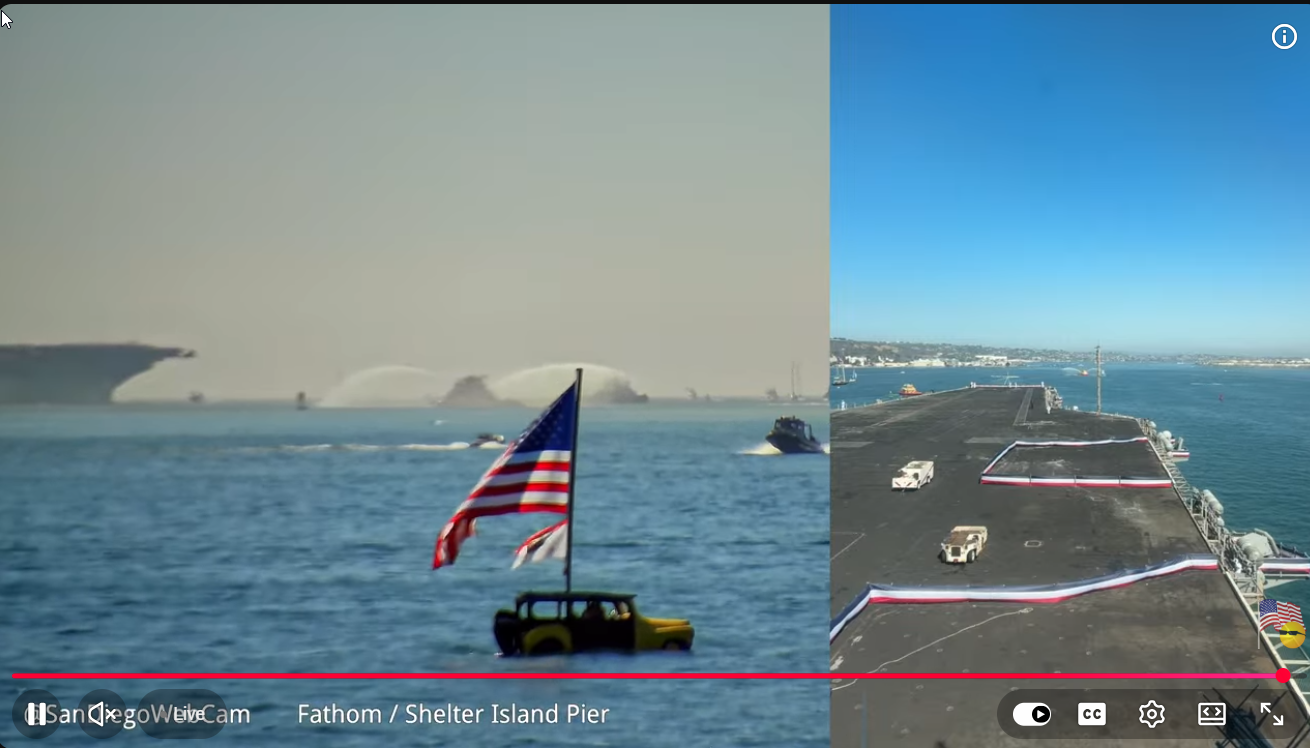
Twenty-six years after I boarded the USS Abraham Lincoln with a cameraman, I watched her return to San Diego. Then something appeared in the harbor that took me back another 57 years.
Some things about San Diego never leave you.
The smell of salt water. The morning fog rolling through the harbor entrance. The sight of a Navy ship coming home.
I grew up with those things.
San Diego was a Navy town, and the Navy was part of our lives whether we wore a uniform or not.
Warships came and went. Sailors disappeared over the horizon and returned months later. Families waited along the waterfront.
We knew what those ships represented.
And we knew that when they sailed, there was always the possibility that not everyone would come home.
On Thursday morning, Oct. 8, 2026, I watched the aircraft carrier USS Abraham Lincoln return to San Diego.
It had been gone 321 days.
Nearly 11 months.
The ship had fought in a war against Iran. Its aircraft had flown thousands of combat missions. Its escorts had launched missiles and defended against Iranian attacks.
The strike group had earned the Presidential Unit Citation.
Its sailors had endured 265 consecutive days at sea without a port call.
And now they were coming home.
I watched the arrival on live cameras from San Diego Bay.
The fog was thick that morning.
At first, you couldn’t see much beyond the water and the haze.
Thousands of people had gathered along the waterfront. Some had been waiting for hours.
Then the tractor tugs headed out.
Those are the powerful little boats that help maneuver enormous ships through the harbor. They were going out to greet the Lincoln.
Dozens of pleasure craft were already offshore.
The fog began lifting.
And there she was.
The Lincoln.
A massive gray shape slowly emerging from the haze.
I had been aboard that ship.
Twenty-Six Years Earlier
In 2000, I boarded the USS Abraham Lincoln with a cameraman.
I was working as a journalist, and the Navy had given us access to the carrier.
An aircraft carrier is one of those things you can describe all day long and still fail to convey its size and complexity.
You really have to go aboard one.
The flight deck alone is extraordinary.
But what always interested me about Navy ships was what happened below decks.
The machinery.
The passageways.
The sailors doing the work that rarely makes the evening news.
I’ve spent much of my journalism career covering the military, and one lesson has remained constant.
The equipment is impressive.
The people are the story.
So when I watched the Lincoln emerge from the fog Thursday morning, I wasn’t thinking only about the enormous ship.
I was thinking about the sailors aboard her.
Some had been away from their families for nearly a year.
Some were about to meet their newborn children for the first time.
Some had endured combat operations, exhausting work schedules and months without setting foot ashore.
And somewhere aboard that ship were young sailors who probably looked much like the sailors I’d encountered when I visited in 2000.
Different generation.
Same Navy.
Same ocean.
Same families waiting at home.
There are places where you live.
And there are places that become part of who you are.
San Diego was the latter.
Which brings me to something that happened Thursday morning.
Something I hadn’t expected.
You’ve Got to Be Kidding Me
As I watched the Lincoln approach the harbor, the cameras showed the pleasure boats gathered offshore.
There were the usual small craft.
Then something appeared in the foreground.
A little yellow amphibious vehicle.
A car that could float.
An American flag was flying from it.
I stared at the screen.
Wait a minute.
I knew that damn thing.
Back in 1969, a fellow who lived about five houses down had that vehicle.
His yard was always a collection of things that looked as though they might someday be useful. Some things never change.
In a January 2025 Google Street View photograph, there sits that same yellow amphibious contraption, surrounded by the accumulated treasures of a lifetime.
But here’s the thing. While the rest of us have spent 57 years getting older, that fellow has kept his amphibious car running.
And on Thursday, there he was, out in San Diego Bay, flying the American flag and welcoming the USS Abraham Lincoln home from war.
The yard was still a mess. The car still floated. And somehow, that seemed exactly right.
Fifty-seven years later.
Still floating around San Diego Bay.
Still flying the American flag.
Still participating in the life of a Navy town.
I couldn’t believe it.
Think about that.
In 1969, Richard Nixon was president.
Neil Armstrong walked on the moon.
The Vietnam War was raging.
I was a teenager living in San Diego.
And five houses down the street was a fellow with an amphibious car.
Now it’s 2026.
We’ve been through the end of the Cold War, the Gulf War, Afghanistan, Iraq and another war in the Middle East.
We’ve watched presidents come and go.
The Navy has commissioned new ships, retired old ones and developed weapons we couldn’t have imagined in 1969.
I’ve spent decades reporting on the military.
And that damn car is still floating.
You have to admire that.
Some Things Don’t Change
I watched the Lincoln make its way toward North Island.
The tractor tugs sprayed water.
The pleasure boats followed.
The sailors lined the flight deck.
Thousands of people waited to welcome their loved ones home.
And there, bobbing around in the harbor, was a little piece of my neighborhood.
It was almost too perfect.
The Lincoln had been to war.
Its sailors had spent nearly nine months without setting foot ashore.
Its aircraft had returned carrying combat markings.
Its strike group had earned one of the nation’s highest military honors.
And among the boats welcoming it home was a vehicle I’d first seen in my old neighborhood 57 years earlier.
I don’t know how many repairs that amphibious car has needed over the decades.
I don’t know how many engines, transmissions or other parts have been replaced.
I don’t know how many times its owner has taken it into San Diego Bay.
But I know one thing.
It was there Thursday morning.
And so was the Lincoln.
Coming Home
There is something special about watching a Navy ship return to San Diego.
But Thursday belonged to the Lincoln and the thousands of sailors who had finally returned.
As the ship approached North Island, I thought about my visit in 2000.
I thought about the young sailors aboard the ship then.
I thought about the sailors aboard it now.
And I thought about how much had changed in the 26 years between then and now.
Then I looked again at that little yellow amphibious car.
The same one from my street.
Still out there greeting the Navy.
And I couldn’t help smiling.
The Lincoln had come home from war.
And somehow, a little piece of my childhood had come out to welcome her.