
There is an old rule in journalism: when everybody is staring at the shiny thing, look behind it.
The shiny thing these days is artificial intelligence.
AI apps write. Generators make pictures. Computers create video, write software and answer questions. Wall Street is throwing around numbers with so many zeroes that you eventually have to take their word for it.
And everybody wants to know whether AI is the next great technological revolution or the next great American financial bubble.
Maybe we’re looking at the wrong thing.
Because AI may live in something called “the cloud,” but somebody forgot to tell the electric company.
The cloud, it turns out, is a building.
A very large building.
Full of very expensive computers.
That requires an astonishing amount of electricity.
And America is building the things about as fast as we can pour concrete.
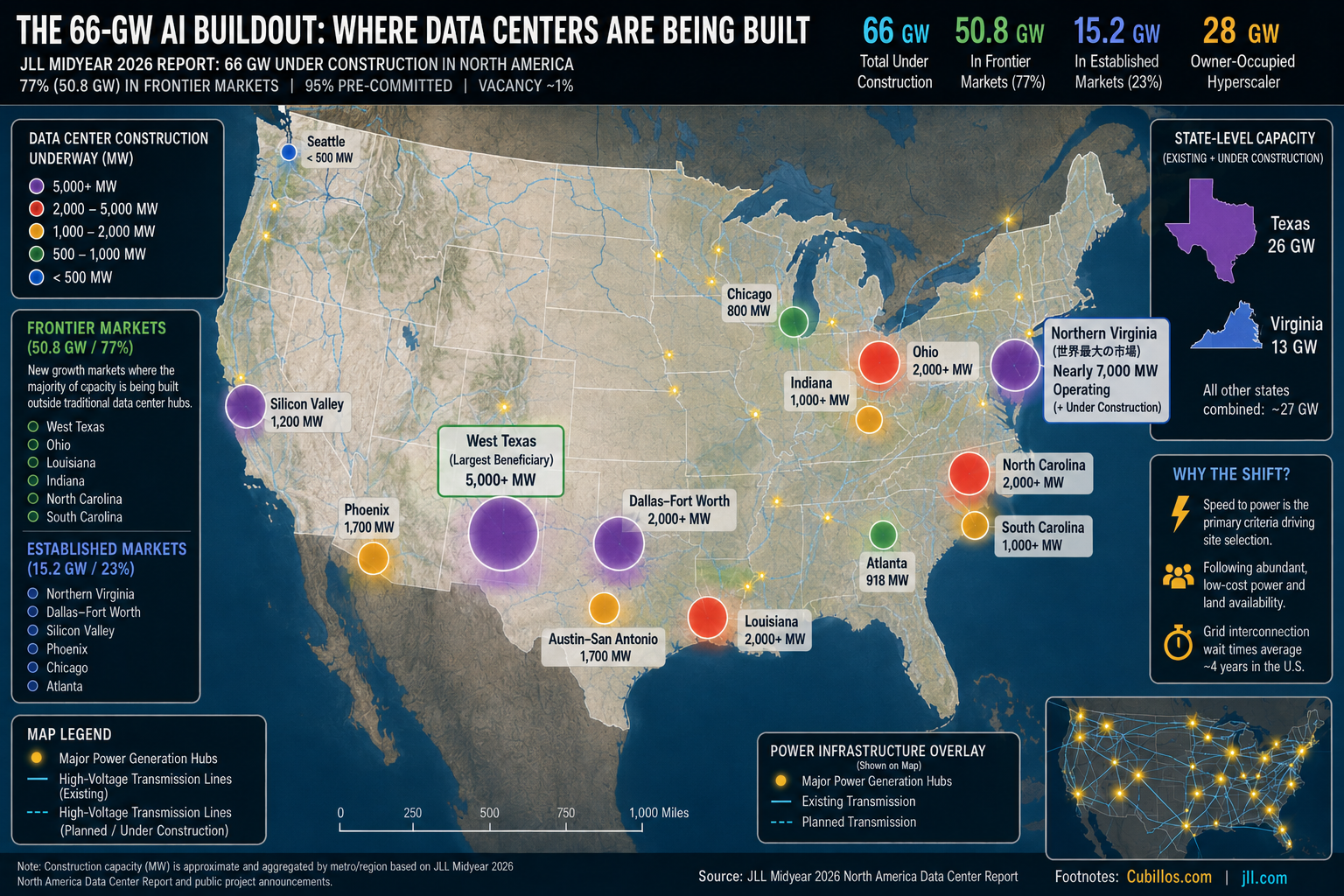
JLL’s latest North American data-center report says the industry absorbed 25 gigawatts of capacity in just the first six months of 2026. That’s twice the pace of a year earlier and five times what it was two years ago.
There are now 66 gigawatts of data-center capacity under construction.
Sixty-six gigawatts.
At some point, “gigawatt” becomes one of those words like “trillion” that normal people aren’t equipped to appreciate.
So here’s an easier way to understand what’s happening.
We’re not building a bunch of computer rooms.
We’re building a new industrial system.
And it needs electricity.
Lots of it.
Where Everybody Went
For years, data centers tended to congregate in familiar places.
Northern Virginia became the granddaddy of them all. Silicon Valley had them. Dallas had them. Phoenix, Chicago and Atlanta became major centers.
That made sense. Put the computers near telecommunications networks, customers, fiber and the rest of the digital plumbing.
AI is beginning to change the map.
JLL says 77 percent of all data-center capacity now under construction is going into what it calls “frontier markets.”
That’s about 50.8 gigawatts of the 66 GW under construction.
And where are these new technological frontiers?
West Texas.
Ohio.
Louisiana.
Indiana.
North Carolina.
South Carolina.
Nobody woke up one morning and discovered that West Texas had become Silicon Valley.
What West Texas has is something Silicon Valley desperately needs.
Electricity.
And land.
JLL has a wonderfully straightforward phrase for what is happening:
“Speed to power.”
It has become one of the most important considerations in deciding where to put a data center. Grid connections in major U.S. markets can take four years or longer.
You can build the building.
You can buy the computers.
You can raise the money.
You can hire the engineers.
Then somebody from the utility company gets out a clipboard and says, “About that electricity…”
Follow the Power
Texas now has roughly 26 GW of existing and under-construction data-center capacity, more than twice Virginia’s 13 GW. Texas could eventually surpass Northern Virginia as the world’s largest data-center market.
That tells us something important about the AI revolution.
The computer industry is starting to follow the power.
That sounds almost backward.
For decades, electricity went where industry was.
Now some of America’s newest industry is going where the electricity is.
And even that may not be enough.
Data-center operators are increasingly looking at generating their own power. Developers are considering natural-gas generation, battery storage and other behind-the-meter systems because waiting years for a utility connection can wreck the economics of a project.
Which brings us back to the bubble.
We’ve Seen This Movie
I’ve heard the argument that AI is a bubble, that eventually it will burst, and the people behind it will take the money and run.
I’m not convinced that’s the right comparison.
But there is an earlier technology boom worth remembering.
The internet.
People remember the dot-com bubble as a parade of goofy websites with enormous valuations and precious little profit.
That’s only half the story.
Underneath those websites was an enormous infrastructure boom.
Telecommunications companies laid fiber all over creation because everybody knew the Internet was going to change the world.
They were right.
They also managed to lose fortunes.
The mistake wasn’t believing in the Internet.
The mistake was believing that every investment made in anticipation of the internet would necessarily make money.
When the bubble burst, companies disappeared and investors got clobbered.
But the fiber stayed in the ground.
And that cheap communications capacity helped make possible much of what came afterward.
Google.
YouTube.
Streaming video.
Cloud computing.
And, eventually, artificial intelligence.
There may be a lesson there.
The Data Centers Aren’t Empty
If you’re looking for evidence that today’s data-center industry has already wildly overbuilt, there’s an inconvenient little number:
One percent.
That’s the current vacancy rate.
It has been around one percent for three consecutive years despite the construction boom. Ninety-five percent of the capacity currently under construction is already committed through leases or owner-occupied projects.
That’s not exactly a landscape full of empty buildings with tumbleweeds rolling through the server aisles.
And 28 GW of the construction is owner-occupied hyperscaler capacity—the enormous facilities being built for the companies consuming the computing power themselves.
So anyone declaring that the data-center bubble has already been exposed has some explaining to do.
The demand is real.
The buildings are being built.
The electricity is being consumed.
But that doesn’t mean there can’t be a bubble.
It means we need to be more precise about where the bubble might be.
The Trillion-Dollar Question
The question isn’t whether AI works.
It works.
The question isn’t whether people use it.
They do.
And the question isn’t whether somebody wants these data centers.
With one percent vacancy, somebody obviously does.
The question is whether the economic value ultimately produced by AI will justify the staggering amount of money being spent to build the infrastructure behind it.
That is a very different question.
The top five hyperscalers announced about $710 billion in planned 2026 capital expenditures, enough to support roughly 35 GW of new or refreshed data-center capacity globally.
Meanwhile, financing is getting creative.
More than $700 billion in data-center debt financing through 2028, while Reuters reports growing use of enormous debt packages and special-purpose financing arrangements to fund AI infrastructure.
That should at least make everybody put down the champagne glass for a minute.
Because financial history has a habit of repeating one particular joke:
Everybody needs to build because everybody else is building.
Nobody wants to be the executive who has to explain in 2028 why his company doesn’t have enough AI computing capacity.
So everybody reserves capacity.
Everybody orders chips.
Everybody signs power agreements.
Everybody builds.
And everybody’s spreadsheets assume somebody will eventually pay enough for all that computing to make the numbers work.
Maybe they will.
But that’s the bet.
The Old Economy Meets the New One
The funny thing about this supposedly futuristic revolution is how quickly it runs smack into the 20th century.
AI needs transformers.
Transmission lines.
Power plants.
Substations.
Natural-gas turbines.
Cooling systems.
Construction workers.
Steel.
Concrete.
Land.
And, depending on the facility, considerable amounts of water.
Reuters recently found the data-center boom rippling through American manufacturing, producing booming orders for generators, electrical equipment, cooling systems, bearings, cables and construction machinery.
Apparently the road to artificial general intelligence runs through the electrical-equipment aisle.
And the electric grid may turn out to be the governor on the whole machine.
Electricity is increasingly more limiting to growth than land, capital or labor in some markets. Data centers are particularly difficult loads because they demand enormous amounts of reliable power concentrated in particular locations and running around the clock.
Silicon Valley can move fast and break things.
Utilities have to keep the lights on.
Those are two very different cultures.
If the Bubble Pops
Suppose the skeptics are right.
Suppose investors eventually discover that America has built more AI computing capacity than the market can profitably support.
Some projects will be canceled.
Some AI companies will disappear.
GPU prices could fall.
Data-center rents could eventually soften.
Companies carrying too much debt could get into trouble.
Investors could lose a pile of money.
Wall Street will announce that nobody could possibly have seen this coming.
But America would still have something.
The power plants would still be there.
The substations would still be there.
The transmission improvements would still be there.
The fiber would still be there.
And those enormous buildings full of computing equipment would still be sitting there.
Just as the internet bust left behind communications infrastructure that helped create the next generation of companies, an AI bust could leave behind enormous amounts of computing infrastructure available much more cheaply to whatever comes next.
That’s the funny thing about technological bubbles.
Sometimes the investors are wrong while the technology is right.
Railroad investors learned it.
Telecommunications investors learned it.
Dot-com investors learned it.
AI investors may learn it too.
So don’t watch only Nvidia’s stock price.
Don’t watch only Anthropic.
And don’t spend too much time listening to somebody on television announce whether AI is a bubble.
Watch West Texas.
Watch Ohio.
Watch Louisiana and the Carolinas.
Watch the transmission lines.
Watch the utilities.
Watch where the substations are going.
Follow the electricity.
Because that may tell us more about the future of artificial intelligence than anything happening in the cloud.