
A while back, I wrote that we ought to stop counting data centers and start counting brains.
I may have been too generous.
Maybe we ought to start by asking who counted the data centers in the first place.
There are maps floating around the internet showing more than 5,000 data centers scattered across the United States. Nice maps. Lots of dots. Very impressive.
There’s just one small problem.
Some of them don’t tell you where the numbers came from.
Or what qualifies as a data center.
That matters.
A server room tucked inside a hospital can be called a data center. So can a university computer center, a county government’s IT operation and a building handling somebody’s payroll records.
Then there are the new AI campuses demanding hundreds of megawatts of electricity and costing billions of dollars.
Put them on a map and each gets one dot.
A dot on a map is not a cooling tower.
And it certainly doesn’t tell you how much water is being used.
Most computers are still cooled with air
Computers make heat. Always have.
For decades, the obvious solution has been air conditioning.
Move cold air across the computer equipment, carry the hot air away and keep the electronics from cooking themselves.
That’s still the dominant method.
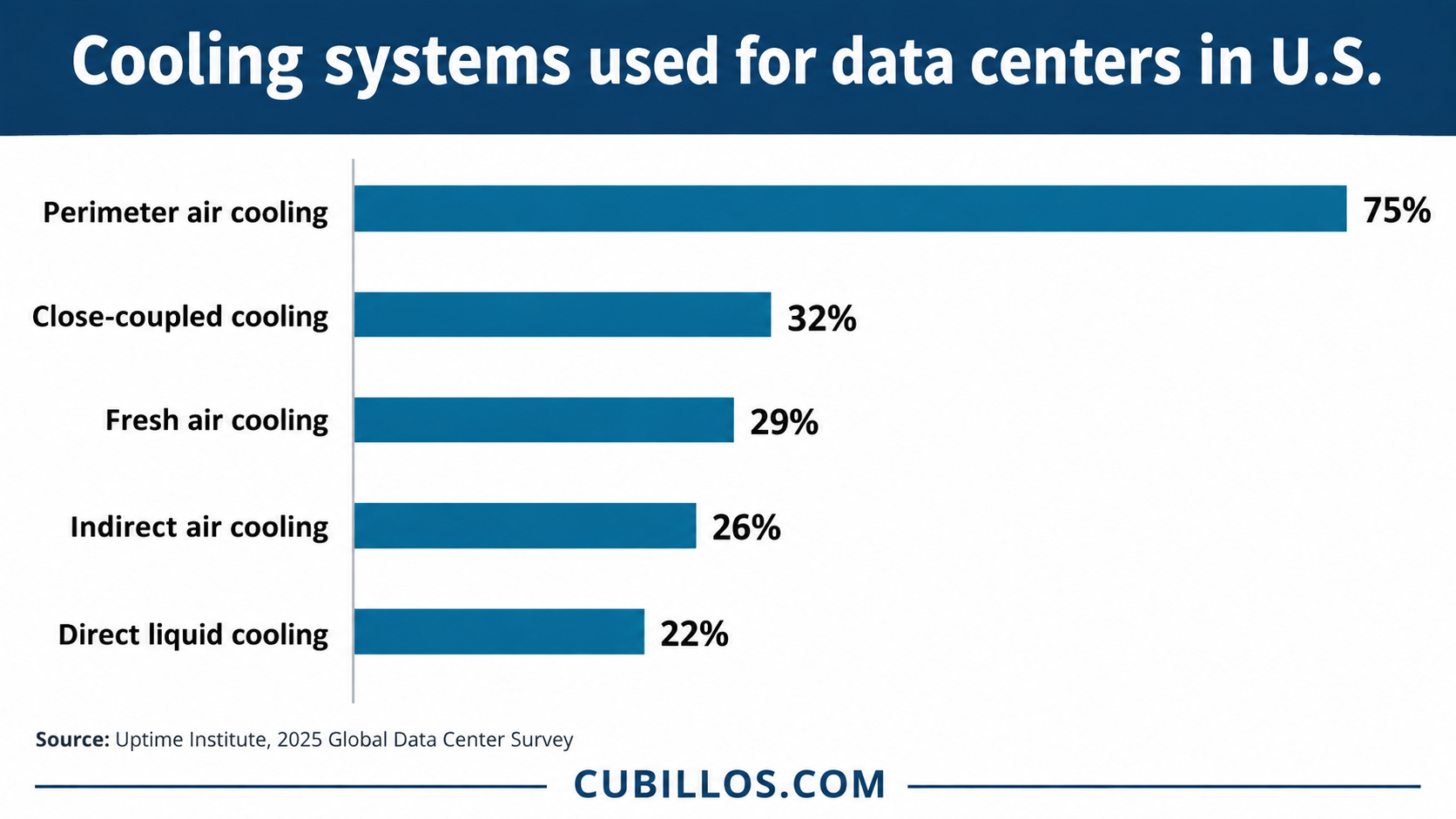
In its 2025 industry survey, Uptime Institute found that 75 percent of respondents used perimeter air cooling for their IT equipment. Direct liquid cooling was reported by 22 percent. Respondents could select more than one method because a facility can use several cooling systems.
That’s what the chart accompanying this column shows.
But here’s where things get squirrelly.
Air cooling does not necessarily mean waterless cooling.
An air conditioner can blow cold air across servers while using chilled water elsewhere in the cooling system. That heat may ultimately wind up at an evaporative cooling tower outside.
Or the system can reject its heat through an air-cooled chiller or dry cooler and consume little or no water in that process.
So asking whether a data center is “air cooled” or “water cooled” isn’t really the right question.
You need to follow the heat.
The little guys are different
This is particularly important when we start talking about the number of data centers in America.
Berkeley Lab has studied what it calls small server rooms and closets in offices, universities, hospitals and other commercial buildings.
These aren’t the giant windowless warehouses we now associate with AI.
Some are literally closets.
Berkeley Lab says the smallest server closets typically depend on the building’s ordinary HVAC system. Server rooms often use the building HVAC supplemented by a dedicated air-conditioning unit.
The Energy Information Administration found just how common these things are.
Its 2018 Commercial Buildings Energy Consumption Survey estimated that 1.237 million commercial buildings contained server closets. About 116,000 contained space classified as a data center or server farm.
Read those numbers again.
More than a million buildings had server closets.
Nobody is proposing that America has a million hyperscale AI data centers.
The server rack sitting down the hall from the hospital billing office isn’t Colossus.
But depending on who is assembling a database and how “data center” is defined, very different kinds of computing facilities can get swept into the discussion.
That’s why I’m increasingly suspicious of impressive-looking maps covered with dots.
Tell me what the dots are.
AI is changing the cooling problem
The new AI centers are different animals.
Modern GPUs can cram extraordinary amounts of computing power — and therefore heat — into a rack.
Eventually there comes a point where blowing ever more cold air across the machines becomes inefficient or impractical.
That’s one reason direct liquid cooling is growing.
Instead of cooling the entire room enough to keep the chips happy, coolant can carry heat directly away from the equipment.
But here’s another bit of terminology that can lead us astray:
Liquid cooling doesn’t necessarily mean enormous water consumption.
The coolant can circulate through a closed loop.
It collects heat.
It moves the heat.
It gets cooled.
Around it goes again.
Your automobile engine is liquid cooled. You don’t pull into a gas station every afternoon and refill the radiator.
The important question is what happens to the heat at the other end.
Eventually, the heat has to leave
You cannot destroy heat.
You can only move it somewhere else.
And this is where the water question really begins.
A data center can reject that heat using dry cooling equipment and outside air.
Or it can use evaporative cooling.
Evaporative cooling towers really do consume water. They deliberately evaporate some water to carry heat into the atmosphere. Additional water must replace what evaporates, and some water must also be discharged to prevent minerals from becoming too concentrated.
For a big data center operating 24 hours a day, that can amount to a lot of water.
Berkeley Lab estimated that U.S. data centers directly consumed about 66 billion liters — roughly 17 billion gallons — of water in 2023. Its projections show substantially greater consumption by 2028 depending upon data-center growth and cooling technologies.
The latest comprehensive federal estimate puts direct U.S. data-center water consumption at about 17.4 billion gallons in 2023. Berkeley Lab projects that consumption could rise to roughly 40 billion to 73 billion gallons annually by 2028, depending largely on growth and cooling technology.
That’s real.
And if somebody wants to build one of these things in Arizona, Utah or some other place where people already fight over water, asking about it isn’t environmental hysteria.
It’s common sense.
But neither does that mean every data center in America is gulping millions of gallons of water.
There’s another water bill
Then there’s the water you never see at the data center.
Electricity generation can consume water, too.
Thermal power plants can use water for cooling. Nuclear plants can use substantial amounts. Hydroelectric generation obviously depends upon water, although calculating its consumptive water footprint raises different questions.
That’s why Berkeley Lab separates data-center water use into direct consumption at the facility and indirect water associated with generating its electricity.
According to Berkeley Lab, in 2023, data centers directly consumed about 17.4 billion gallons of water, as noted above. Producing their electricity consumed an estimated 211 billion gallons more.
So when a company announces that its shiny new AI campus uses a closed-loop cooling system and consumes very little water on site, I have another question.
Fine.
Where are you getting the electricity?
Because moving the water consumption 40 miles down the road to a power plant doesn’t make it disappear.
Follow the heat
This leaves us with three questions worth asking whenever somebody proposes a data center in your community.
How are the computers cooled?
Air or liquid?
How does the facility get rid of the heat?
Dry cooling or evaporation?
Where does the electricity come from?
Those answers tell us considerably more than the words data center ever will.
And they certainly tell us more than another colorful internet map covered with dots.
There are legitimate concerns about the water required by the enormous AI infrastructure now being built across the country. Some of these projects really are huge. Some really will consume substantial amounts of water.
Those numbers deserve scrutiny.
But a server room at the local hospital and a billion-dollar AI campus aren’t environmentally equivalent simply because somebody’s spreadsheet calls both of them data centers.
Neither are their cooling systems.
Neither are their electric loads.
Neither are their water requirements.
If we’re going to fight over data centers — and judging by county commission meetings around the country, we most certainly are — let’s at least fight over the right numbers.
A dot on a map isn’t a cooling tower.
And a cooling tower isn’t a water-use figure.
Follow the heat. Then count the gallons.