
UPDATE – July 23, 2026: Since this article was first published, the story has taken several important turns. Cheyenne officials have confirmed that the contamination was traced to wastewater discharged during a subcontractor’s fill-and-flush operation on Meta’s data center cooling system. However, investigators still have not determined where the bacterium, Cupriavidus gilardii, originally came from.
The city has acknowledged that the water used for the flush was purchased from its own municipal utility, and no public investigation has identified whether the bacteria originated in the water supply, construction equipment, newly installed piping, soil, or another environmental source.
Goat Systems LLC, the owner of the data center, has appealed the city’s Notice of Violation, arguing that officials have not produced sufficient evidence establishing the origin of the bacteria or the company’s responsibility.
Meanwhile, Cheyenne has permanently changed its wastewater policies, prohibiting future fill-and-flush discharges from data center cooling systems into the municipal sewer. Importantly, the city’s drinking water was never affected; the contamination was limited to the reclaimed-water system, which has since been disinfected and returned to service.
For months, people have been arguing about AI data centers.
Will they use too much electricity?
Will they consume too much water?
Will they overwhelm local infrastructure?
This week, Cheyenne, Wyo., reminded us there’s another question we probably should have been asking.
What happens before the first server is even turned on?
If you only read the headlines, you might think an AI data center contaminated a city’s water supply.
That’s not what happened.
Meta’s AI data center wasn’t shut down.
It isn’t even open.
The facility is still under construction.
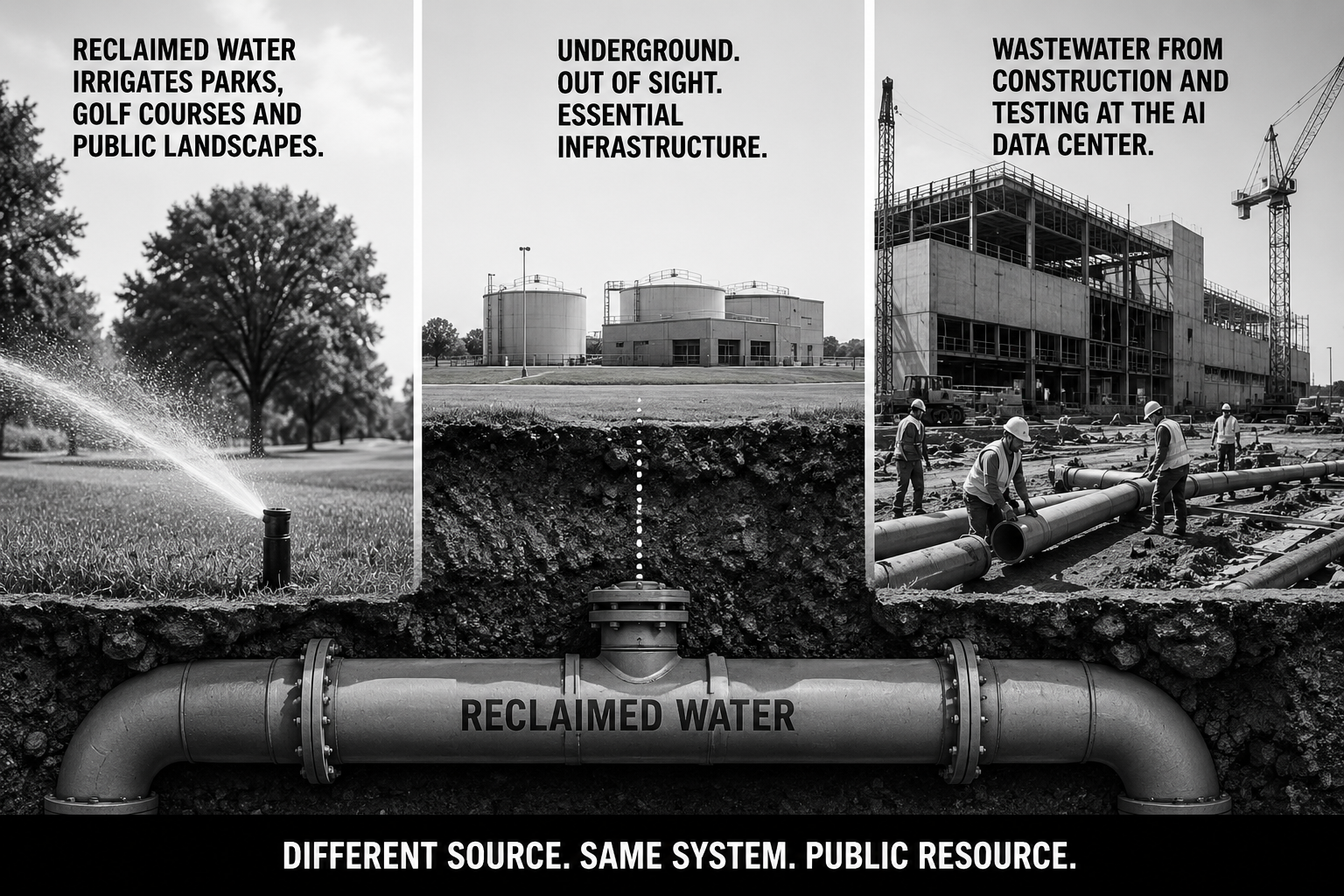
The incident occurred during a standard construction and commissioning procedure known as a fill-and-flush. The contractor, Fortis Construction Inc., pumped water through newly installed cooling pipes to remove dirt, welding residue and other construction debris before the cooling system could be placed into service.
That wastewater entered Cheyenne’s sewer system.
City officials later traced a rare bacterium to the city’s municipal reclaimed-water system. As a precaution, they took portions of that system offline, disinfected the facilities, revoked the contractor’s wastewater discharge privileges and required future commissioning wastewater from similar projects to be hauled away rather than discharged into the municipal sewer.
Then something happened that didn’t generate nearly as many headlines.
Testing confirmed the system was clear.
The Dry Creek and Crow Creek reclamation facilities returned to service, and Cheyenne’s reclaimed-water system was placed back online.
That’s how infrastructure is supposed to work.
A problem is discovered.
Officials investigate.
The system is cleaned.
Procedures are changed.
Operations resume.
Cheyenne didn’t respond by banning data centers.
It responded by improving its procedures.
The city identified a weakness in how wastewater from commissioning a large industrial facility was being handled and changed the rules.
That’s called governance.
It’s worth noting that the affected water wasn’t drinking water.
Nor was it reclaimed water intended to cool the future data center.
It was Cheyenne’s municipal reclaimed-water system—the recycled water used to irrigate parks, golf courses, athletic fields and public landscaping.
That’s an important distinction because reclaimed water is often dismissed as though it has little value.
In reality, it’s one of the most valuable tools communities have for conserving drinking water. Every gallon used to irrigate a park is a gallon that doesn’t have to come from a reservoir or aquifer.
But reclaimed water is still infrastructure.
It still has to be treated.
It still has to meet health standards.
It still has to be protected.
The Wyoming incident reminds us that as AI infrastructure expands, communities will have to think about more than substations and electric grids.
They’ll also need to think about wastewater treatment, reclaimed-water systems, permitting, environmental safeguards and how new industrial facilities fit into existing public infrastructure.
That’s a worthwhile conversation.
Calling for an outright ban based on a single commissioning incident that was investigated, corrected and resolved isn’t.
The most interesting part of this story isn’t that something went wrong before the first AI server came online.
It’s that the city learned from it, fixed it and moved forward.
That’s what good engineering does.
And it’s what good public policy should do, too.
Here is the complete Cheyanne Timeline of the investigation.