
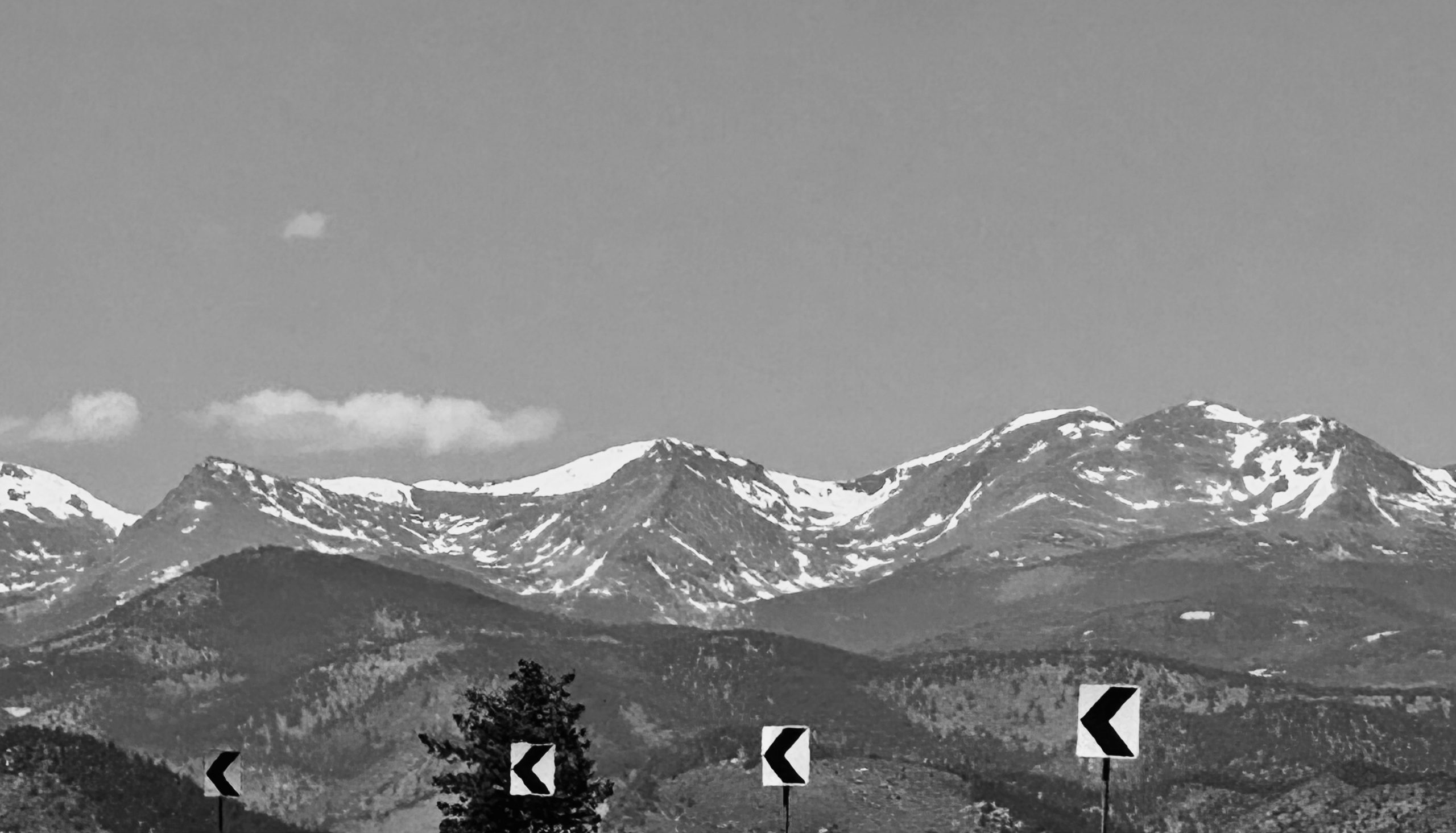
I didn’t realize it at the time, but I was looking at a water crisis.
I was in Colorado in June, driving through the Rockies, looking up at mountains that ought to have been wearing considerably more white.
There was snow up there. Just not much of it.
I took a photograph through the windshield. The high peaks rise across the horizon, magnificent as ever, but the snow is mostly reduced to streaks and patches across the upper slopes.
Pretty picture.
Bad news.
My sister lives in Colorado, and she had already been telling me what a lousy winter it had been for skiing. The ski slopes had struggled through a miserable season—delayed openings and limited terrain in places, unusually early closings, and snowfall far below normal at some resorts.
Turns out the skiers were sitting on the first warning sign.
By June 1, Colorado’s statewide snowpack had fallen to just 14 percent of the 30-year median, according to the National Weather Service. The Natural Resources Conservation Service reported that snowmelt at Colorado’s monitoring stations had occurred about 36 days earlier than normal.
Thirty-six days.
Spring didn’t so much arrive early as steal a month from the calendar.
Colorado’s ski industry paid for it. The state recorded about 10.5 million skier visits during the 2025-26 season, down roughly 24 percent from the previous winter and the lowest total in decades.
But lost ski days are the small end of this problem.
Because those mountains are a bank.
The Reservoir Before the Reservoir
We tend to think of Lake Powell and Lake Mead when somebody mentions Colorado River water. Great blue reservoirs, giant concrete dams and those increasingly famous white bathtub rings showing where the water used to be.
But the Colorado River’s savings account starts much higher up.
Snow piles up in the Rockies during winter. It melts in spring and summer. The runoff feeds creeks and rivers that eventually replenish the Colorado River system.
So the snow sitting on those mountains is essentially water in storage.
And when it isn’t there, there’s nothing to release later.
That’s what struck me after I returned home and continued following a story I’d been watching for the past year: the increasingly bitter argument among the seven Colorado River states over who is going to give up water.
Colorado, Wyoming, Utah and New Mexico are in the Upper Basin.
Arizona, Nevada and California are in the Lower Basin.
For years they’ve known there was a problem. They’ve held meetings. They’ve negotiated. They’ve produced proposals. They’ve disagreed over whose arithmetic is the correct arithmetic.
If meetings produced water, Lake Mead would be overflowing.
They don’t.
The seven states failed to reach an agreement on how to operate the river after the current rules expire. Finally, Washington stepped in.
And Then There Is Mexico
Funny how Mexico tends to disappear when Americans start arguing about the Colorado River.
We talk about the seven Colorado River states as though the river reaches the international boundary, checks its passport and turns around.
It doesn’t.
The Colorado River ends in Mexico.
Under a 1944 treaty, Mexico was allotted 1.5 million acre-feet of Colorado River water a year. That’s its share of a river that once flowed through a vast delta before reaching the Gulf of California.
Mexico has already shared in the shortages. Its deliveries have been reduced as Lake Mead has fallen, and Mexico has agreed to additional conservation measures intended to leave water in the Colorado River system.
So perhaps we ought to call this what it really is.
Eight governments are trying to divide a shrinking river: seven American states and Mexico.
The lawyers can argue about compacts, treaties, senior rights, Upper Basin obligations and Lower Basin obligations.
The river remains unimpressed.
It begins as snow in the Rocky Mountains, runs roughly 1,450 miles through the American Southwest and into Mexico, and somewhere along that journey we’ve promised nearly every drop of it to somebody.
Now there aren’t as many drops.
Which is a mighty inconvenient thing for a legal system built around dividing them.
The Bureau of Reclamation has now established a two-year operating plan requiring the three Lower Basin states—Arizona, California and Nevada—to reduce their Colorado River use by 1.25 million acre-feet a year.
Arizona takes the largest hit.
The Upper Basin states aren’t facing comparable mandatory cuts under the plan. They’re being encouraged to conserve voluntarily.
You can imagine how well that sits downstream in Vegas, Phoenix and L.A.
The Dams Have a Problem
Here’s where this moves from another Western water fight into something considerably more serious.
Lake Powell is getting dangerously close to an elevation where Glen Canyon Dam can no longer generate hydroelectric power normally.
The magic number is roughly 3,490 feet above sea level, what the Bureau of Reclamation calls the minimum power pool.
The reservoir has recently been only a few dozen feet above it.
This isn’t simply a matter of having enough water to make a turbine spin. Hydroelectric dams depend on something called hydraulic head—essentially the height and pressure of water pushing through the turbines.
Lower the reservoir and you reduce that pressure.
Keep lowering it and eventually the generating machinery can’t do its job.
At Glen Canyon, reach minimum power pool and you’ve got a very expensive dam that has lost one of the principal things dams are supposed to do.
Generate electricity.
And Glen Canyon isn’t some decorative water wheel.
Its electricity feeds into the Western power system. Losing that generation means electricity has to be found somewhere else, including during periods of high demand.
There is an even uglier number farther down the measuring stick.
Around 3,370 feet, Lake Powell approaches what’s known as dead pool—the point where gravity can no longer move stored reservoir water through the dam downstream in the normal fashion.
That’s when the terminology starts sounding less like engineering and more like something from an Old Testament sermon.
Minimum power pool.
Dead pool.
You don’t need a hydrology degree to recognize that those aren’t encouraging phrases.
The Great Western Bet
The Colorado River made much of the modern American West possible.
Phoenix.
Las Vegas.
Southern California.
Huge agricultural regions.
Millions upon millions of people living in a country where nature did not necessarily intend millions upon millions of people to live.
For most of the last century, Americans solved that little geographic inconvenience with an impressive combination of concrete, engineering and confidence.
We built Hoover Dam.
We built Glen Canyon Dam.
We built canals.
We moved water enormous distances and made deserts bloom.
It was an astonishing accomplishment.
But underneath the whole enterprise was an assumption: enough water would continue coming down that river to make the system work.
The giant reservoirs provided the cushion.
Wet years filled them.
Dry years drew them down.
One bad snow year didn’t necessarily mean disaster because yesterday’s water was waiting behind a dam.
That cushion is disappearing.
The reservoir buffer that protected the river system for decades is gone.
That means every lousy snowpack matters more. Every hot summer matters more. Every acre-foot promised on paper matters more.
And every argument among seven state governments gets harder.
Then I Look at That Photograph
I keep coming back to the photograph I took in June.
There are the Rockies stretched across the horizon. A beautiful blue Colorado sky overhead. Pine-covered slopes below. Road signs in the foreground marking the turn.
And up high, scattered patches of snow.
At the time, I simply thought there wasn’t much snow on the mountains.
Now I look at it differently.
I was looking at Lake Powell.
I was looking at Lake Mead.
I was looking at irrigation water for farms hundreds of miles away.
I was looking at drinking water for cities I couldn’t see.
I was looking at electricity that hadn’t been generated yet.
All of it sitting—or, more importantly, not sitting—on those mountains.
The governors can negotiate.
The lawyers can litigate.
The Bureau of Reclamation can issue operating plans.
Congress can hold hearings.
Arizona can point at California. California can point upstream. The Upper Basin can explain that it already suffers reductions when nature doesn’t provide enough water.
They can even hold another meeting.
But eventually somebody has to look out the window.
Because there is one participant in the Colorado River negotiations that doesn’t have a governor, doesn’t hire lawyers and doesn’t care what anybody was promised in a compact written a century ago.
The river.
And you can’t negotiate with an empty reservoir.