
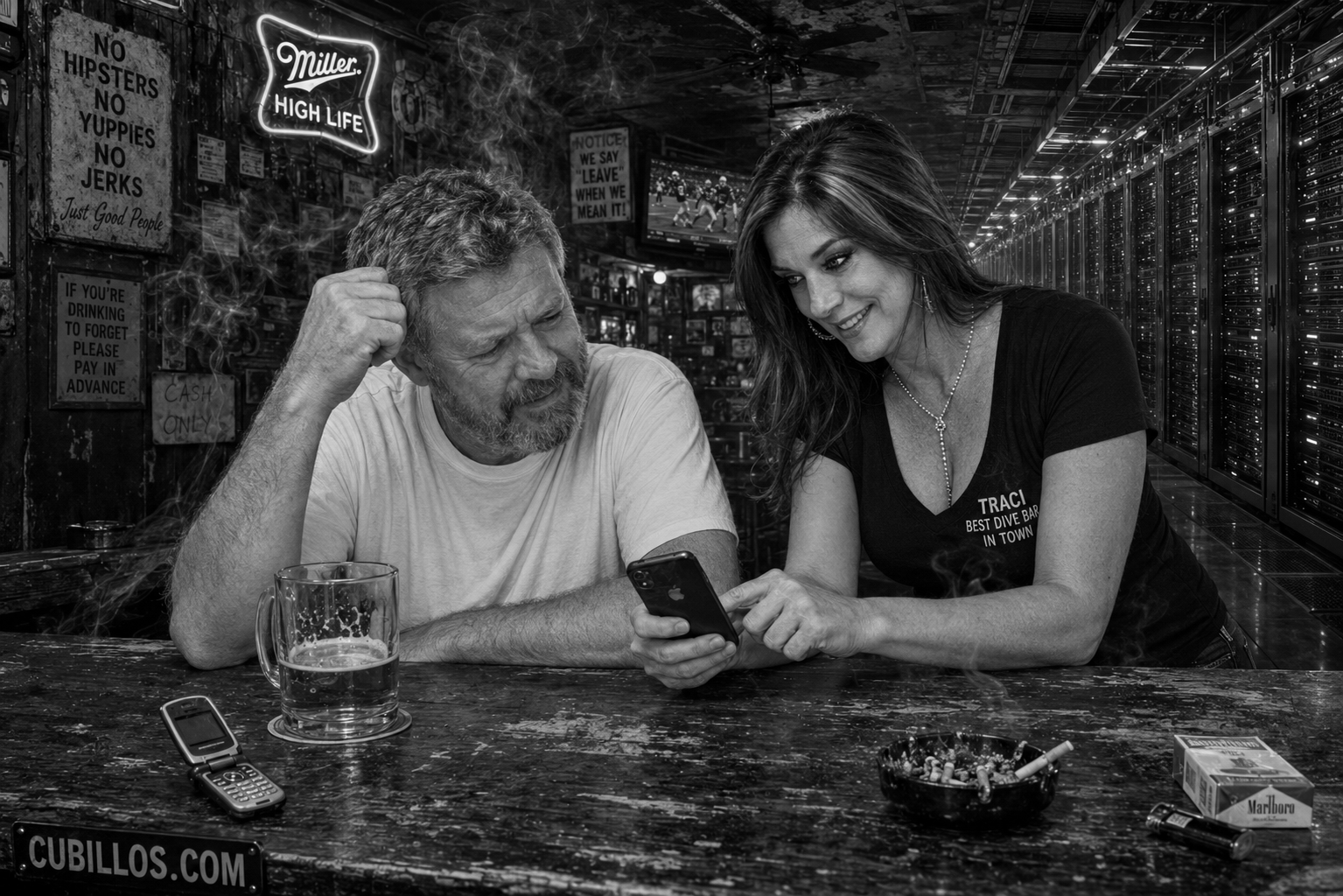
A few years ago, my buddy, Paul, finally surrendered.
For years, Paul had resisted the smartphone revolution. He had his flip phone. It made telephone calls. People could call him. He could call them.
As far as Paul was concerned, Alexander Graham Bell had pretty much nailed the concept the first time around.
Then Paul finally bought a smartphone.
He brought it down to our local pub.
And had the bartender set it up for him.
Tracy poured beer, tended bar, and provided technical support for customers being dragged into the 21st century.
I thought about Paul recently while looking at the extraordinary number of data centers being built across America.
Because Paul didn’t know it, but that day at the bar he wasn’t simply changing phones.
He was plugging into an entirely different world.
I remember the Nokias of the 1990s.
Great little phones. You could drop one on concrete and worry about the concrete.
You made a telephone call.
That was pretty much the deal.
The phone talked by radio to a cell tower. The tower connected into the cellular company’s switching network, where computers and electronic switches figured out who you were, where you were, and where your call was supposed to go.
Those telephone switching facilities were distant ancestors of today’s data centers, but the mission was fundamentally different.
The network existed primarily to connect one person with another.
Then came my BlackBerry.
Something had changed.
The telephone wasn’t merely connecting me to another telephone anymore.
It was connecting me to information.
Email arrived.
Messages arrived.
Calendars synchronized.
That tiny keyboard became so addictive that people started calling BlackBerrys “CrackBerrys.”
Behind all of it was something most of us rarely thought about.
Servers.
The information wasn’t necessarily sitting on the device in my hand. Computers somewhere else were storing it, processing it and sending it to me.
Then I traded the BlackBerry for an iPhone 3.
That was different.
The BlackBerry had brought my email to my telephone.
The iPhone began turning the telephone into something else entirely.
I could browse the Web.
Read the news.
Check email.
Use maps.
Take photographs.
Listen to music.
And increasingly download apps that could do things that once required sitting in front of a computer.
The iPhone was the window.
The machinery was somewhere else.
And that’s an important part of the data-center story because nobody ever asked Americans whether they wanted thousands of enormous buildings filled with computers.
We asked for something else.
We wanted everything on our phones.
Every photograph.
Every song.
Every map.
Every newspaper.
Every bank account.
Every television program.
Every email.
Every social network.
Every store.
Everywhere.
And somebody had to put all that stuff somewhere.
We gave those places the wonderfully harmless-sounding name “data centers.”
Sounds like someplace accountants might work.
They aren’t.
Modern data centers are industrial facilities packed with servers, networking equipment, cooling systems, transformers, backup generators and electrical equipment on a scale that would have been difficult to imagine when I was carrying that Nokia.
Then came Paul.
While I’d gone through Nokia, BlackBerry and iPhone, Paul had essentially skipped several chapters.
Flip phone.
Flip phone.
Flip phone.
Smartphone.
He walked into the pub carrying a device representing decades of technological change and handed it to the bartender.
He needed help setting it up.
Traci connected him to Wi-Fi.
Got his account working.
Set up his email.
Showed him where the apps were.
Maybe showed him how to use the camera.
Paul thought she was setting up his new telephone.
She was connecting him to data centers.
Lots of them.
Because by then the smartphone wasn’t really a telephone in the old sense.
It was a terminal.
Touch an icon and somewhere a computer responded.
Ask for directions and computers somewhere calculated the route.
Open Facebook and servers retrieved your account.
Watch a video and machines somewhere began feeding millions of bits of information through the Internet, through the cellular network, and finally into the little screen in your hand.
Store a photograph in the cloud and the photograph went into somebody else’s computer.
We didn’t build the data-center industry all at once.
We built it one Paul at a time.
Then multiplied Paul by billions.
Every new smartphone meant another person wanting information immediately.
Then came streaming television.
Cloud storage.
Social media.
Online shopping.
Video conferencing.
Smart homes.
Connected cars.
And now artificial intelligence.
That’s where the numbers start becoming enormous.
The internet required tremendous computing power.
Artificial intelligence requires another leap.
When I typed something into my Nokia, the phone itself did most of what little computing was necessary.
When I used my BlackBerry, servers increasingly became part of the experience.
When I picked up that iPhone, remote computing became part of everyday life.
Today I can ask an AI a complicated question from essentially the same little device.
The answer isn’t being created inside the phone.
My question travels across a network to computers somewhere else. Specialized processors perform billions upon billions of calculations and send the result back.
We have gone from connecting telephones to connecting human beings to enormous concentrations of computing power.
Which makes the evolution rather remarkable.
The Nokia said:
Connect me to another person.
The BlackBerry said:
Connect me to my information.
The iPhone said:
Connect me to everything.
Artificial intelligence says:
Ask me anything.
Each step required more infrastructure behind the curtain.
More servers.
More buildings.
More electricity.
More transmission capacity.
More cooling.
And, in many places, more water.
That’s why the current fight over data centers isn’t simply about artificial intelligence.
AI is accelerating it enormously, but the road to today’s gigantic computing campuses began long before ChatGPT appeared.
We spent thirty years moving more of our lives through that little device in our pockets.
Every time we asked it to do something new, something had to be built on the other end.
Paul probably wasn’t contemplating any of this when he walked into the pub.
He just wanted his new phone to work.
So he handed it to someone who apparently knew what she was doing.
The bartender.
Tracy got him connected.
And then poured him a beer.
Looking back, that may have been the perfect ceremony for entering the data-center age.
Neither of them knew it, but that little transaction was democracy’s vote for another server rack.