
There are times when Washington solves a problem nobody knew we had.
This week it was artificial intelligence.
Apparently, AI needed a better name.
President Donald Trump signed an executive order declaring that the executive branch will henceforth call Artificial Intelligence “Super Intelligence,” or SI. Federal agencies are directed to use SI instead of AI in official correspondence, public communications, websites, reports and other non-statutory documents.
This should clear things right up.
Those of us who have spent the past year trying to explain the difference between a data center and an AI data center may now add SI data center to the vocabulary.
Everybody clear?
A data center is basically a building full of computers, networking equipment, cooling systems and enough electrical gear to make your neighborhood substation feel inadequate.
It can handle banking transactions, store photographs, stream movies, run websites, provide cloud computing, process corporate records or do any number of other digital chores.
It may also run artificial intelligence.
That does not mean every data center is an AI data center, although you would never know that from some of the public discussion these days.
A developer announces a 500-megawatt data center and somewhere between the planning commission and Facebook it becomes a 500-megawatt AI center.
Now presumably it has a chance of becoming a Super Intelligence center.
We are making progress.
AI is still AI
There is a small complication in Washington’s renaming project.
The law still calls it artificial intelligence.
In fact, the new executive order has to borrow the existing legal definition of AI to tell us what SI is.
Section 3 says that, for purposes of the order, “Super Intelligence” and “SI” mean the technologies and systems already encompassed by the definition of “artificial intelligence” in federal law.
In other words, at the moment:
SI is AI wearing a new name tag.
The order recognizes the problem. It gives the Assistant to the President for Science and Technology 60 days to propose legislative language establishing a federal definition of Super Intelligence. That proposal is supposed to consider whether the new definition should modify, expand or supersede the existing statutory definition of artificial intelligence.
That word legislative matters.
Congress writes the statutes. An executive order can tell executive agencies what terminology the administration wants used in non-statutory documents, but changing statutory references to artificial intelligence requires dealing with the laws Congress enacted. The order itself asks for proposed amendments to those laws.
So we now have two languages.
There is the language the White House wants the executive branch to use.
And there is the language the law still uses.
The rest of us are standing outside wondering what to call the computer.
I’m sticking with AI
For ordinary people, I suggest a radical solution.
Call it AI.
Everybody knows what you mean.
If you’re talking specifically about the Trump administration’s policy, explain that the administration now calls artificial intelligence Super Intelligence, or SI.
Then get on with the story.
There is no reason for the fellow wondering whether a data center is going up behind his house to learn a new acronym because the White House decided the old one didn’t sound sufficiently impressive.
More importantly, we shouldn’t let the new terminology make an already confusing subject worse.
When a company says it is building a data center, we ought to ask what kind.
Will it primarily handle conventional cloud computing?
Will it train AI models?
Will it run AI inference?
How much electricity will it require?
How much water?
Will it have its own power generation?
Who pays for the transmission lines and other infrastructure?
Those questions tell a community considerably more than whether somebody has put AI or SI in front of the words data center.
Names have a way of doing political work. “Super Intelligence” certainly sounds grander than “Artificial Intelligence.” The White House says the new term better represents technologies that have moved beyond merely imitating or automating aspects of human intelligence and now amplify human capabilities.
Maybe so.
But changing the label on the box doesn’t tell us what’s inside it.
And there is another problem.
For years, superintelligence has carried a rather different meaning in discussions about artificial intelligence: the idea of intelligence exceeding human capabilities. Now the federal government is using essentially the same phrase as its general replacement for AI.
So something that was AI on Monday can be SI on Tuesday without getting one bit smarter.
Only Washington could achieve superintelligence without upgrading the computer.
And then came the signature page
All of which brings us to one final detail.
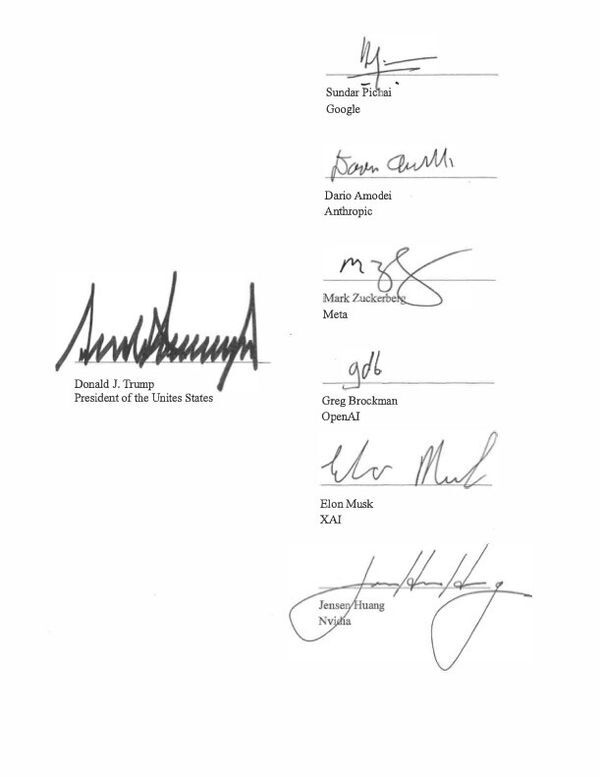
The same day Trump signed the executive order, he and six technology executives signed a separate White House Accord on Super Intelligence, a voluntary agreement concerning development and safeguards.
The signatories included Sundar Pichai of Google, Dario Amodei of Anthropic, Mark Zuckerberg of Meta, Greg Brockman of OpenAI, Elon Musk of xAI and Jensen Huang of Nvidia.
And Donald J. Trump.
The White House distributed an image of the signed document. The image was also posted by the White House and Trump, so this was not some clever Internet alteration. News organizations and fact-checkers subsequently confirmed the typo.
There, immediately beneath Trump’s signature, was his title:
President of the Unites States.
Not United.
Unites.
On a document devoted to Super Intelligence.
There are jokes a columnist has to work for, and there are gifts from heaven.
So, until Congress sorts this out, I’m going to continue calling artificial intelligence AI, a data center a data center, and an AI data center an AI data center when we actually know that’s what it is.
As for Super Intelligence?
It can wait until the Unites States gets the spelling right.